Unity Intuity: Microgrid Knowledge Conference and the Future of Energy Infrastructure

ORLANDO—Unifying theory knots together fundamental forces to create cohesion and simplify interactions.
Now that sounds like the definition of a party to me.
Participating in the Microgrid Knowledge Conference this week in Orlando involved plenty of fun and enlightening conversations throughout the day, but my single biggest impression--as editor of MGK--was one of unity stretching out into the future. Magnetic powers are propelling numerous challenges—from AI-data center growth to grid constraint to the value of fuel diversity—toward each other at breakneck pace.
And that may be a very good thing in the long run. If we all pull together as a team.
“In the utility space you have a lot of people lobbying for certain goals,” Michael Stadler, co-founder and chief technical officer of Las Vegas-based microgrid modeling platform and MGK exhibitor Xendee Corp., said during a break in action at the conference.
“Who is lobbying for all of the distributed generation resources?” Stadler asked. “We need to be stronger together.”
So that’s why Microgrid Knowledge is a thing

Seeking that cohesion was a key attraction for drawing 400 or so of our newest and longtime best friends to the Renaissance Orlando at SeaWorld, which hosted MGK 2026. From generators to integrators to financiers to utilities, all are compelled by this unstoppable force called energy demand aiming squarely at the immovable object called the power grid.
Many projections call for U.S. electricity demand to explode in the coming decade as macro factors such as the AI race, reshoring of manufacturing, industrial and transportation electrification beckon to be served. Failure to do so could lead to catastrophic global impacts in competitiveness, not to mention an affordability crisis which could imperil domestic tranquility, such that it is.
Energy sovereignty is what matters most going forward, e2Companies CEO James Richmond pointed out. Countries and companies share that priority and those concerns.
“The key point is the frailty of the grid; the grid right now is in dire straits,” Richmond told Microgrid Knowledge. “When the EIA (U.S. Energy Information Administration) forecasts that outages will go up 100X by 2030 and it doesn’t hardly make the news, people are asleep at the wheel.”
Indeed, the American Society of Civil Engineers, EIA, PJM Interconnection and others echo each other in warning that energy demand growth is swamping new power generation installation and the outdated infrastructure cannot handle the load. The answer, my friend, may be at the end of the grid, behind the meter and at the edge.
You might even call them microgrids.
“The world is asleep . . . and they should know with rates going up and grid stability down,” Richmond added. “The people who can help solve it are the people in this group, because we’re all kind of behind-the-grid solutions.”
Unified theory only matters if we can see the journey together
Einstein and others were big on expounding the merits of unified field theory but Stephen Hawking, no intellectual slouch himself, wondered what the life of a mathematical (and perhaps energy) model really meant unless it was truly a explanation of how we got here and where we go from here.
“Even if there is only one possible unified theory, it is just a set of rules and equations. What is it that breathes fire into the equations and makes a universe for them to describe?” Hawkings noted. “The usual approach of science of constructing a mathematical model cannot answer the questions of why there should be a universe for the model to describe. Why does the universe go to all the bother of existing?”
That’s a hard act to follow, but the rise of AI has forced a lot of tough questions which need answers from smart minds. Sure, there is a venture capital aspect to the microgrid sector--and we aren't immune to hype-- but proofs of concept are showing that fortifying power generation and delivery at the edge, closer to the customer, can both improve the overall picture while avoiding macro infrastructure costs and imperiling affordability for all.
It’s not easy but MGK 2026 was full of people willing to do hard things such as build a distributed energy network which ultimately can save the whole of the grid.
“They’re complicated and evolving constantly,” Jaclyn Whiteman, who is utility Duke Energy’s director of distributed energy asset management and co-chair of the MGK Conference Advisory Board, said during the opening keynote of the Microgrid Knowledge event.
Finding validation on a long, hard journey
Massive economic and energy forces put into play might have paid off for some, but it’s also been a brutal year or decade for some who often felt like voices in the wilderness, crying wolf while others rested easily with visions of flat load growth in their dreams.
They hopefully can see the light, of course, at the end of the proverbial tunnel. And they know it’s a train and they know they are ready for it despite the risk.
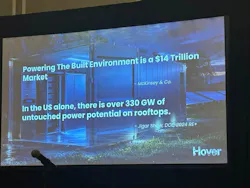
“All of you are building the grid,” Hover Energy CEO Chris Griffin praised the microgrid community during the MGK keynote. “Thank you for being here, for pressing. There were days it didn’t feel like it was worth it, but it is.”
One key factor in what makes microgrids viable is versatility. They can unify multiple resources into one generational force integrating natural gas power with solar and battery storage. They are not as vulnerable to the loss of long-time tax incentives as renewable energy alone, nor as vulnerable to the transient electricity load which can fluctuate with AI computation fed by only one source.
And they can move faster, jumping around long project development interconnection processes. Building a sizable transmission line could take a decade or more.
“It’ll have to be a multi-technology system,” Xendee’s co-founder Stadler pointed out. “The momentary discussion (for customers such as data center developers) is how do we get this power, and with a utility it may take 10 years. . . but they say I need power next year, how do I get that?
“With renewables and batteries and generators,” Stadler added. “We’ve been doing generators a long time, and so we know how to deal with transient (large load shifts in milliseconds). It would be a big deal if it was just renewables.”
Not all power utilities are ignoring the solutions available at the edge of their grids. Duke Energy itself has about 10 microgrid projects completed and operational over the past decade, including one in the North Carolina community of Hot Springs, a microgrid which kept that community charged for most of a week while the main grid was down in the wake of Hurricane Helene two years ago.
Multiplying the value of microgrids in unison
Microgrids already are proven to be worthy storm and outage response tools, but the value proposition can stack much deeper with time, deployment and cooperation among the companies engaged in building at the edge.
If you’ve seen one microgrid, you’ve seen one microgrid, the long-running quip at MGK goes. The true, long-term power multiplies in unification.
“With microgrids, it’s important to operate in concert,” Nelson Peeler, senior vice president of grid strategy, planning and integration for Duke Energy, said in his Microgrid Knowledge keynote address, calling it a “system perspective” around the interconnected value of distributed energy resources.
“Now microgrids can work together to support not only the site they were designed for, but also support the overall system,” Peeler added. “The best way to promote new microgrid solutions is for the existing ones to be so outstanding we cannot live without them.”
Stacking benefits and unifying them not only breeds success for the moment but also demonstrates long-term value.
The American Society of Civil Engineers last year graded U.S. energy infrastructure, including the grid, at a lowly D+... and that was an improvement over four years earlier. The system needs hardening fast, and that might cost more than $1 trillion to do.
That’s a lot of money but the alternative of possibly losing the global AI race might prove more expensive on an infinitely deeper level. And forgetting the economic gains brought to modern society with large-scale electrification might seem penny wise, pound foolish, too.
Avoiding spinning in our graves
There is a cost-effective answer at the edge—called microgrids, DERs, energy parks and more. Don't stop me if you've heard this one before.
“It will help,” e2Companies CEO Richmond said about the microgrid developers installing assets which can harden the grid.
“Putting in assets behind the meter, and now that’s actually firming the grid, taking spinning reserves off the grid,” Richmond added. “Spinning reserves are very inefficient. The assets are needed behind the meter.”
Close to one hundred companies and hundreds of microgrid experts or advice seekers united in Orlando at the Renaissance to talk about the near future of energy deployment in the so-called Industrial Compute Age. Many of them see microgrids at the sweet spot of integration which no one resource can deliver by itself: Natural gas is still relatively cheap; solar and battery prices have fallen dramatically even without tax incentives and both AI and control technologies make off-grid and co-located energy installation more possible than ever.
Alone they are vulnerable to market dynamics, together they have resiliency.
Now that’s a form of unity which even business rivals can get behind. Every race has the same goal: to finish and finish strong.
“Bringing the grid back: Microgrids are key for that,” Duke Energy’s Whiteman said.
When the Grid Can't Wait: Unlock Solar Capacity with DC-Coupled Storage
New White Paper by ELM Microgrid
About the Author
 Rod Walton, Microgrid Knowledge Managing Editor
Rod Walton, Microgrid Knowledge Managing Editor
Managing Editor
For Microgrid Knowledge editorial inquiries, please contact Managing Editor Rod Walton at [email protected].
I’ve spent the last 18 years covering the energy industry as a newspaper and trade journalist. I was an energy writer and business editor at the Tulsa World before moving to business-to-business media at PennWell Publishing, which later became Clarion Events, where I covered the electric power industry. I joined Endeavor Business Media in November 2021 to help launch EnergyTech, one of the company’s newest media brands. I joined Microgrid Knowledge in July 2023.
I earned my Bachelors degree in journalism from the University of Oklahoma. My career stops include the Moore American, Bartlesville Examiner-Enterprise, Wagoner Tribune and Tulsa World, all in Oklahoma . I have been married to Laura for the past 36-plus years and we have four children and one adorable granddaughter. We want the energy transition to make their lives better in the future.
Microgrid Knowledge and EnergyTech are focused on the mission critical and large-scale energy users and their sustainability and resiliency goals. These include the commercial and industrial sectors, as well as the military, universities, data centers and microgrids. The C&I sectors together account for close to 30 percent of greenhouse gas emissions in the U.S.
Many large-scale energy users such as Fortune 500 companies, and mission-critical users such as military bases, universities, healthcare facilities, public safety and data centers, shifting their energy priorities to reach net-zero carbon goals within the coming decades. These include plans for renewable energy power purchase agreements, but also on-site resiliency projects such as microgrids, combined heat and power, rooftop solar, energy storage, digitalization and building efficiency upgrades.