Harvard Engineering Senior Builds Microgrid Controller to Solve Real-World Challenge
The future of workforce skills seems to cause anxiety in many of America’s economic sector leaders. From welding to energy, the fear of a shortfall in talent is repeated often at conferences and on company calls.
Whether the danger is real or overblown due to our inability to see around the corners of the future, the happier truth is that extraordinary talent and drive abound among young people ascending to places of real contribution in many or our technology sectors.
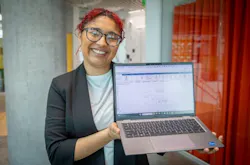
Microgrids are no different, as a new generation embraces the many integrated pieces which make up on-site power of the future. The Harvard University John A. Paulson School of Engineering and Applied Sciences (SEAS) this month highlighted the work of Ellen Caraballo, Class of 2026.
Click here to see full Harvard story about Ellen Caraballo’s microgrid controller
The electrical engineering major participated in SEAS’ capstone course on Engineering Design Projects. This course challenged students such as Caraballo to engineer a “creative solution to a real-world problem.”
Caraballo chose to build a universal microgrid controller for unstable electrical power systems.
“My project was on creating an adaptable controller for a microgrid system to be able to provide backup power generation for places that have a lot of outages,” Carballo replied in the story written by Matt Goisman, communication manager at SEAS.
Caraballo obviously considers life well beyond the so-called isolated academia of university to focus on places which don’t have the luxury of taking electricity for granted. In fact, that vision comes natural to Caraballo.
“I'm from Puerto Rico, so I've seen first-hand some of the issues that are still happening even now, nine years after Hurricane Maria,” she said as quoted in the Harvard story. “I actually surveyed a bunch of residents, and just hearing their struggles, hearing things they go through, and their frustrations at constant outages or constant load-shedding that they have to deal with without having power really inspired me to find a way that maybe this solution could be solved.”
All power is local, right? Carballo already realizes this, noting that even a neighborhood generator or solar system supply 100 homes can make a huge difference in energy resiliency and affordability.
It took Carballo nearly two semesters to build the controller and the model to test it. Her project advisor was Isaac Traylor, Train Systems Metier Manager at Alstom, which is where Ellen did summer internships in 2024 and 2025.
To access the next generation of microgrid innovation, be sure to attend next year's Microgrid Knowledge Conference. MGK 2027 will be May 4-6, 2027 at the Renaissance Glendale in Glendale, Arizona.
Microgrid Knowledge 2026 was in Orlando.
About the Author
 Rod Walton, Microgrid Knowledge Managing Editor
Rod Walton, Microgrid Knowledge Managing Editor
Managing Editor
For Microgrid Knowledge editorial inquiries, please contact Managing Editor Rod Walton at [email protected].
I’ve spent the last 18 years covering the energy industry as a newspaper and trade journalist. I was an energy writer and business editor at the Tulsa World before moving to business-to-business media at PennWell Publishing, which later became Clarion Events, where I covered the electric power industry. I joined Endeavor Business Media in November 2021 to help launch EnergyTech, one of the company’s newest media brands. I joined Microgrid Knowledge in July 2023.
I earned my Bachelors degree in journalism from the University of Oklahoma. My career stops include the Moore American, Bartlesville Examiner-Enterprise, Wagoner Tribune and Tulsa World, all in Oklahoma . I have been married to Laura for the past 36-plus years and we have four children and one adorable granddaughter. We want the energy transition to make their lives better in the future.
Microgrid Knowledge and EnergyTech are focused on the mission critical and large-scale energy users and their sustainability and resiliency goals. These include the commercial and industrial sectors, as well as the military, universities, data centers and microgrids. The C&I sectors together account for close to 30 percent of greenhouse gas emissions in the U.S.
Many large-scale energy users such as Fortune 500 companies, and mission-critical users such as military bases, universities, healthcare facilities, public safety and data centers, shifting their energy priorities to reach net-zero carbon goals within the coming decades. These include plans for renewable energy power purchase agreements, but also on-site resiliency projects such as microgrids, combined heat and power, rooftop solar, energy storage, digitalization and building efficiency upgrades.