UK Government Launches Plug-In Solar Panel Initiative to Boost “Homegrown” Energy Production
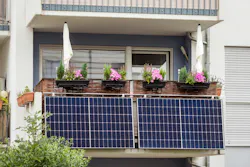
The U.K. government has announced a major plug-in solar panel initiative designed to lower household energy bills and reduce the country’s dependence on foreign oil.
The government is working with EcoFlow, a portable power and renewable energy company, to roll out the systems to the market. They should be available in major retail shops, including Lidl and Iceland supermarkets, within months.
“The Iran War has once again shown our drive for clean power is essential for our energy security so we can escape the grip of fossil fuel markets we don’t control,” Ed Miliband, the U.K.’s energy secretary, said in a statement.
Plug-in solar—also known as balcony or “mini” solar—refers to small-scale photovoltaic systems designed for apartment dwellers, renters and buildings without rooftop access, though anyone with a sunny outdoor space can set one up.
The systems typically include one to three lightweight panels mounted on balconies, railings, or stands. Paired with a microinverter, the panels plug directly into a standard electrical outlet and feed electricity into the home, offsetting consumption from the grid in real-time.
“Allowing plug-and-play solar is a very positive step for expanding access to renewable energy in the UK,” Lorna Wallace-Smith, Head of UK Communications for EcoFlow, said in a statement. “Seeing these systems available in stores by summer would be a major win for households, enabling people to take advantage of the longer, brighter days and start generating their own clean electricity straight away.
After a slow start, many U.S. states are getting on board with balcony solar
Unlike traditional rooftop installations, balcony solar requires little to no permanent construction and is easy to install, making it a low-cost, portable entry point into distributed energy.
With outputs ranging from 200 watts to 1,600 watts, the systems are designed to offset a portion of household electricity consumption rather than fully power a home.
Balcony solar is wildly popular in Europe, particularly in Germany where more than 1.2 million systems have been installed.
Hampered by what developers call outdated interconnection rules and utility resistance, DIY solar technology has taken longer to gain traction in the U.S. In 2025, Utah became the first state to legalize balcony solar. Virginia will be next — its bill has cleared the Virginia General Assembly and awaits Gov. Abigail Spanberger’s signature (she is expected to sign the bill). Maine’s legislation allowing plug-in solar could land on the governor’s desk in the coming weeks.
Driven by consumer concerns over rising energy prices, at least 23 other states are actively debating similar legislation, including California, Colorado, Michigan, Ohio and South Carolina.
Bright Saver, a non-profit that promotes plug-in solar in the U.S., says the systems can reduce electricity bills by $35 to $55 per month.
Solar panels, heat pumps to be standard in new U.K. homes
In addition to the plug-in solar rollout, the U.K. government also introduced new rules that require the majority of new homes built in England are cheaper to heat and power.
The Future Homes Standard requires that most new homes come with solar panels or on-site renewable generation and heat pumps. High-rise residential buildings are exempted from the new standards.
“As we make the switch to clean, homegrown energy, today’s standard is what the future of housing can and should look like. Not only will these changes protect hardworking families from shocks abroad but will also slash hundreds of pounds off their energy bills every year,” U.K. housing secretary Steve Reed said in a statement.
Several English communities are already reaping the benefits of renewable energy. In 2024, the village of Hook Norton in Oxfordshire launched a small community-led microgrid designed to power affordable, sustainable homes.
The smart microgrid includes a 100-kWh battery and a 68-kWp rooftop solar array installed on the new homes, as well as an existing 5-kWp solar array. Smart microgrids use sensors, advanced automation and control systems to optimize energy use.
Last year, Octopus Energy, a global clean energy tech business, and gs8, a UK residential developer, launched Carpenters Yard in Essex County. It is their second and largest “zero bills” community with homes powered by a microgrid that includes solar panels, heat pumps and batteries.
The company says renewable energy, artificial intelligence, energy storage and modern construction techniques will eliminate homeowner’s energy bills for five to 10 years.
“People want to be free of these fossil fuel crises —since the conflict in the Middle East began, interest in solar has shot up 50%, heat pump and electric cars are also seeing surges, Greg Jackson, founder and CEO of Octopus Energy, said in response to the Future Homes Standard announcement. “Every solar panel, heat pump and battery cuts bills and boosts Britain’s energy independence. And the government’s latest steps can help cut the costs of electrification.”
About the Author
 Kathy Hitchens
Kathy Hitchens
Special Projects Editor
I am a writer and special projects editor for Microgrid Knowledge. I have over 30 years of experience covering the renewable energy, electric vehicle, utility, technology, entertainment, education, and financial sectors. I have a BFA in Media Arts from the University of Arizona and a MBA from the University of Denver.