Air Force Selects Mainspring Linear Generator for Multi-Fuel Testing at California Base
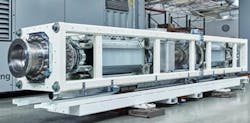
Mainspring Energy will deliver at least one of its linear power generators to the U.S. Department of the Air Force (DAF) in a pilot program testing power generation on multiple fuels including natural gas and hydrogen.
The pilot project will be held at the Travis Air Force Base in northern California sometime this year. The Air Force will assess the linear generator for fuel efficiency, power output, fuel consumption and emissions data by fuel type.
Mainspring’s linear generators convert fuel directly into electricity through a low-temperature, flameless reaction. They are similar to fuel cells in converting fuel into electricity, but linear generators achieved this through direct conversion processes instead of a fuel cell’s electrochemical reaction.

The Air Force wants to test multiple resources, not only methane gas and hydrogen but also propane, biofuels, syngas and ammonia. The pilot can match data on energy density, fuel access and environmental impacts.
"DAF's reliance on any single fuel type presents a supply chain risk. A generator capable of running on multiple fuel types reduces vulnerability to fluctuating fuel standards, availability, or price shifts, providing resilience without the need for costly equipment replacement," said Kirk Phillips, Air Force Office of Energy Assurance director, in a statement.
Mainspring Energy competed for the project award via the Tradewinds Solutions Marketplace platform. The selection could Mainspring as a key provider for all Defense Department branches seeking multi-fuel energy solutions. Tradewinds aims streamline procurement by emphasizing innovation, scalability, and mission impact.
The Air Force Office of Energy Assurance (AF OEA), a directorate of the Air Force Civil Engineer Center (AFCEC), develops energy solutions that close energy resilience gaps and strengthen our nation's Air Force and Space Force installations at home and abroad.
Mainspring Energy has delivered its linear generator to a broad range of on-site power projects. Most recently, renewable natural gas producer (RNG) California Bioenergy acquired the linear generators to power biogas upgrading sites through the state this year.
CalBio converts dairy waste biogas into RNG and has expanded across multiple dairy facility clusters statewide. The company has used Mainspring’s linear generators in the past and is purchasing eight more to be deployed at its North Visalia and South Tulare biogas upgrading sites.
About the Author
 Rod Walton, Microgrid Knowledge Managing Editor
Rod Walton, Microgrid Knowledge Managing Editor
Managing Editor
For Microgrid Knowledge editorial inquiries, please contact Managing Editor Rod Walton at [email protected].
I’ve spent the last 18 years covering the energy industry as a newspaper and trade journalist. I was an energy writer and business editor at the Tulsa World before moving to business-to-business media at PennWell Publishing, which later became Clarion Events, where I covered the electric power industry. I joined Endeavor Business Media in November 2021 to help launch EnergyTech, one of the company’s newest media brands. I joined Microgrid Knowledge in July 2023.
I earned my Bachelors degree in journalism from the University of Oklahoma. My career stops include the Moore American, Bartlesville Examiner-Enterprise, Wagoner Tribune and Tulsa World, all in Oklahoma . I have been married to Laura for the past 36-plus years and we have four children and one adorable granddaughter. We want the energy transition to make their lives better in the future.
Microgrid Knowledge and EnergyTech are focused on the mission critical and large-scale energy users and their sustainability and resiliency goals. These include the commercial and industrial sectors, as well as the military, universities, data centers and microgrids. The C&I sectors together account for close to 30 percent of greenhouse gas emissions in the U.S.
Many large-scale energy users such as Fortune 500 companies, and mission-critical users such as military bases, universities, healthcare facilities, public safety and data centers, shifting their energy priorities to reach net-zero carbon goals within the coming decades. These include plans for renewable energy power purchase agreements, but also on-site resiliency projects such as microgrids, combined heat and power, rooftop solar, energy storage, digitalization and building efficiency upgrades.