The Macro Grid Dilemma: Extreme Weather Making Utility T&D Challenges Even Worse
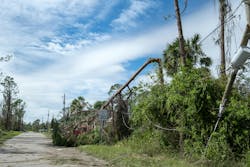
Still think the utility grid might be able to handle what’s coming both in rising energy demand by digital infrastructure and increasingly devastating weather impacts?
New reports coming from several fronts indicate that the utility grid cannot overcome what it's dealing with now, much less meet the intense challenges of the near future. These kinds of worsening statistics might make the value argument for more distributed energy, on-site power and microgrid deployments at the commercial, industrial and residential customer levels.
In fact, microgrids have stepped up and proved their worth in the wake of major storms in the U.S. and Jamaica.
First up, the federal Energy Information Administration recently reported that U.S. electric power interruptions extended to the longest number of hours per customer in the past 10 years. The electric service interruptions caused by weather events and other outages in 2025 averaged about 11 hours per every customer, according to the EIA.
These outage durations were the most hours of interruption of any year in the last 10, and more than 50% higher than 2023, the EIA report says. Hurricanes Beryl, Helene and Milton account for 80% of the hours without electricity last year.
And yet the EIA chart shows that while 2024 was a benchmark year in the worst possible way, it hardly qualified as an outlier. Hours of electric power interruption have been rising steadily since 2014, according to the federal statistics.
Eastern seaboard states such as Florida, South Carolina and North Carolina experienced the highest level of electric power interruptions due to major storms. Microgrids were put into work in the Carolinas and Florida to alleviate some of the power interruptions at the edge of the grid.
Statistics from consumer surveyor JD Power show that the struggle is going more extreme every year. In JD Power’s latest Utilities Intelligence Report, nearly half of utility customer respondents say they experienced a power outage in the first half of 2025.
Forty-eight percent of those outages were caused by major weather such as hurricanes, flash flooding, ice storms, fire or other weather. Some of these extreme weather events were so intense by nearly one-fifth of customers say they had to evacuate their homes, according to JD Power.
Overall, property damage from extreme weather caused at least $131 billion in losses globally for the first half of 2025, according to German-based insurer Munich RE.
“Disasters like the one (wildfires) in Los Angeles have become more likely due to global warming and they teach us a very important lesson: people, authorities and companies must all adapt to new circumstances,” Thomas Blunck, member of the Board of Management at Munich RE, said in a statement. “The best way to avoid losses is to implement effective preventive measures, such as more robust construction for buildings and infrastructure to better withstand natural disasters. Such precautions can help to maintain reasonable insurance premiums, even in high-risk areas.”
Earlier this year, the American Society of Civil Engineers released its quadrennial Infastructure Report Card, downgrading the U.S. energy sector to a grade of D+. Upgrading a 20th century power grid to 21st century needs and standards could require close to $1.9 trillion in near-term capital investment, according to the ASCE report card.
One big problem is that utility and energy infrastructure investment, while growing in recent years, is still lagging by some $580 billion in needed upgrades, the ASCE said in the March release.
“An increase in electric vehicles and a rise in data centers will demand 35 GW of electricity by 2030 alone, up from 17 GW in 2022,” reads the energy snapshot of the ASCE Infrastructure Report Card. “This rapid acceleration, compounded by federal and state net zero greenhouse gas emission goals, means utilities will need to double existing transmission capacity to connect new renewable generation sources.”
And those recommendations don’t even take the extreme weather impacts into account.
About the Author
 Rod Walton, Microgrid Knowledge Managing Editor
Rod Walton, Microgrid Knowledge Managing Editor
Managing Editor
For Microgrid Knowledge editorial inquiries, please contact Managing Editor Rod Walton at [email protected].
I’ve spent the last 18 years covering the energy industry as a newspaper and trade journalist. I was an energy writer and business editor at the Tulsa World before moving to business-to-business media at PennWell Publishing, which later became Clarion Events, where I covered the electric power industry. I joined Endeavor Business Media in November 2021 to help launch EnergyTech, one of the company’s newest media brands. I joined Microgrid Knowledge in July 2023.
I earned my Bachelors degree in journalism from the University of Oklahoma. My career stops include the Moore American, Bartlesville Examiner-Enterprise, Wagoner Tribune and Tulsa World, all in Oklahoma . I have been married to Laura for the past 36-plus years and we have four children and one adorable granddaughter. We want the energy transition to make their lives better in the future.
Microgrid Knowledge and EnergyTech are focused on the mission critical and large-scale energy users and their sustainability and resiliency goals. These include the commercial and industrial sectors, as well as the military, universities, data centers and microgrids. The C&I sectors together account for close to 30 percent of greenhouse gas emissions in the U.S.
Many large-scale energy users such as Fortune 500 companies, and mission-critical users such as military bases, universities, healthcare facilities, public safety and data centers, shifting their energy priorities to reach net-zero carbon goals within the coming decades. These include plans for renewable energy power purchase agreements, but also on-site resiliency projects such as microgrids, combined heat and power, rooftop solar, energy storage, digitalization and building efficiency upgrades.