NERC Warns of 2028 Capacity Shortfalls Amid Exploding AI and Data Center Loads
The North American Electric Reliability Corporation (NERC) continues to sound the alarm about the health of the country’s power grid.
In its 2025 Long Term Reliability Assessment (LTRA), the electric reliability organization found that electricity demand could outpace supply in large parts of the country as early as 2028.
NERC is an independent, nonprofit international regulatory agency based in Washington, D.C. The organization is responsible for developing and enforcing mandatory reliability standards for the bulk power system (the backbone of the electric grid) across the United States, Canada and the northern portion of Baja California, Mexico.
Each year, NERC analyzes the bulk power system and publishes the LTRA, which includes 10-year projections around electricity supply and demand, transmission adequacy and key trends that may impact grid reliability.
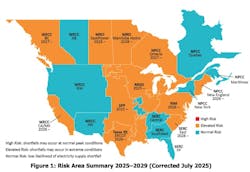
The 2025 assessment found that 13 of 23 assessment areas may face resource challenges by the end of the decade.
Regions at the highest risk of energy shortfalls include those managed by the Midcontinent Independent System Operator (MISO), PJM, the Electric Reliability Council of Texas (ERCOT) and significant portions of the Western Electricity Coordinating Council (WECC).
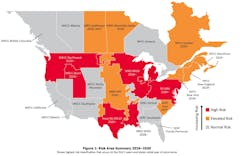
Based on current bulk power system planning forecasts, NERC predicts all regions except for MRO-Manitoba will be at elevated or high risk of supply shortfalls by 2030 under both normal and extreme weather conditions.
“This assessment is not a prediction of failure but an early warning on the trajectory of risk,” John Moura, director of Reliability Assessment and Performance Analysis at NERC, said in a statement. “The path forward is still manageable but only if planned resources come online and on time.”
Risk levels continue to climb
The resource adequacy shortfalls outlined in the 2025 LTRA are more acute than in previous years.
In its 2024 report, NERC placed several regions in an elevated-risk category. However, none were expected to experience peak summer or winter shortfalls—the key criterion for high risk classification.
Clearly, a lot has changed in the past 12 months.
“Electricity peak demand and energy growth forecasts over the 10-year assessment period continue to climb higher than at any point in the past two decades,” the report said.
NERC now forecasts that summer peak demand will grow by 224 GW over the next 10 years— an increase of more than 69% compared with its 2024 predictions. It expects winter peak demand to swell by 246 GW during the same time frame.
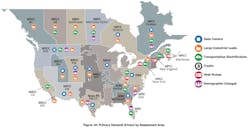
Much of the demand growth is expected to come from data centers, which are being built rapidly to support the expanding use of AI-powered applications. Cryptocurrency, hydrogen fuel plants and other large loads were also cited as contributing to increased demand, though NERC noted that additional factors are at play.
Increased penetration of intermittent renewable resources, the retirement of aging fossil fuel-based generation, inadequate transmission infrastructure and uncertainty around new resource additions are also fueling concerns that the industry will not be able to keep pace with rapidly increasing demand.
The warnings are probably the starkest for MISO, which spans much of the Midwest, including major markets such as Minneapolis, Milwaukee, Detroit and Indianapolis. Capacity shortfalls in the region may appear as early as 2028.
PJM, ERCOT, WECC-Basin and WECC-Northwest are expected to cross into high-risk territory by 2029.
NERC’s priority actions to mitigate capacity shortfalls
To address rising energy and capacity risks, the LTRA outlined a set of priority actions for planners, operators, regulators and the industry:
- Planners, operators and regulators: Speed new resources and carefully manage retirements to keep generation aligned with rising demand.
- NERC, industry and regulators: Account for large, emerging loads—such as data centers and AI facilities—to maintain operator flexibility during grid stress.
- NERC, regional entities and industry: Upgrade reliability analysis with wider-area assessments and scenario planning to better anticipate future risks.
- Regulators and policymakers: Streamline siting and permitting to accelerate new resource and transmission development.
- ISOs, RTOs and the Federal Energy Regulatory Commission: Ensure essential reliability services—voltage, frequency, and ramping—are maintained as the resource mix shifts.
The role of onsite power and microgrids
In addition to the priority actions outlined by NERC, some utilities and large energy-intensive facilities are already deploying onsite power solutions—including microgrids—to help manage emerging reliability pressures and localized peak-demand challenges across the bulk power system.
These systems provide local electricity to critical loads, reduce peak demand, provide essential reliability services and bring new capacity online faster than traditional projects constrained by interconnection timelines.
While these systems support local reliability, they alone cannot resolve the broader grid-level risks projected in the LTRA. However, for energy-intensive sites such as data centers, AI operations, and hydrogen plants, onsite power can ensure continuity of service while smoothing localized load spikes, indirectly easing pressure on the bulk power system.
For example, the Monarch Compute Campus microgrid in West Virginia will leverage natural gas generators paired with battery storage to manage AI workloads at its Mason County data centers.
In Ohio, American Electric Power (AEP) plans to deploy fuel cells at customer sites to support its rapidly expanding data center load. Bloom Energy is expected to supply the utility with 100 MW of fuel cells this year, and up to 1 GW over the coming decade.
About the Author
 Kathy Hitchens
Kathy Hitchens
Special Projects Editor
I am a writer and special projects editor for Microgrid Knowledge. I have over 30 years of experience covering the renewable energy, electric vehicle, utility, technology, entertainment, education, and financial sectors. I have a BFA in Media Arts from the University of Arizona and a MBA from the University of Denver.