How Integrated Microgrids Can Redefine Cold Ironing
Key Highlights
-
Rising cold-ironing mandates are outpacing grid capacity: Ports face accelerating global regulations requiring shore power within tight timelines, while grid-only solutions are often too slow, costly, carbon-intensive, or unreliable to meet growing 5–30 MW per-berth demand.
-
Integrated microgrids offer a practical near-term solution: INNIO’s modular microgrid concept—combining hydrogen-ready cogeneration, solar PV, and battery storage—can supply reliable shore power, stabilize voltage and frequency, operate islanded from the grid, and avoid major grid upgrades.
-
Simulations show strong economic and emissions benefits: In a 20 MW cold-ironing scenario with limited grid access, the microgrid reduced energy costs by up to 67% (plus added thermal savings) and cut annual CO₂ emissions by ~35%, while enabling a phased pathway toward deep decarbonization and hydrogen use.
Andrea Pivatello
Senior Business Development Manager
INNIO Group
Ports worldwide are moving quickly to lower emissions and prepare for a more electrified future. A major driver of this shift is cold ironing (or onshore power supply, OPS) – the practice of providing shore-side electricity to docked vessels so they can switch off their onboard auxiliary engines which normally run on maritime fuels. Cold ironing has the potential to reduce emissions in ports by more than 90%[1] while also lowering noise, contributing meaningfully to cleaner port operations. Yet as regulatory timelines accelerate, ports face a growing gap between rising power needs and local grid capacity.
INNIO Group recently examined this scenario, presenting a practical pathway for ports to support cold ironing while navigating high power demand, rising regulatory requirements, and infrastructure constraints. INNIO’s analysis focuses on an integrated, modular microgrid concept that combines hydrogen-ready cogeneration, solar photovoltaic (PV) systems, and battery storage to supply cold ironing loads. Together, these technologies form a scalable system that helps ports meet near-term requirements while advancing toward longer-term climate goals.
What follows is a synthesis of INNIO’s findings, framed in the context of the ongoing shift toward port electrification.
An expanding regulatory landscape
The policy environment across Europe, North America, Asia-Pacific, and global maritime institutions is evolving quickly. In the European Union, the Alternative Fuels Infrastructure Regulation (AFIR) and FuelEU Maritime Initiative require shore power at major ports by 2030, with additional requirements through 2035. In North America, the California Air Resources Board (CARB) mandates shore power at all California ports by 2027[2]. The U.S. Maritime Administration also is investing in modernizing port infrastructure.[3]
Across Asia-Pacific, national commitments – including Chinese carbon-neutrality goals[4] and Indian port electrification initiatives[5] – support shore-side power expansion. Japan and South Korea also plan shore power for cruise and container terminals by 2028.
Globally, the International Maritime Organization (IMO) has set carbon-intensity reduction targets of 11% by 2026, rising to 40% by 2030 and 70% by 2050. The One Ocean Summit Shore Power Declaration further emphasizes international commitment to broad deployment by 2028. Together, these measures place ports under increased pressure to supply reliable power within tight timeframes. Many ports have only a 12- to 18-month window to identify feasible approaches that fit existing infrastructure and budgets.
The limitations of grid-only approaches
Although conventional shore-power systems reduce emissions, they face structural constraints that make relying solely on the grid challenging. Most ports require substantial grid reinforcement – often 5 to 30 MW per berth – with implementation timelines of 6 to 48 months and high associated costs.[6] Many port grids cannot reliably meet strict vessel power-quality requirements without stabilization equipment, and port areas often experience above-average power interruptions, creating operational risks.
Environmental and economic outcomes also vary. In regions with high grid carbon intensity, shore power may shift rather than reduce emissions. In more than one-third of global ports, electricity costs for shore power exceed marine fuel costs, limiting economic viability.[7] Obviously, such constraints can prevent grid expansion from meeting cold-ironing requirements on time or within budget.
Integrated microgrids as a local energy source
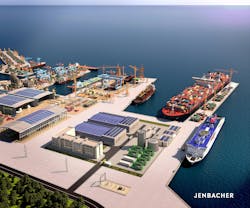
One answer: locally deployed microgrids. By integrating generation, storage, and advanced control systems, microgrids provide a flexible pathway to meet near-term operational needs while complementing grid infrastructure.
In addition, integrating cogeneration into a port-level microgrid creates a more flexible and resilient local energy system. The microgrid incorporates distributed energy resources – including cogeneration units, renewable generation, and energy storage – supported by advanced control, protection, and energy-management systems.
This architecture transitions between grid-connected and islanded operation, fast frequency regulation during vessel connection or disconnection, and voltage stability across wide load variations. The microgrid also supports reactive-power management, improved economic dispatch through its energy management system, and black start capability. The coordinated system helps ports manage vessel load changes, maintain stable operation during shore-power connections, and deliver reliable service even under wide variations in demand.
Insights from INNIO’s simulation
INNIO conducted a simulation to develop a more optimized solution for a representative scenario where a port was limited to 3 MW of grid capacity but required 20 MW for cold ironing. The modeled microgrid incorporated on-site cogeneration, photovoltaic (PV) arrays, and battery storage. A detailed analysis was performed, examining potential electrical load curves at 15-minute resolution for the 20 MW demand, along with an estimated thermal load curve to assess potential heat requirements.
On-site generation consisted of seven INNIO’s Jenbacher J624 natural gas cogeneration units (six operational, one redundant) supplying most of the electrical load. PV generation provided supplementary power, and the battery storage system supported short-term load fluctuations and black start capability. Heat recovered from the Jenbacher units supplied thermal demand within the port, further reducing total energy costs.
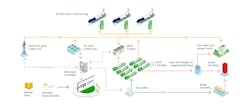
According to the optimization results, the integrated microgrid achieved:
- A 67% reduction in levelized cost of energy (LCOE) compared to traditional onboard power generation from maritime fuel combustion and an additional 20% cost benefit through thermal integration
- A decrease in annual CO2 emissions from approximately 32,500 metric tons to 21,300 metric tons.
These results highlight how multi-technology systems, anchored by Jenbacher cogeneration technology, can support energy supply and environmental goals without relying solely on external grid upgrades.
A phased transition
A phased decarbonization pathway could begin with natural-gas cogeneration equipped with heat recovery, providing an initial (up to) 40% reduction in greenhouse gas emissions. Incorporating solar PV and battery storage raises total reductions to 60–65%. Subsequent hydrogen blending with natural gas can achieve 67–72% reductions, while full hydrogen operation (supported by expanded H2 production and storage) can deliver over 95% emissions reduction.
This phased approach allows Jenbacher cogeneration systems to evolve from natural gas to hydrogen as fuel availability and infrastructure develop. Combined with renewables and storage, it supports low-carbon cold ironing while maintaining reliable on-site capacity, helping ports meet near-term regulations and long-term climate goals.
Looking ahead
As regulatory timelines shorten and grid capacity challenges persist, local microgrids provide a practical pathway for ports to expand shore power. In a recent white paper, INNIO provides the data, simulation insights, and a phased roadmap to evaluate solutions that fit within existing infrastructure, meet regulatory deadlines, and support decarbonization goals.
Further research directions include vessel-side integration with emerging hybrid power systems, digital twin modeling for predictive maintenance, machine learning to forecast vessel power demands and arrival patterns, and frameworks for stacking multiple grid services to increase economic value. Opportunities also exist to develop supportive regulatory frameworks and integrate port energy systems with electricity markets for grid balancing, frequency and voltage regulation, and feed-in schemes.
Even with constraints on grid capacity and renewable deployment, the analysis shows that advanced microgrids, renewable generation, and cogeneration systems can immediately deliver substantial emission reductions and economic benefits when deployed strategically.
Download INNIO’s full white paper here to explore the data, simulation results, and roadmap in detail.
[1] DNV GL Maritime, 2024
[2] California Air Resources Board, 2020
[3] U.S. Department of Transportation, 2025
[4] Clean Air Asia & Asia Development Bank, 2023
[5] ‘Harit Sagar Green Port Guidelines’
[6] Okti Setyaningsih et al., 2024
[7] Merkel et al., 2023
Sponsored by: