California School District Using Solar, Storage, V2G and a Microgrid to Power More Sustainable Future
In California’s Central Valley, the Porterville Unified School District (PUSD) is launching a zero-emission transportation infrastructure project and microgrid that will reshape the way it handles energy, transportation and resilience over the next three decades.
The 1,171-kW microgrid will integrate solar, energy storage and electric vehicle chargers to support both the district’s operations and the broader grid.
ForeFront Power, a San Francisco-based commercial and industrial-scale renewable energy solutions provider, will integrate a 408-kW / 1632-kWh battery energy storage system with a 763 kW solar array on existing shade structures at two of the district’s parking lots.
The system is expected to generate nearly 1.425 million kWh of renewable energy each year, offset approximately 80% of the district’s annual electricity load, and avoid an estimated 21,000 metric tons of carbon emissions over its 30-year life.
“This project represents a significant investment in our students, schools and community, while helping position the district for a more efficient and sustainable future,” Brad Rohrbach, assistant superintendent of business services for Porterville Unified School District, said in a statement.
ForeFront Power will operate the microgrid under an asset management services agreement.
Microgrid to power electric bus fleet
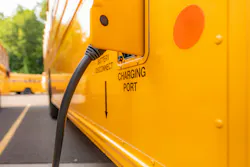
In addition to providing resilience and peak shaving capabilities, the microgrid will feed 35 DC fast charging ports for the district’s planned fleet of electric buses.
Eight additional ports will be installed in the north parking lot to charge smaller district-owned vehicles. The microgrid and a charge management system provided by The Mobility House will enable the chargers to access power from both the onsite solar and storage resources, as well as the power grid.
Two of the chargers will be bi-directional, meaning they can discharge power from a vehicle’s battery to the grid when needed. Also known as vehicle-to-grid (V2G) services, the technology enables the district to offset some energy expenses, serve as a clean energy resource for the community, and support the resilience of the broader power grid.
“Clean energy technologies such as solar microgrids, electric school buses and V2G have enormous potential to provide clean and affordable energy and transportation solutions for school districts and communities across the country,” said Greg Hintler, CEO of The Mobility House North America.
Located about halfway between Bakersfield and Fresno, Porterville USD has more than 13,000 students enrolled across 22 campuses, the vast majority of whom are from economically disadvantaged homes and rely on school buses to get to and from school.
PUSD aims to transition its entire bus fleet to electric by 2035, avoiding an additional 15,000 metric tons of CO2 emissions over the microgrid’s 30-year lifespan.
“When complete, this clean energy portfolio will serve as a national model for how vulnerable communities can mitigate rising energy and fuel costs, improve public health, meet ambitious climate goals, and protect themselves from climate emergencies,” said Ruben Fontes, CEO at ForeFront Power.
Multiple funding sources leveraged
The microgrid, EV charging infrastructure and the investment in electric buses have been made possible, in part, by a grant from the U.S. Environmental Protection Agency’s Clean School Bus Program.
CALSTART, a nonprofit that works to accelerate the adoption of clean transportation technologies, helped the district to secure nearly $14 million from the program in 2023. The organization is serving as the district’s technical and project management partner.
PUSD and CALSTART are also pursuing funds from the California Air Resources Board and the California Energy Commission’s Zero Emission School Bus and Infrastructure project.
“PUSD’s commitment to decarbonize their fleet is transformational for the San Joaquin Valley, for the broader Porterville community, and for school districts that are navigating similar transitions. Funding programs that reduce capital costs are critical to make these school electrification projects possible,” said Valerie Thorsen, regional director at CALSTART.
A living lab
PUSD’s new microgrid will also provide educational and job training opportunities for students and the surrounding community.
As part of its Climate Action Pathways for Schools (CAPS) initiative, students will be able to use the microgrid as a living lab, gaining invaluable renewable energy, sustainability and conservation skills.
PUSD and its partners have also launched a community outreach program that offers both educational information on zero-emissions fleet operations as well as internship opportunities.
About the Author
 Kathy Hitchens
Kathy Hitchens
Special Projects Editor
I am a writer and special projects editor for Microgrid Knowledge. I have over 30 years of experience covering the renewable energy, electric vehicle, utility, technology, entertainment, education, and financial sectors. I have a BFA in Media Arts from the University of Arizona and a MBA from the University of Denver.