Student Leads Church's Solar and Storage Project that Unites Remote Washington Community Through Resilience
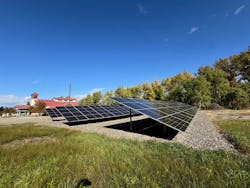
When Methow Valley United Methodist Church (MVUMC) switched on its new solar-plus-storage system in October, it marked a major milestone in the local church’s goal of serving as a community resilience hub.
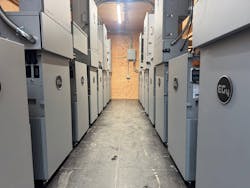
The church microgrid system pairs a 76-kilowatt solar array with a 100-kilowatt, 458-kilowatt-hour battery energy storage system. It is expected that the solar and storage will fully support normal church operations during warmer months (May through October). In the winter, due to frigid temperatures and shorter days, it should provide power for a duration of about a day and a half.
But what makes this project notable is not the 156 solar panels on the church’s south lawn, the battery energy storage system housed in a nearby shipping container, or even the fact that it will support the local power grid by dispatching stored energy during times of peak demand.
What sets the MVUMC installation apart is the young woman largely responsible for bringing it to life.
A student-led initiative
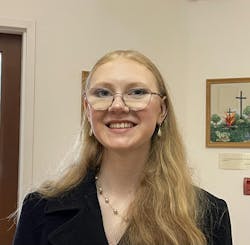
Juliana Robinson is a senior at the Methow Valley Independent Learning Center (ILC), an alternative public high school focused on a human-centered approach to learning, not traditional content-driven classrooms. This means students are encouraged to leave campus to gain real-world experience and pursue their passions through internships and by working with mentors.
For the past two years, in addition to her schoolwork and extra-curriculars, she has played a central role in designing the church’s solar-plus-storage system and helping write the grant that made the installation possible.
“I got interested initially in the project because of my interest in engineering,” Robinson told Microgrid Knowledge.
Robinson grew up in the Methow Valley and has been a part of the church since she was a baby. Her mom, Rev. Leigh Ann Robinson, is the church’s pastor.
“We have this really large, wonderful facility, but it's not in use as much as we would like,” Juliana Robinson said. “We were looking for ways to really be able to use it to benefit the community because that's what it was designed for.”
The church sits on a large plot of land about half way between the small towns of Twisp and Winthrop, much of which is undeveloped. Church leadership considered planting a garden or building tiny homes in an empty field to support food and housing needs in the community, but neither option was feasible due to the bedrock beneath the site, which makes water access difficult.
Installing solar and energy storage to create a resiliency hub, however, was both achievable and closely aligned with the United Methodist Church’s Social Principles on creation care. Those principles call on members to “be responsible stewards and to lovingly tend all that God has wrought.”
For many UMC congregations, this commitment has taken shape through renewable energy projects—ranging from mobile microgrids to permanent solar and energy storage systems.
In the Methow Valley of north-central Washington, where power outages rarely occur in isolation, an investment in resiliency carries clear community value. Outages often coincide with wildfire evacuations, flooding rains, or extreme cold, and in winter, the closure of a key mountain pass can complicate response and restoration.
Working with mentors

To develop a system that would allow the church to better serve the community, Juliana worked closely with Michiel (Mac) Zuidweg, principal at Washigton-based MZ Solar Consulting, her mentor on the project.
Zuidweg has been in the renewable energy industry for more than 20 years. He started his own firm in 2018 to provide technical consulting for solar and battery projects in the C&I space and was a key player in the development of the Swinomish Senior Center Microgrid and the Adjuntas Microgrid in Puerto Rico, among others. The Adjuntas Microgrid, developed in partnership with the Honnold Foundation, won the Microgrid Knowledge Greater Good Award — Highest Recognition in 2023.
Zuidweg, who lives in the Methow Valley, invited a group of ILC students to accompany him to a project site. Robinson was one of those students. From the questions she asked, Zuidweg said her interest in engineering was apparent.
It was clear that she was “analytically minded and she was really, really smart,” he said. After a second visit to the site once it was complete, Robinson asked Zuidweg to help her with the MVUMC project.
They met weekly to work on designs and conduct an energy analysis. They used Xendee’s platform to model the system.
Zuidweg also loaded Robinson up with reading. Lots of reading. “I did not actually think that she was going to read everything,” Zuidweg said, but she did. “She understands all the concepts.”
Inspired by a similar project at a United Methodist Church on Vashon Island, Washington, Robinson helped MVUMC pursue a grant from the Washington State Department of Commerce (DOC) to pay for the system that would transform the church into a community resilience hub.
Washington’s DOC has been very active in funding resilience projects in recent years, including four microgrids for the Confederated Tribes of the Colville Reservation, a solar and energy storage microgrid on Orcas Island, and the aforementioned Swinomish Senior Center Microgrid.
“I worked with a really experienced grant writer, Mary Jane Perry,” Robinson explained. “I was able to write portions of the grant application, primarily the sections related to our community and the impact that this would have on our community as a resilience hub.”
In 2024, MVUMC was awarded roughly $850,000 through the DOC’s Climate Commitment Act.
The CCA is a cap-and-invest program–a market-based climate policy that limits total greenhouse gas (GHG) emissions from major sources—such as power plants, fuel distributors or industrial facilities—and requires those emitters to purchase allowances for every ton of CO₂ they release. The money raised from selling these allowances is then invested in clean energy, climate resilience and community benefit projects.
Breaking ground
With the grant money in hand, things progressed quickly. Robinson and Zuidweg met with contractors, conducted site reviews and worked to manage stakeholder expectations. “Every single time there had to be a decision made, we would incorporate Juliana” to get her opinion and ensure her vision was being carried out, Zuidweg said.
They broke ground in May and turned the system on in October.
Additional funding received allowed the church to repair its geothermal heating and cooling system and purchase an EV charger. When it’s installed next year, the charger will be available to the community during power outages, ensuring those with electric vehicles have a way out of the valley.
MVUMC also received funds to build a commercial kitchen, allowing the church to feed the community as well as offer shelter in times of crisis.
Developing a resiliency hub
Juliana is headed off to college next year and dreams of working in renewable energy or mathematics. While she’s busy filling out college applications, she’s also still very much involved in transforming her church into a resource center for the community.
She recently conducted two community ideation sessions, bringing together different stakeholders to uncover areas where they need more resilience.
Those sessions highlighted a critical gap: the need for a central, accessible hub where people could connect with the wide range of services offered by local nonprofits.
“We have a really strong community here. People really come together to support each other, and that's kind of the strongest asset we have as a community,” Juliana said. But there is also a challenge: “there are so many different organizations doing different things and providing different services, and especially in a time of crisis…if they don't know what resources are out there and they don't have somewhere they can go to just find them, then it's difficult.”
Robinson hopes that the church can become that central place where people can access information, be in community with others and receive the support they need.
A new sense of purpose
Rev. Robinson said the whole project has been very gratifying.
“It’s exciting for me to see how this has brought a new energy and life into the congregation,” she said. “There is a new sense of purpose and excitement.
The enthusiasm is contagious, with members of the broader community volunteering their knowledge and expertise so they can be a part of the project.
Around town, Juliana is known as “the grant girl,” her mom said, adding that people are excited to see a young person so engaged in the community.
“I've talked to so many people who…come up to me and say, ‘oh, this is such a cool thing, and I have these skills and I would love to talk to you more, or I have this idea,’” Juliana said.
“I think it's part of a broader focus towards [renewables and resilience],” she added. “We have this common energy and this common excitement towards these new things that are happening to help our community, how can we really harness that energy and really make good out of it?”
About the Author
 Kathy Hitchens
Kathy Hitchens
Special Projects Editor
I am a writer and special projects editor for Microgrid Knowledge. I have over 30 years of experience covering the renewable energy, electric vehicle, utility, technology, entertainment, education, and financial sectors. I have a BFA in Media Arts from the University of Arizona and a MBA from the University of Denver.