Resilient Rural Healthcare: KVH’s Microgrid Projects Set a Community Standard
Key Highlights
- KVH broke ground on geothermal and solar projects to improve energy efficiency and operational reliability despite FEMA funding delays.
- The planned microgrid will include solar carports, battery storage, hydrogen fuel cells, and intelligent switchgear to enable islanded operation during outages.
- Long-term goals involve expanding solar capacity, adding redundancy, and integrating predictive load management to create a self-sufficient energy ecosystem.
- The phased approach allows KVH to utilize multiple funding streams, ensuring continuous progress toward community resilience and energy independence.
- This project demonstrates that rural communities can lead in resilience efforts by stacking achievable projects for long-term sustainability.
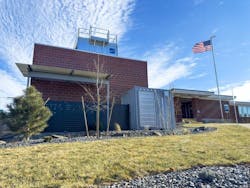
When the U.S. Federal Emergency Management Agency (FEMA) decided to suspend the Building Resilient Infrastructure and Communities (BRIC) program and delay nearly $10 million in awarded funding for the Goldendale Emergency Preparedness Microgrid, Klickitat Valley Health (KVH) could have paused its mission critical project.
Instead, the small rural hospital in south-central Washington chose to move forward - adopting a phased approach that keeps construction on track and momentum alive for one of the Pacific Northwest’s most ambitious community-based microgrid efforts.
Building the Foundation for Energy Independence
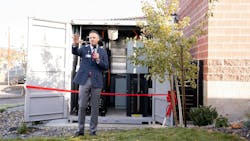
On November 6, KVH broke ground on two cornerstone projects that will serve as the backbone of the hospital’s future microgrid: a 45-ton ground-source heat-pump system and 375 kilowatts (kW) of solar carports. Together, these systems will lower operating costs, improve reliability, and prepare the campus for islanded operation when additional phases come online.
The geothermal installation, now under construction, will draw on 40 boreholes drilled 400 feet deep, using the earth’s constant temperature to provide year-round heating and cooling. Once completed in summer 2026, it is expected to save roughly $60,000 annually in energy costs. The solar carport array, scheduled for completion by year-end 2026, will add shaded parking, public EV charging, and another $30,000 in yearly utility savings.
Both projects were made possible through Washington State Department of Commerce Clean Energy Community Grants, funded by the state’s Climate Commitment Act. For KVH, that support represents more than sustainability—it is a matter of fiscal responsibility and operational readiness.
“Breaking ground on these projects is about responsible stewardship of community dollars and ensuring reliability for patient care,” said Jonathan Hatfield, KVH CEO. “By pairing geothermal and solar, we’re lowering utility costs and hardening our campus against energy disruptions.”
The Vision: A Community-Scale Microgrid
The long-term plan, known as the Goldendale Emergency Preparedness District, links the hospital and Goldendale School District through a 1 megawatt solar-plus-storage microgrid that can power critical facilities during prolonged grid outages.
At full build-out, the system will include:
- Two 500 kW AC solar carports (nearly 1 MW DC total)
- 979 kW / 3.9 MWh battery storage systems at each site
- A 100 kW hydrogen fuel cell with up to 36 hours of runtime supported by advanced metal-hydride storage
- Campus-wide intelligent switchgear enabling island mode and automated load shedding
- Interconnection between the hospital and schools to share generation and serve as mutual emergency shelters during extended outages
The combined system - valued at approximately $17 million - will supply enough stored and renewable energy to operate essential hospital functions, emergency communications, and community shelters for multiple days without the grid.
Even as the FEMA portion remains frozen, KVH has completed 90 percent design, site surveys, and permitting. The current geothermal and solar projects are being built to integrate directly with the forthcoming microgrid controls and switchgear, ensuring no duplication of cost or effort.
Resilience as Rural Healthcare Infrastructure
For a critical-access hospital serving fewer than 15,000 residents across a vast and mountainous region, resilience is not optional. Goldendale experiences frequent windstorms, wildfire smoke events, and highway closures that can isolate the community.
“Each technology we add - hydrogen, geothermal, solar, or storage - adds a layer of redundancy,” said Jonathan Lewis, KVH Director of Support Services & Capital Projects. “Even when major funding streams are uncertain, we can keep building piece by piece. The microgrid is both our energy future and our emergency plan.”
The phased model allows KVH to leverage multiple funding sources: state clean-energy programs, legislative capital grants, federal tax credits, and hospital capital reserves. This diversification is increasingly seen as essential for small rural systems navigating complex federal grant timelines.
A Template for Other Communities
Once operational, the Goldendale microgrid will provide more than power - it will serve as a demonstration site for how rural healthcare, education, and emergency services can share distributed energy assets. The architecture supports public access EV charging, renewable-energy education, and data sharing with state agencies tracking resilience outcomes.
Future expansion phases include:
- Extending solar generation to additional hospital buildings
- Adding a second battery-energy-storage enclosure for redundancy
- Integrating the geothermal system into predictive load-management controls
- Enabling “black start” capability for the hydrogen fuel-cell plant
KVH’s broader objective is to create a self-reliant energy ecosystem capable of sustaining essential operations during regional blackouts and reducing dependence on diesel fuel. The hospital’s earlier Central Utility Plant modernization and switchgear upgrade have already positioned the campus for seamless interconnection.
Sustaining Momentum
While national attention has focused on large urban microgrids, KVH’s incremental progress demonstrates that rural communities can lead in practical resilience. Each completed subsystem contributes immediate value - lower bills, cleaner operations, and stronger emergency capacity - while paving the way for more advanced integration later.
“Resilience doesn’t require waiting for the perfect grant,” Lewis added. “It’s about stacking achievable projects until the whole system becomes self-supporting.”
With boreholes drilling, conduit trenches opening, and solar canopies soon to rise, Klickitat Valley Health continues to prove that perseverance can be as powerful as any funding stream.
About the Author
Jonathan Lewis
Jonathan Lewis is KVH Director of Support Services & Capital Projects.