Curing Healthcare’s Carbon Ailment: UC Irvine Fully Electrifies New Hospital

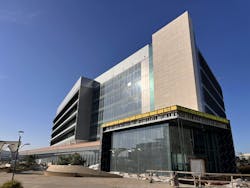
When the University of California Irvine Health System (UCI Health) begins caring for patients in its new acute care hospital this week, it won’t just be unveiling a state-of-the-art facility—it will be debuting the country’s largest all-electric hospital and a new blueprint for resilient, low-carbon care.
As the sixth hospital in the UCI Health System, the 144-bed facility features a 24-hour emergency department, 10 advanced operating rooms and a broad range of specialty centers spanning cancer, cardiology, digestive health, neuroscience and orthopedics.
Located on UCI Health’s medical campus in Irvine, just a half mile away from John Wayne Airport, the seven-story, 350,000-square foot hospital will rely entirely on on-site solar and sustainably sourced electricity from the grid to power normal operations.
“There’s a lot to be excited about,” according to Joe Brothman, facilities and general services director at UCI Health. Brothman has played a central role in the facility’s planning and design since its inception nearly six years ago.
“The University of California always tries to be progressive and very environmentally conscious,” he said, and given the size and location of the facility, it was determined that going all-electric was both feasible and financially prudent.
Rooftop solar panels on the facility’s parking structures will provide about 10% of the facility’s anticipated 2 MW daily load.
The balance will be provided by sustainably sourced electricity from the grid. The University of California manages a power purchasing organization that ensures all power used by UCI Health is sustainably sourced renewable electricity, Brothman explained.

First, do no harm
For an industry whose primary tenant is to “first, do no harm,” the healthcare sector has a carbon problem. Greenhouse gases, including carbon dioxide, methane and ozone, pose a significant threat to public health, yet U.S. healthcare facilities are responsible for 8.5% of the country’s total emissions.
A major driver is the way most hospitals produce heat: fossil fuel–powered boilers and combined heat and power (CHP) systems that supply steam or hot water for space conditioning, sterilization, laundry, and other essential services.
Burning those fossil fuels is one reason why hospital care alone accounts for more than a third (36%) of the sector’s emissions.
UCI Health–Irvine aims to break that cycle. By going fully electric, the hospital eliminates a large source of onsite emissions and avoids locking in decades of fossil-fuel dependence. And electrification is only the starting point.
Designed with efficiency in mind
The team, which includes Brian Pratt, the campus architect and associate vice chancellor for design and construction services at UC Irvine, general contractor Hensel Phelps and CO Architects, has taken a number of other steps to reduce the facility’s environmental footprint and improve the health of both patients and the surrounding community.
The hospital is expected to achieve LEED Platinum certification, the top designation granted by the U.S. Green Building Council’s Leadership in Energy and Environmental Design (LEED) program. This recognition is given to buildings that meet exceptional standards in energy, water, materials, indoor air quality, and site sustainability.
Key features include the use of recycled water for irrigation, Energy Star–certified equipment, an all-glass facade that maximizes natural light to reduce lighting loads and a highly efficient building envelope that minimizes energy use for heating and cooling.
“The concept of health care without harm is first and foremost with this new site,” Brothman told Microgrid Knowledge. “It’s a great example of us providing cutting edge care for the community in a way that doesn't have any negative externalities for our neighbors. I'm extremely excited about that.”
These energy-saving measures extend throughout the facility, including one of the most challenging areas to electrify: the kitchen.
“Kitchen equipment is one of the most energy intensive parts of any large institution like this,” Brothman explained.
Finding appropriately sized, energy efficient electric appliances to replace the natural gas ovens, burners and deep fryers typically found in a commercial kitchen proved challenging. The equipment not only needed to feed thousands of staff, patients and visitors each day, it had to deliver the level of culinary excellence that UCI Health considers an integral part of patient care.
Weathering storms
Beyond sustainability, the hospital’s design prioritizes operational resilience. Traditional hospitals of this size typically rely on a central steam plant, with large boilers providing steam and hot water through natural gas combustion.
Such centralized systems can be vulnerable: a single failure—whether a ruptured steam line during an earthquake, boiler issue or dispersion tube malfunction—can trigger a cascade of outages across the facility.
UCI Health–Irvine takes a different approach. The facility uses modular, point-of-use systems to deliver steam and hot water exactly where needed, eliminating single points of failure.
The system is designed in multiple phases, allowing different pieces of equipment to run independently or in combination depending on demand. Even if one component requires maintenance or experiences an issue, the other systems can continue operating, ensuring that the hospital maintains full or reduced functionality.
Brothman describes the design as “almost like an N+2 system. Instead of just having a primary system and a backup, we have three primary systems, any one of which can sustain the hospital’s operations.”
While no system is perfect, he says, this cutting-edge approach offers both flexibility and reliability far beyond what traditional centralized systems can provide.
A future microgrid connection?
Although the hospital is fully electric for day-to-day operations, it will still rely on diesel generators for emergency power. “When we were programming the facility, diesel backup generators were the only approved method of emergency power that hospitals in California could utilize,” Brothman explained.
Four generators serve the hospital, with an additional unit for an adjoining medical office building. Together, they allow the campus to operate independently of the grid for up to 96 hours, with the possibility of extended operation if fuel is delivered.
Brothman said they are considering how battery storage, peak load management or other resilient and sustainable solutions could be adopted in the future. “We're always looking at ways to be more efficient, be more sustainable,” he said.
There’s also a 20-MW microgrid just down the road, providing backup and islandable power for UC Irvine’s main campus. “We talk about how great it would be if we could plug into that one day,” he said.
Microgrids are increasingly providing reliable power to hospitals across the country. Recent months have seen solar, energy storage and even biomass-powered microgrids launched at facilities from Maryland, to Wisconsin and California.
Brothman noted that the central-utility-plant model pioneered at UCI Health is already being adopted widely, with similar projects underway across the U.S. and around the world—many of them already well into construction.
“I've been an advocate for sustainable operations my entire career, and this is, I think, the crown jewel of what can be done in terms of building a facility from the ground up and keeping your community's health in mind,” Brothman said. “Seeing it come to life from the initial concept phase to now opening…has been a highlight of my career.”
About the Author
 Kathy Hitchens
Kathy Hitchens
Special Projects Editor
I am a writer and special projects editor for Microgrid Knowledge. I have over 30 years of experience covering the renewable energy, electric vehicle, utility, technology, entertainment, education, and financial sectors. I have a BFA in Media Arts from the University of Arizona and a MBA from the University of Denver.