New Nanogrid-Powered Drone System Designed to Power Asymmetrical Warfare, Protect Troops
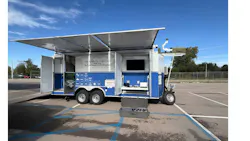
Three American companies have launched an integrated platform that will enable the U.S. military, government agencies and commercial and industrial operations to conduct continuous drone operations remotely.
The Persistent Drone Operations Nanogrid is the result of a partnership between Sesame Solar, Target Arm and AG3 Labs.
Nanogrids are small self-contained electric power generation systems — essentially small microgrids.
Michigan-based Sesame Solar’s mobile power hub is the backbone of the nanogrid. It generates electricity via onboard solar panels and low pressure solid-state hydrogen. The hub also features battery energy storage. Because it generates its own power, the hub reportedly requires no fuel resupply and operates independently of the power grid.
The self-generating power system's technology was also part of a separate nanogrid demonstration project at the White Sands Missile Range in New Mexico.
The Persistent Drone Operations Nanogrid launches, recovers, recharges and relaunches drones using Target Arm’s Ralar system, an autonomous robotic arm that can keep drones in the air 24/7 — with no on-site drone pilot required.
The solution uses SPADE drones from AG3 Labs. SPADEs are the smallest, lightest category of unmanned aircraft systems (UAS) in the Department of Defense (DOD) classification system.
The Persistent Drone Operations Nanogrid is available as a standalone solution or it can be configured as a microgrid that connects up to 12 individual nanogrids.
Drones are changing how wars are fought
The shape of modern warfare is evolving as militaries around the world increasingly rely on drones to observe and attack enemy combatants. Drones are relatively cheap compared to traditional ordinance and can level the playing field between otherwise unequally matched foes.
This type of asymmetrical warfare has been a hallmark of the Russia-Ukraine war.
Group 1 UAS, such as AG3 Lab’s SPADEs, are what the military calls attritable — effective on the battlefield, but cheap enough that they won’t dramatically impact the military’s budget or operational capacity if they’re lost.
The challenge with drone operations, however, is that there is no standard for recharging them in the field. A recent paper published by the U.S. Army said, “A drone launch team without recharge capability becomes irrelevant after its first sortie.”
The Persistent Drone Operations Nanogrid aims to become that standard.
“Mobile electric power is a critical fifth supply requirement along with food, water, munitions and fuel. If a forward expeditionary team can’t power its drones, or their batteries fail from heat or cold, warfighters lose one of their most valuable assets,” Lauren Flanagan, CEO and co-founder of Sesame Solar, said in a statement. “Together with Target Arm and AG3 Labs, we’ve built a comprehensive solution that eliminates the fuel supply chain while keeping drones in the air for extended durations.”
Because the system can be operated remotely, it also promises to reduce risk for troops.
“The launch and the recovery are two of the most exposed moments of a drone mission — someone standing in the open, waiting on an aircraft. Ralar takes a person out of that moment entirely,” Jeffrey A. McChesney, CEO & founder of Target Arm, said in a statement. “What makes our system even more unique is that drones can be launched from a moving vehicle or a boat, so warfighters never need to stop to complete their mission.”
Home-grown technology
Fully manufactured in the U.S., the Persistent Drone Operations Nanogrid meets the mandates to reduce reliance on foreign-made drones, as outlined in Executive Order 14307.
The nanogrid also has a number of potential applications beyond military use, from law enforcement to critical infrastructure protection and emergency management. Commercial and industrial operations could also leverage the technology for inspecting and monitoring remote, large or difficult to access sites.
About the Author
 Kathy Hitchens
Special Projects Editor
I am a writer and special projects editor for Microgrid Knowledge. I have over 30 years of experience covering the renewable energy, electric vehicle, utility, technology, entertainment, education, and financial sectors. I have a BFA in Media Arts from the University of Arizona and a MBA from the University of Denver.