100 MW Solar Hybrid Installation Now Powering the Nigerian State Secretariat
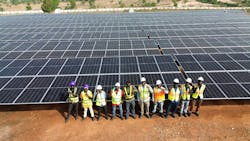
A new 100-MW solar hybrid facility was commissioned this month in Nigeria. The installation will provide power to the Nasarawa State Secretariat in Lafia, the state’s capital. The State Secretariat is the central administrative hub for the state government, housing various ministries, departments and agencies.
The commercial and industrial-scale installation will significantly reduce the Secretariate’s use of diesel fuel as well as its carbon emissions, supporting the government’s transition to clean energy. It will also reduce energy costs, enhance voltage stability and ensure a reliable power supply.
In partnership with Step Engineering, Husk, a major provider of distributed energy resources (DER) in Africa, managed the engineering, procurement and commissioning of the project. They will provide training and support the plant’s operation for the first 24 months, after which responsibility will be transferred to the state government.
“Nasarawa state has been an unwavering supporter in helping to scale Husk’s operations in Nigeria,”Olu Aruike, Husk’s vice president of business development for West Africa and Nigeria country director, said in a statement. “This project further deepens the strong relationship with the state, and demonstrates the huge, untapped potential for C&I solar in Nasarawa and across government agencies and businesses in Nigeria.”
Solving electricity access with renewable energy
Electricity access is a persistent issue across Africa, particularly in sub-Saharan countries such as Nigeria. Most of the nearly 600 million people on the continent without affordable electricity live in the region.
Husk has developed a number of DER projects in Nigeria in recent years to address this problem, including more than 40 remote minigrids and a 1.3 MW C&I system for an international agrifood conglomerate.
Husk’s hybrid solar and energy storage minigrids are typically between 30kW and 50kW at commissioning; additional generation capacity can be added as demand grows.
Minigrids, sometimes referred to as remote microgrids, are typically built and operated in areas without access to a central electric grid. Minigrid systems use software to control distributed energy resources like solar panels and battery storage, providing remote communities with reliable, clean, and affordable power – they are thriving in Africa.
Nigeria is one of the largest minigrid markets in the world with over 100 systems currently online.
In January, the World Bank and the African Development Bank, supported by private sector energy development partners and nearly 30 African heads of state, launched the Mission 300 initiative with the goal of bringing electricity to 300 million Africans by 2030.
Minigrids, already in high demand across the continent in places like Zambia, Ethiopia and Nigeria, are expected to play a key role in the initiative.
The World Bank estimates that sub-Saharan Africa will need 160,000 new minigrids to achieve universal access by 2030.
About the Author
 Kathy Hitchens
Kathy Hitchens
Special Projects Editor
I am a writer and special projects editor for Microgrid Knowledge. I have over 30 years of experience covering the renewable energy, electric vehicle, utility, technology, entertainment, education, and financial sectors. I have a BFA in Media Arts from the University of Arizona and a MBA from the University of Denver.