United Nations Grant Funds 10 Minigids in Turkmenistan
The government of Turkmenistan and the United Nations Development Program (UNDP) will build 10 solar minigrids in remote regions of the Central Asian republic over the next five years. The Global Environment Fund (GEF), one of the world’s largest sources of public environmental funding, provided a grant of more than $4.17 million to pay for the project.
The minigrids will be built in remote regions, where inhabitants are far from the reaches of the central grid and rely on diesel generators for their electricity.
Minigrid systems use software to control distributed renewable energy resources like solar panels and battery storage, providing remote communities with reliable, clean and affordable power.
Sometimes referred to as remote microgrids, minigrids are typically built and operated in areas without access to a central electric grid. They are in high demand in Africa, where they are a cornerstone of Mission 300, an initiative from the World Bank and African Development Bank to bring electricity to 300 million people on the continent by 2030.
The 10 Turkmen solar minigrid pilots will be implemented by the United Nations Office for Project Services (UNOPS) and will have a combined capacity of up to 2 MW.
They are designed to accelerate the country’s transition to renewable energy by showcasing what’s possible with solar energy solutions.
The minigrid pilots will also help the Turkmen government establish the regulatory and technical framework needed to expand adoption of renewable energy across the former Soviet state.
“The partnership between UNDP and UNOPS brings out the potential of the best of the United Nations system. UNDP brings their policy, experience and finance background. UNOPS brings their ability to implement practically, pragmatically and in a rapid manner to move forward,” Tim Lardner, UNOPS’ regional director for Europe and Central Asia, said in a statement. “This partnership will allow a rapid expansion of renewable energy in rural areas throughout Turkmenistan.”
As part of the pilot, UNOPS will conduct feasibility assessments for similar projects in 120 additional remote communities.
“Expanding access to reliable and cleaner energy is an important investment in people's well-being, resilient communities and Turkmenistan's sustainable development,” Narine Sahakyan, UNDP resident representative in Turkmenistan, said in a statement.
An isolated desert land
One of the world’s most isolated countries, Turkmenistan broke away from the Soviet Union in 1991. According to the U.S. State Department, a letter of invitation is required for entry, as is a visa. Tourists must be accompanied by an approved tour guide, and internet access is highly censored.
A key stop along the Silk Road, the ancient trade routes that linked Asia, the Middle East, Africa and Europe for more than 1,500 years, the country is nestled between the Caspian Sea to the west and Kazakhstan, Uzbekistan, Afghanistan and Iran to the north, east and south.
The second largest country in Central Asia by land area, it is also one of the least populated.
Roughly the size of California, about 80% of the country is covered by inhospitable deserts. About 40% of its 7.7 million people live in urban areas, which are built around the oases that dot the country. Ashgabat, the capital known for its white marble buildings, is home to around 1 million people.
Smaller remote communities are found along Turkmenistan’s three main rivers or in the Kopet-Dag mountain range.
Natural gas is abundant, but renewables are on the agenda
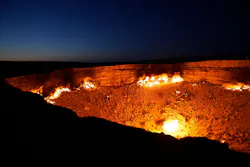
Turkmenistan has large underground natural gas deposits, as evidenced by the Darvaza Gas Crater, also known as the “Gates of Hell” or the “Door to Hell.” Located deep in the Karakum Desert, the large pit has been burning since the 1970s, when a Soviet exploration rig collapsed into a sinkhole and ignited the natural gas within.
Perhaps not surprisingly, the Turkmen electric grid is powered solely by natural gas generation, according to the International Energy Agency (IEA).
The government, however, has committed to increasing its adoption of renewable energy. In 2020, Turkmenistan’s National Strategy for the Development of Renewable Energy until 2030 was announced, and it is a signatory to the Paris Climate Agreement.
The country is working towards reducing its greenhouse gas (GHG) emissions to 20% of 2010 levels by 2030 and thereafter, achieving zero GHG emissions growth.
“This project offers an opportunity to translate the country's renewable energy ambitions into practical solutions, combining policy development, national capacity-building and tangible investments in solar energy,” Sahakyan said. “Together with our partners, we aim to help create the conditions for wider adoption of renewable energy, strengthen energy security and ensure that communities, including women and other vulnerable groups, can benefit from more reliable energy services.”
About the Author
 Kathy Hitchens
Special Projects Editor
I am a writer and special projects editor for Microgrid Knowledge. I have over 30 years of experience covering the renewable energy, electric vehicle, utility, technology, entertainment, education, and financial sectors. I have a BFA in Media Arts from the University of Arizona and a MBA from the University of Denver.