Aspen’s New Microgrid Comes Online Just in Time for Wildfire Season

One of the world’s most popular winter ski destinations is taking a sharp turn into summer energy resiliency.
An integrated clean energy microgrid has been commissioned at the Aspen Airport Business Center (AABC) in Colorado. The project, which connected an existing 5-MW solar array with a large-scale battery energy storage system (BESS), was a collaboration between Holy Cross Energy (HCE), Pitkin County and the Roaring Fork Transit Authority (RFTA).
It will power critical public services during emergencies or grid outages, enhance local grid reliability and advance the county’s clean energy goals.
HCE, the rural electric cooperative serving Pitkin County, provided technical expertise, system planning and coordination for the project, which is located across Highway 82 from the Aspen Airport.
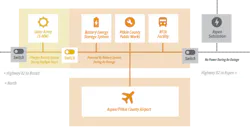
The microgrid will power the AABC campus, which includes several restaurants, a gas station, an animal hospital and a RFTA operations center. It will enable RFTA to continue providing critical transit services during grid outages to Pitkin and Eagle Counties, as well as the nearby town of Glenwood Springs.
“This project demonstrates what’s possible when local governments, utilities, and community partners work together toward a shared vision. The AABC microgrid strengthens the resilience of critical public services while advancing our transition to a cleaner, more flexible energy system,” Bryan Hannegan, president and CEO of Holy Cross Energy, said in a statement.
Downhill race to winning clean energy alternatives
Deep in the Rocky Mountains, Pitkin County is home to nearly 17,000 people. It also boasts four highly rated ski resorts — Aspen Mountain, Snowmass, Buttermilk and Aspen Highlands.
The area is increasingly prone to wildfires, which can damage power infrastructure and lead to extended grid outages. To reduce that risk, many utilities, including HCE, have turned to public safety power shutoffs — a practice of proactively cutting electricity when conditions make it likely that equipment could spark a fire.
The AABC microgrid was developed in response to the 2018 Lake Christine Fire. Sparked over the July 4 weekend, it burned more than 12,500 acres and destroyed several homes.
In its wake, the County, HCE and RFTA came together to explore options to improve disaster resilience while also transitioning the grid away from fossil fuels. Supported by RMI (formerly Rocky Mountain Institute), they conducted a multi-month study that pointed to distributed clean energy resources and community-driven planning as the best path forward.
“We’re creating a model for how communities can prepare for future challenges while reducing emissions and increasing energy independence,” Hannegan said.
Just in time for wildfire season
The microgrid has come online just as Colorado’s wildfire season ramps up. The state is in the midst of a drought, which was exacerbated by lower-than-normal snowfall this winter. There are already several active blazes, and the state is bracing for what this summer might bring.
“Continuity planning and disaster recovery are part of our resiliency team’s efforts to stay ahead of natural disasters and provide vital services within the county”, said Jeffrey Woodruff, Pitkin County Commissioner Board Chair.
About the Author
 Kathy Hitchens
Kathy Hitchens
Special Projects Editor
I am a writer and special projects editor for Microgrid Knowledge. I have over 30 years of experience covering the renewable energy, electric vehicle, utility, technology, entertainment, education, and financial sectors. I have a BFA in Media Arts from the University of Arizona and a MBA from the University of Denver.