Ayuda da el Camino: Puerto Rico Cooperative Ok'd to Deliver First Intermunicipal Microgrid

Help is on the way. Puerto Rico’s first electric cooperative has the go-ahead to develop and operate numerous microgrids in the mountainous region of the outage-prone U.S. territory island.
La Cooperativa Hidroeléctrica de la Montaña gained Puerto Rico Energy Bureau approval to proceed on its “Microgrid of the Mountain” (Microrred de la Montana) project. The Microgrid of the Mountain will be considered the island’s first intermunicipal microgrid and combines hydroelectric and solar photovoltaic power.
The focus of the Microgrid of the Mountain is to improve energy reliability in the Cordillera Central region. Puerto Rico’s power grid is vulnerable to hurricanes and also often dependent on imported fossil fuel resources.
“Residents of the Cordillera Central can be in control of their electric power service and decision-making regarding the electricity they consume,” reads the project mission statement on the La Cooperativa Hidroeléctrica de la Montaña website. Under a cooperative model, the Microrred de la Montaña is the ideal project to ensure that the generation and distribution of the electricity that our neighbors consume is under our local control.”
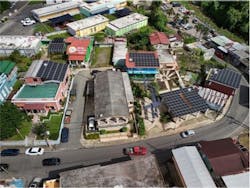
The cooperative will also use battery storage with solar in the microgrid systems. The series of 5-MW projects include new 38-kV power lines between the towns of Adjuntas, Jayuya, Lares and Utuado. Adjunta also is home to a newly installed "microgrid lab" in a collaboration with Casa Pueblo and the Oak Ridge National Laboratory.
The microgrids will be set up through the Resiliencia Energética Fotovoltaica Comunitaria initiative. The cooperative plans to install the solar and storage systems utilizing the roofs of local businesses, churches and other community centers.
Last year the U.S. Department of Energy selected Cooperativa Hidroeléctrica de la Montaña to participate in the Communities LEAP program intended to help continue development of the Microgrid of the Mountain project. DOE also provided about $500,000 in technical assistance aid.
La Cooperativa Hidroeléctrica de la Montaña was created in 2019 after a series of both system and organizational failures by the island’s energy planning leadership.
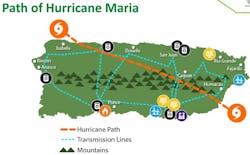
Hurricanes Irma and Maria, which hit within two weeks of each other in 2017, nearly completely destroyed Puerto Rico’s power transmission system. The “double punch” knocked out 80% of the island’s electric grid, noted a report by the National Renewable Energy Laboratory (now National Laboratory of the Rockies).
This sustained destruction also caused one of the largest electricity blackouts in history. At the time, the U.S. Federal Emergency Management Agency allocated $3.2 billion for electricity grid restoration.
Three years later, Puerto Rico suffered a major earthquake which damaged its largest power generation plant.
This spring, SkySense and other partners will energize a new microgrid at the island's largest airport, Luis Muñoz Marín International Airport (SJU) in San Juan. The $14 million microgrid features 2-MW of solar panels and 500-kWh in battery storage capacity.
About the Author
 Rod Walton, Microgrid Knowledge Managing Editor
Rod Walton, Microgrid Knowledge Managing Editor
Managing Editor
For Microgrid Knowledge editorial inquiries, please contact Managing Editor Rod Walton at [email protected].
I’ve spent the last 18 years covering the energy industry as a newspaper and trade journalist. I was an energy writer and business editor at the Tulsa World before moving to business-to-business media at PennWell Publishing, which later became Clarion Events, where I covered the electric power industry. I joined Endeavor Business Media in November 2021 to help launch EnergyTech, one of the company’s newest media brands. I joined Microgrid Knowledge in July 2023.
I earned my Bachelors degree in journalism from the University of Oklahoma. My career stops include the Moore American, Bartlesville Examiner-Enterprise, Wagoner Tribune and Tulsa World, all in Oklahoma . I have been married to Laura for the past 36-plus years and we have four children and one adorable granddaughter. We want the energy transition to make their lives better in the future.
Microgrid Knowledge and EnergyTech are focused on the mission critical and large-scale energy users and their sustainability and resiliency goals. These include the commercial and industrial sectors, as well as the military, universities, data centers and microgrids. The C&I sectors together account for close to 30 percent of greenhouse gas emissions in the U.S.
Many large-scale energy users such as Fortune 500 companies, and mission-critical users such as military bases, universities, healthcare facilities, public safety and data centers, shifting their energy priorities to reach net-zero carbon goals within the coming decades. These include plans for renewable energy power purchase agreements, but also on-site resiliency projects such as microgrids, combined heat and power, rooftop solar, energy storage, digitalization and building efficiency upgrades.