Swedish Tidal Energy Startup Achieves Microgrid Generation at Remote Faroe Islands
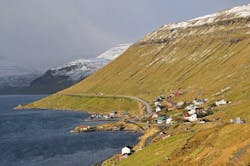
Swedish tidal energy startup Minesto reported that its microgrid-scale Dragon project is operating and generating electricity to the isolated grid serving the remote Faroe Islands in the northern Atlantic Ocean.
Minesto installed the commercial-scale Dragon 4 power plant along the shore in Vestmanna, Faroe Islands. The project was partially funded by the Swedish Energy Agency and includes partners such as Faroese utility Sev, Capture Energy and IVL.
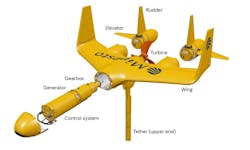
Dragon 4 generates only about 100 KW but generates important data for studying the tidal energy kite concept. Earlier, Minesto’s Dragon 12 produced about 1.2 MW capacity and was recovered for inspection and maintenance after 10 months operating in the water around Vestmannasund.
”Right at the start, we want to add delivery of tidal energy into electrification applications for the customer value of our microgrid to be proven and demonstrated,” Martin Edlund, CEO of Minesto, said in a statement detailing the collaboration last fall. “Small-scale electrification to reduce CO2 emissions is a core component in the global energy transition as well as in our sales growth projections.”
Minesto’s website describes the Dragon projects as “first steps” in researching and honing the so-called energy kite design. The technology generates electricity from the tidal streams and ocean currents utilizing principals like “a kite flying in the wind,” as the company describes it.
“The wing uses the hydrodynamic lift force created by the underwater current to move the kite,” reads the company’s primer on its technology. “With an onboard control system, the kite is autonomously steered in a predetermined figure-of-eight trajectory, pulling the turbine through the water at a water flow several times higher than the actual stream speed. The turbine shaft turns the generator which outputs electricity to the grid via a power cable in the tether and a seabed umbilical to the shore.”
The Faroe Island chain is an autonomous territory of Denmark and situated between Iceland, Norway and Scotland. The weather is mildly cool but windy throughout the year.
Minesto first generated electricity from its design in 2019 with grid interconnection achieved a year later. The company has a power purchase agreement with the Sev utility.
Design, Engineering and Cutting Edge On-Site Power
All part of Content at Microgrid Knowledge Conference
Happening May 4-6 in Orlando
Learn more here and Register now
About the Author
 Rod Walton, Microgrid Knowledge Managing Editor
Rod Walton, Microgrid Knowledge Managing Editor
Managing Editor
For Microgrid Knowledge editorial inquiries, please contact Managing Editor Rod Walton at [email protected].
I’ve spent the last 18 years covering the energy industry as a newspaper and trade journalist. I was an energy writer and business editor at the Tulsa World before moving to business-to-business media at PennWell Publishing, which later became Clarion Events, where I covered the electric power industry. I joined Endeavor Business Media in November 2021 to help launch EnergyTech, one of the company’s newest media brands. I joined Microgrid Knowledge in July 2023.
I earned my Bachelors degree in journalism from the University of Oklahoma. My career stops include the Moore American, Bartlesville Examiner-Enterprise, Wagoner Tribune and Tulsa World, all in Oklahoma . I have been married to Laura for the past 36-plus years and we have four children and one adorable granddaughter. We want the energy transition to make their lives better in the future.
Microgrid Knowledge and EnergyTech are focused on the mission critical and large-scale energy users and their sustainability and resiliency goals. These include the commercial and industrial sectors, as well as the military, universities, data centers and microgrids. The C&I sectors together account for close to 30 percent of greenhouse gas emissions in the U.S.
Many large-scale energy users such as Fortune 500 companies, and mission-critical users such as military bases, universities, healthcare facilities, public safety and data centers, shifting their energy priorities to reach net-zero carbon goals within the coming decades. These include plans for renewable energy power purchase agreements, but also on-site resiliency projects such as microgrids, combined heat and power, rooftop solar, energy storage, digitalization and building efficiency upgrades.