Himandhoo and Electrolytes too: Quino Energy Bringing Water-Based Batteries to Maldives Island Microgrid

Chinese digital technology company Tencent is funding development of an organic water-based battery storage installation to support a hybrid solar microgrid project for a remote island in the Maldives.
Quino Energy will supply its water-based organic flow batteries under a CarbonX grant by Tencent. The batteries store electrical energy in organic molecules called quinones.
The solar and storage microgrid is planned for Himandhoo Island in the Maldives. It will complement and integrate with solar panels and lithium-ion batteries for the island project in the Indian Ocean.
“This represents the first commercial deployment of the organic flow battery technology, in addition to government supported projects we previously announced,” Eugene Beh, California-based Quino Energy’s co-founder and CEO, said in a statement. “The collaboration showcases how Quino’s technology will continue to enable cooperation between parties from across the world to rapidly advance the next generation of flow batteries.”
Like many remote island microgrid projects, the use of renewable energy and batteries will offset the reliance on imported diesel for generators. It will also offer energy system resiliency in the face of extreme weather events.
Tencent did not release financial details of its CarbonX award to Quino Energy, but it is awarding nearly $30 million across 16 winning teams. Tencent is one of the world’s largest multimedia companies with e-commerce, social media and investment wings.
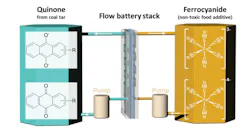
Last year in the U.S., Quino Energy was part of a partnership awarded a $10 million grant to develop an 8-MWh water-based flow battery to support a solar microgrid at the High Desert Regional Health Center in Los Angeles County.
Quinones are organic compounds which include benzene and ketone and can be reactive in biological and chemical processes. Quino Energy will manufacture the proprietary organic electrolyte in Pune, India.
The company and project are supported by investment firm Atri Energy Transition, which led Quino Energy’s Series A fundraising round in October 2025.
“The selection of Quino by Tencent for the CarbonX Award is an endorsement of organic electrolyte chemistry,” said S. Kishore, founder of Atri Energy Transition. “We are happy to be part of the transition of this chemistry from pilot to commercial scale.”
A flow battery, unlike a lithium-ion counterpart, takes solid-state charge storage materials and dissolves them in electrolyte solutions, which are then pumped through the electrodes.
The Quino Energy electrolyte can be dropped into vanadium flow battery hardware, potentially providing a less expensive electrolyte.
Suqian Time Energy Storage will provide hardware for the flow battery.
The solar component of the microgrid, which includes floating photovoltaic generation, is being financed by the Asian Development Bank and advances the ongoing Preparing Outer Islands for Sustainable Energy Development (POISED) project focused on terrestrial solar PV and battery storage for island microgrids.
About the Author
 Rod Walton, Microgrid Knowledge Managing Editor
Rod Walton, Microgrid Knowledge Managing Editor
Managing Editor
For Microgrid Knowledge editorial inquiries, please contact Managing Editor Rod Walton at [email protected].
I’ve spent the last 18 years covering the energy industry as a newspaper and trade journalist. I was an energy writer and business editor at the Tulsa World before moving to business-to-business media at PennWell Publishing, which later became Clarion Events, where I covered the electric power industry. I joined Endeavor Business Media in November 2021 to help launch EnergyTech, one of the company’s newest media brands. I joined Microgrid Knowledge in July 2023.
I earned my Bachelors degree in journalism from the University of Oklahoma. My career stops include the Moore American, Bartlesville Examiner-Enterprise, Wagoner Tribune and Tulsa World, all in Oklahoma . I have been married to Laura for the past 36-plus years and we have four children and one adorable granddaughter. We want the energy transition to make their lives better in the future.
Microgrid Knowledge and EnergyTech are focused on the mission critical and large-scale energy users and their sustainability and resiliency goals. These include the commercial and industrial sectors, as well as the military, universities, data centers and microgrids. The C&I sectors together account for close to 30 percent of greenhouse gas emissions in the U.S.
Many large-scale energy users such as Fortune 500 companies, and mission-critical users such as military bases, universities, healthcare facilities, public safety and data centers, shifting their energy priorities to reach net-zero carbon goals within the coming decades. These include plans for renewable energy power purchase agreements, but also on-site resiliency projects such as microgrids, combined heat and power, rooftop solar, energy storage, digitalization and building efficiency upgrades.