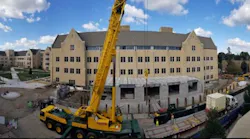
Expanding Horizons of Microgrid Research: St. Thomas University Celebrates Center's Additions
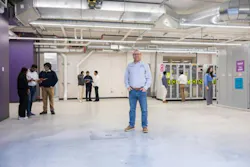
What may be the largest microgrid research facility in U.S. higher education just got bigger and even better equipped to lead in a more decentralized grid future.
The University of St. Thomas in St. Paul, Minnesota, this month celebrated the ribbon-cutting ceremony for its expanded Center for Microgrid Research. The facility, which originally had only two students, is now home to new surroundings for about 25 researchers and students.
“This building that we are in today will usher in a new kind of power engineering research, education and workforce training,” Mahmoud Kabalan, university electrical engineering professor and Bright Green Director for the St. Thomas Center for Microgrid Research, said in a statement.
St. Thomas is one of the largest private universities in the Twin Cities region and, under Kabalan’s leadership, has supported microgrid studies for most of the past decade. The expansion construction, which was led by Ryan Companies, includes three 500-kW gen-sets supplied by Caterpillar to contribute to roughly 3 MW of on-site combined capacity.
Putting money where the microgrid value prop is
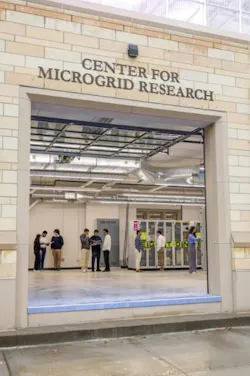
Kabalan and his team at the Center for Microgrid Research has secured more than $35 million in funding from contributors such as the National Science Foundation, U.S. Army Engineer Research and Development and the Minnesota Department of Commerce.
This accelerating support is focused on studying how microgrids can aid a utility grid system facing numerous infrastructural, weather and industrial demand challenges.
“If the grid goes down, or something really bad happens, like a natural disaster or a cybersecurity attack on infrastructure, you need to keep the lights on,” U.S. Rep. Betty McCollum said. “You need to keep the drinking water safe.”
Kabalan has partnered with many other groups to further the microgrid research at St. Thomas. These collaborators include power generation equipment firm Cummins, the National Laboratory of the Rockies (formerly National Renewable Energy Laboratory), CDW and Bright Green, which previously contributed $2 million in funding to support the center and Kabalan’s position.
The microgrid work is critical to preparing a new generation of electrical engineers for understanding and developing expertise in on-site and behind-the-meter power solutions, Kabalan has noted in past conversations. This statement is backed up by reports from the American Society of Civil Engineers and others which warn that utility-scale and macro U.S. energy infrastructure is perhaps a trillion dollars behind in upkeep and upgrade.
“We are educating the engineers that we need to run the grid of the 21st century,” Kabalan told StateTech in a 2025 interview. “We’re going to cover that in the textbook, and guess what? We’re going to go down to the basement and check out how this equipment actually works in real life. It provides a very unique, hands-on, real-world experience for our students.”
Growing the university research footprint
The new work expanded the St. Thomas Center for Microgrid Research by 6,000 additional square feet. The first floor can support up to 45,000 pounds of weight, allowing the facility to accommodate on-site research into electric buses and container-size grid systems, the university release noted.
An outdoor segment includes grid-level battery energy storage and load bank capacity.
“How do you get products from different companies and make them work together?” Kabalan said in his statement on the university website. “That is the trillion-dollar question.”