When the Grid Can’t Wait: Unlocking Existing Solar Capacity with DC-Coupled Storage
Key Highlights
- DC‑coupled energy storage enables solar project owners to bypass interconnection bottlenecks by capturing clipped energy and adding capacity without increasing grid export or triggering lengthy restudies.
- By monetizing previously curtailed generation and shifting energy to higher‑value periods, DC‑coupled storage can materially improve project economics and create substantial incremental revenue from existing assets.
- With standardized system designs and expanding state and federal incentives, DC‑coupled storage has moved from a custom retrofit into a fast, repeatable, and economically compelling solution for accelerating grid capacity using infrastructure already in place.
As utilities, developers, and communities work to meet accelerating demand—from electrification to AI-driven load growth—one reality is becoming increasingly clear: the fastest megawatt is not the one waiting in an interconnection queue. It’s the one already built.
Across the U.S., existing utility-scale and community solar assets are quietly leaving value on the table. Not because of a lack of generation potential, but because of interconnection limits and inverter constraints that cap how much power can be exported to the grid at any given time. Industry research from organizations like National Renewable Energy Laboratory indicates that inverter clipping can result in 5% to 15% of annual energy production being curtailed, particularly in systems designed with higher DC-to-AC ratios to maximize output.
DC-coupled energy storage is emerging as one of the most practical and immediate ways to recover that lost value—while addressing one of the industry’s most persistent barriers: interconnection.
Bypassing the interconnection bottleneck
In regions served by organizations like PJM Interconnection and CAISO, interconnection timelines now routinely stretch two to four years, according to publicly available queue data and market reports. Upgrade costs tied to those interconnections frequently exceed $200–$500/kW, creating both economic and scheduling challenges for new projects.
DC-coupled storage offers a fundamentally different approach.
By integrating battery storage on the DC side of an existing solar array—behind the inverter—developers can capture excess production that would otherwise be clipped, store it, and dispatch it later without increasing the system’s AC export capacity. Because the grid only “sees” the inverter’s maximum output, the addition of storage does not necessarily change the facility’s impact on the grid.
Because DC-coupled storage operates behind the existing inverter and does not increase AC export at the point of interconnection, many projects can be deployed without triggering full interconnection restudies—particularly when charging is limited to on-site solar generation. While requirements vary by market and utility, this approach is increasingly recognized as a non-material modification, aligning with emerging frameworks that allow storage to utilize surplus capacity behind existing assets.
The result is a meaningful acceleration in deployment timelines. What might take several years as a new interconnection-driven project can often be completed in less than twelve months as a retrofit. In a market where speed to power is increasingly critical, that difference is significant.
From custom engineering to repeatable solutions
Historically, adding storage to an existing solar asset required custom engineering, complex integration, and site-specific redesign. That is beginning to change.
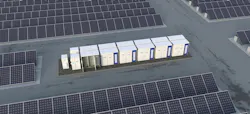
A new generation of integrated DC-coupled systems is simplifying deployment by combining DC-DC converters, modular battery enclosures, and advanced control platforms into standardized solutions. These systems are designed to integrate directly with existing PV infrastructure, reducing engineering complexity and enabling faster, more predictable installations.
Equally important is the evolution of controls. Modern energy management platforms—often built on cloud-based infrastructure such as Microsoft Azure—can dynamically coordinate solar generation, battery charging, and grid dispatch in real time. This enables operators to optimize system performance across multiple value streams while maintaining compliance with interconnection requirements.
For providers deploying these systems at scale, the shift toward integrated hardware and software is enabling a more repeatable model—one that aligns with how utilities and developers increasingly deploy infrastructure: modular, standardized, and rapidly scalable.
Turning lost energy into revenue
The economic case for DC-coupled storage begins with a simple premise: energy that was previously lost can now be monetized.
Consider a 10 MW community solar project producing approximately 18,000 MWh annually. If even 10% of that output is clipped, roughly 2,000 to 3,000 MWh per year is effectively unused. With DC-coupled storage, much of that energy can be captured and shifted to higher-value periods.
According to analysis from firms such as Lazard, electricity prices in many markets vary significantly throughout the day, with peak pricing often two to three times higher than midday solar generation periods. By shifting energy into those higher-value windows, storage can materially increase revenue.
When combined with additional value streams—such as capacity payments, demand charge reduction, or participation in ancillary services markets—the financial impact becomes substantial. In many markets, a system pairing 10 MW of solar with a 5 MW / 20 MWh battery can generate $350,000 to $650,000 in incremental annual value, depending on local market conditions.
Even without incentives, this can support payback periods in the high single digits. With incentives, the economics shift significantly.
Incentives are accelerating the tipping point
Policy support is playing a critical role in accelerating adoption.
States like Illinois have implemented incentive structures that significantly reduce the cost of deploying storage alongside solar, particularly within community solar programs.
At the federal level, the Investment Tax Credit—expanded under the Inflation Reduction Act—now applies to standalone storage and can be further enhanced through domestic content and energy community adders.
Combined, these incentives can offset a substantial portion of project costs—often in the range of 60% to 80%. This dramatically improves project returns.
Systems that might otherwise see payback periods of eight to twelve years can achieve payback in as little as three to five years, with internal rates of return rising into the high teens or beyond. For asset owners, this transforms storage from a long-term optimization into an immediate value creation opportunity.
More than an asset upgrade—A grid solution
While the project-level economics are compelling, the broader system benefits are equally important.
DC-coupled storage increases the effective capacity of existing solar assets without requiring new transmission or distribution upgrades. It improves hosting capacity, reduces peak loading on local infrastructure, and provides a flexible resource that can respond to real-time grid conditions.
For utilities facing rapid load growth—whether from data centers, electrification, or population expansion—this approach offers a scalable way to add capacity quickly and cost-effectively.
For communities, it enhances resilience by enabling local energy resources to support critical loads during outages. In this way, DC-coupled storage is not simply an enhancement to existing assets. It is a strategic tool for accelerating the energy transition using infrastructure that is already deployed.
The fastest path forward
The past decade has been defined by the rapid buildout of new renewable generation. The next phase of the energy transition will require maximizing the value of that existing infrastructure.
DC-coupled energy storage sits at the intersection of speed, economics, and grid impact. It enables developers to bypass interconnection constraints, unlock stranded energy, and deliver new capacity in a fraction of the time required for greenfield projects.
At a moment when the grid needs more power—faster than ever—the opportunity is clear: The most valuable megawatts may not be the ones still waiting to be built, but the ones already connected—ready to be unlocked.
AUTHOR
Aron Bowman is President of ELM Microgrid, a U.S.-based manufacturer of modular energy storage systems. ELM’s solutions are supported by its FieldSight™ Energy Management System, a cloud-based platform designed to optimize performance, dispatch, and lifecycle management across distributed energy assets.
This content is sponsored by: