CERAWeek Day One Takeaway: Behind-the-Meter Power is Critical for AI Growth
HOUSTON –Taking the lead in the AI race may mean starting from behind, energy-wise.
As in behind-the-meter, doing data center and artificial intelligence factory-connected power projects as their own entity and getting in front of the slow utility interconnections. Once they’ve delivered speed-to-power for hyperscalers willing to pay a premium, those power generation assets can eventually be interconnected to the grid.
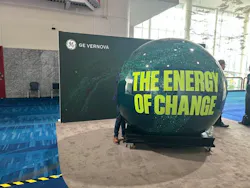
It's a flip for the old energy dynamic but now one of the commonly repeated themes from the first day of the CERAWeek 2026 conference which started Monday in downtown Houston. Perhaps the most important energy event in the U.S. from a global and geopolitical and multi-sector perspective, CERA Week expounds on many things, but the intersection of distributed energy and AI was crossed over and over again as it kicked off.
Grid edge is where the action is

Call them microgrid projects. Call them energy parks or co-located power generation, but you must call them into reality as quickly as possible, according to the demands of the nation’s digital infrastructure drivers such as Google, Microsoft, Amazon, Meta, Oracle, Apple and IBM, to name some.
“The world is changing in ways none of us can predict,” Ernest Moniz, a trained nuclear physicist who was the U.S. Energy Secretary under President Obama and now heads up two advocacy groups pushing for greater nuclear and natural gas adoption.
“The grid edge is where the action is,” Moniz said during a session at CERAWeek’s New Energies Hub. “They want to add as much captive power as possible. It will lead to a lot more projects behind-the-meter.”
The mergers and acquisition activity around distributed energy, which includes natural gas-fired generation done as on-site prime power, is showing the long-term financial belief in the concept of “speed to power.” BlackRock’s Global Infrastructure Partners and EQT are partnering to buy power generation utility AES, while Google acquired developer Intersect Power.
Tulsa-based natural gas infrastructure firm Williams Cos., which owns and operates an interstate system of pipelines serving utilities throughout the southern and eastern U.S., started up its New Energy Ventures and Power Innovations division to pursue these kinds of accelerated transactions with commercial and industrial sector customers.
“Our natural gas infrastructure is positioned to deliver speed to power,” Jaclyn Presnal, vice president of Williams’ New Energy Ventures Group, said during a later New Energies Hub session Monday afternoon at CERAWeek. Our natural gas infrastructure is positioned to deliver speed to power.
“The pipelines are in place and natural gas is abundant,” Presnal added. “A common request (from new industrial customers) is ‘as fast as possible.’”
Hyperscalers want speed to power and willing to pay for it
Now that’s speed-to-power demand. The power grid is not currently constructed to deliver that kind of pace from design to commissioning, so hyperscalers and other industrial customers are willing to pay up to deploy sooner and interconnect later.
“What’s different about this cycle is bankable off-takers with hyperscalers,” Eve Hanson, senior vice president of research and innovation with ventures investor Energy Impact Partners. “They are dictating how quickly things are going to come online.”
Companies already working on off-grid projects include data center developers Pacifico Energy, Fermi America, NScale, Creekstone Energy, Cyrus One and others. These are GW and billion-dollar scale projects advancing the announced U.S. goal to win the global AI race and, hopefully, deliver macro-grid resilience and services from the edge.
The grid is struggling and outdated for current challenges, as the American Society of Civil Engineers and others have told us. AI is not the only driver of this—the grid operators have been warning of capacity issues before ChatGPT became a thing—but the hypersonic growth in use of AI and automation in the so-called Industrial Compute Age is making it a critical issue.
“Everybody is using it and interacting with it in a real way right now,” Conner Prochaska, who is director of the U.S. Department of Energy’s Advanced Research Projects Agency-Energy, said early in the CERAWeek’s slate of sessions. “It’s here, we’re doing it and we need to make sure we have energy for it.”
CERAWeek continues through Thursday at the George R. Brown Convention Center and Hilton Americas Hotel in downtown Houston. It is owned, organized and operated by S&P Global.
A Grid in Peril and Resiliency Lives at the Edge
New and Free E-Book from Microgrid Knowledge
About the Author
 Rod Walton, Microgrid Knowledge Managing Editor
Rod Walton, Microgrid Knowledge Managing Editor
Managing Editor
For Microgrid Knowledge editorial inquiries, please contact Managing Editor Rod Walton at [email protected].
I’ve spent the last 18 years covering the energy industry as a newspaper and trade journalist. I was an energy writer and business editor at the Tulsa World before moving to business-to-business media at PennWell Publishing, which later became Clarion Events, where I covered the electric power industry. I joined Endeavor Business Media in November 2021 to help launch EnergyTech, one of the company’s newest media brands. I joined Microgrid Knowledge in July 2023.
I earned my Bachelors degree in journalism from the University of Oklahoma. My career stops include the Moore American, Bartlesville Examiner-Enterprise, Wagoner Tribune and Tulsa World, all in Oklahoma . I have been married to Laura for the past 36-plus years and we have four children and one adorable granddaughter. We want the energy transition to make their lives better in the future.
Microgrid Knowledge and EnergyTech are focused on the mission critical and large-scale energy users and their sustainability and resiliency goals. These include the commercial and industrial sectors, as well as the military, universities, data centers and microgrids. The C&I sectors together account for close to 30 percent of greenhouse gas emissions in the U.S.
Many large-scale energy users such as Fortune 500 companies, and mission-critical users such as military bases, universities, healthcare facilities, public safety and data centers, shifting their energy priorities to reach net-zero carbon goals within the coming decades. These include plans for renewable energy power purchase agreements, but also on-site resiliency projects such as microgrids, combined heat and power, rooftop solar, energy storage, digitalization and building efficiency upgrades.