Getting Closer to the Edge: How Modular and Distributed Generation Can Transform Power Infrastructure
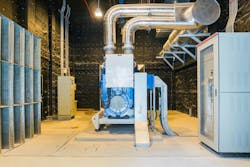
Want energy resiliency? Get closer.
That’s the tune that more commercial and industrial customers are telling not only the power utilities which traditionally met those prime power demands, but also the refrain also hums in the ears of distributed energy and microgrid developers and generation partners alike.
Co-location and on-site power? C’mon now, get closer.
“What is happening in real time right now is that the utility grid model hasn’t changed in 135 years, and the reality is that model is no longer going to work,” Brian Melka, president and CEO of industrial and home generator provider Rehlko, formerly Kohler Energy, told Microgrid Knowledge in an exclusive interview.
“Whether it’s aging infrastructure, considering that 60% to 70% of that infrastructure needs to be replaced, and demand is changing,” Melka added. “What’s driving this is for energy production, consumption and management much closer to where the demand is.”
The center is crumbling but the edge is holding
That driving force is the commercial and industrial customer, whether its data centers, industrial computing and manufacturing facilities or even residential consumers seeking more control over their own power resiliency. Data shows that long-distance transmission infrastructure is in desperate need of upgrade, and a build-out at the edge of the grid could help avoid inefficient costs accruing down the road.
Wisconsin-based Rehlko is an old hand at distributed generation, despite the new name. The larger Kohler Industries spun off and rebranded its generator business last year so the parent company could focus on its core home product lines.
The Kohler brand of generators and home power solutions is more than a century old, and why not change the name because the game is evolving into something brand new and a nod to the past at the same time. Centralized utility generation is still a marvel but honestly it was built and has remained a 20th-century tool for 20th-century problems.
Nearly everything must change at the edge and nearer the meter. Backup power can evolve into prime power, the grid interconnection can evolve into off-grid and distributed, decentralized energy choices could become more of the norm than the exception.
“Power plants hundreds of miles away—we don’t believe that is the future,” Rehlko’s Melka said. “Right now, speed-to-power is a No. 1 issue in a lot of industries, especially data centers. Speed-to-power is a problem, a real challenge.”
It’s hardly just AI and EVs
Data centers currently consume close to 5% of national utility-scale electricity generation. If nothing changes—meaning that utilities and developers don’t match up by building more power capacity of diverse resources such as natural gas, nuclear and renewables—that average will be closer to 25%.
Some call this scaremongering and hype; some call this bubble building by investors. A rising tide of consensus, however, calls it an immediate and inevitable challenge that will only get worse if not faced and solved sooner than later.
“If you take nothing else away, take this: This world and this country will get more electrified,” Aamir Paul, president of North America operations for global energy management giant Schneider Electric, said during his company’s Innovation Summit in Las Vegas last month.
“In 2025 industrial electricity demand surges 15%,” Paul pointed out. “The U.S. must absorb 1,000 terawatt hours of added demand in the next 10 years.”
If the nation cannot do that, it must ready itself for widespread energy unaffordability, load shedding and failure to keep up with technology supremacy on the world stage. Once again, previous long-term load projections predicted flat load growth, so these futurists can be wrong.
But what if they are not? Energy leaders must get closer to the problem and figure it out. We may not know who’s right for 10 years.
Rehlko-Kohler has worked with Schneider Electric and many other partners on distributed energy solutions, so together they have reached an agreement on what might be coming.
Even if a portion of AI projects are purely hyped, it’s just a part of all the other rising demand scenarios.
“Power is going up 1% annually for the average home,” Rehlko CEO Melka pointed out. “That doesn’t sound like a lot until 10 to 15 years go by. And we haven’t even hit that yet.
“AI is still a small percentage of overall power,” he added. “There is the underlying demand coming from cloud-based computing, other factors in the commercial and industrial space, and you still see double-digit increases annually even before you add in AI.”
Opportunity knocks for modularity and standardization
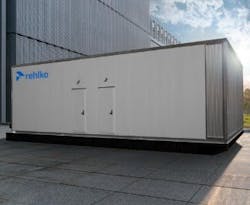
Rehlko and its financial backers are investing in the idea that the rising demand scenario is ever closer. The company has acquired United Kingdom back-up power firm The Wilmott Group and is collaborating with Toyota Motor North America to develop a hydrogen-power fuel cell system for a hospital in Washington state.
Getting closer also means getting smaller or at least building out energy capacity in layers of modularity. Standardization, modularity and co-location are key goals in the energy transition.
“We’re driving modularity,” Melka said. “A 1-GW data center doesn’t fire up as 1 GW—it fires up as 50 MW, then another 50 MW.”
This means more power in a smaller footprint, a shift that is happening with Rehlko, Cummins Inc. and other gen-set producers such as Innio.
“Essentially I want Lego blocks,” Rehlko’s CEO added. “How do I build modular units as we scale power on the campus over time?”
Every step gets the industry closer to an answer.
About the Author
 Rod Walton, Microgrid Knowledge Managing Editor
Rod Walton, Microgrid Knowledge Managing Editor
Managing Editor
For Microgrid Knowledge editorial inquiries, please contact Managing Editor Rod Walton at [email protected].
I’ve spent the last 18 years covering the energy industry as a newspaper and trade journalist. I was an energy writer and business editor at the Tulsa World before moving to business-to-business media at PennWell Publishing, which later became Clarion Events, where I covered the electric power industry. I joined Endeavor Business Media in November 2021 to help launch EnergyTech, one of the company’s newest media brands. I joined Microgrid Knowledge in July 2023.
I earned my Bachelors degree in journalism from the University of Oklahoma. My career stops include the Moore American, Bartlesville Examiner-Enterprise, Wagoner Tribune and Tulsa World, all in Oklahoma . I have been married to Laura for the past 36-plus years and we have four children and one adorable granddaughter. We want the energy transition to make their lives better in the future.
Microgrid Knowledge and EnergyTech are focused on the mission critical and large-scale energy users and their sustainability and resiliency goals. These include the commercial and industrial sectors, as well as the military, universities, data centers and microgrids. The C&I sectors together account for close to 30 percent of greenhouse gas emissions in the U.S.
Many large-scale energy users such as Fortune 500 companies, and mission-critical users such as military bases, universities, healthcare facilities, public safety and data centers, shifting their energy priorities to reach net-zero carbon goals within the coming decades. These include plans for renewable energy power purchase agreements, but also on-site resiliency projects such as microgrids, combined heat and power, rooftop solar, energy storage, digitalization and building efficiency upgrades.