Touching Down at JFK: New Terminal One Microgrid Nears Completion

The famous New York international airport which once welcomed both the Beatles and the Concorde to the United States of America is getting a $19 billion facelift and historic microgrid which are changing the way projects interact with the environment around them.
Schneider Electric is a leading contributor to the JFK International Airport New Terminal One renovation project and this month released an ESG update with help from teammates with SE Advisory Services.
The JFK Terminal One ESG report is focused on decarbonization innovations, including key elements of the massive on-site energy reinvention that is the JFK Terminal One microgrid. It consists of a 7.7-MW rooftop solar array, 2.76 MW of fuel cell capacity and battery storage backup which are designed to handle up to 50% of the projected 2050 energy demand.
All of that happens while the JFK New Terminal One, which opens its first phase next year, eventually handles about 23 million passengers annually.
“We are targeting opening between the end of the year and first quarter 2027, and a date will be announced in partnership with the Port Authority of New York and New Jersey,” said Uzoamaka N. Okoye, chief of staff of New Terminal One at JFK, in response to questions submitted by Microgrid Knowledge. “Operations will begin with our Phase A, which includes the new arrivals and departure halls and the east pier with the first 14 gates.”
AlphaStruxure is leading the microgrid development at the airport. This involves intense coordination with JFK New Terminal One and airport manager Port Authority of New York and New Jersey.
Orchestrating microgrid and airport renovation requires harmony

Phase A of the New Terminal One includes the first 14 gates of the new arrivals and departure halls. Mechanical completion of the JFK airport microgrid could be in the third quarter this year.
That’s a lot of moving parts, not counting ground crews, passengers and jets all around.
“We coordinate all construction activity closely with the Port Authority and other terminal partners, ensuring that disruptions for travelers are minimized while safely advancing the most ambitious aviation infrastructure project in the United States. We also work very closely with our design-builder and all third-party contractors to align and integrate construction activities,” Okoye said. “Delivering a complex infrastructure at this scale is akin to conducting an orchestra and we are well-positioned with the support and expertise across all of our partners.”
Achieving this harmoniously was made possible with years of pre-planning and coordination from parties including airport leaders, the Port Authority, Schneider Electric, AlphaStruxure and other contracted partners. The sustainability strategy at the heart of the work includes decarbonizing energy operations through the solar-storage and fuel cell microgrid while also reducing energy consumption within the built environment of New Terminal One by numerous LEED-certified efficiency measures.
The ultimate landing point is to reduce Scope 1 and 2 greenhouse gas emissions by 80% in 2050 compared to the 2006 baseline, according to the Schneider Electric ESG update.
“Some emissions metrics fully mature once the terminal is operating with real-time data, so building that measurement backbone early is essential to being both operationally ready and audit ready,” JFK New Terminal One’s Okoye told Microgrid Knowledge. “Having the support of all stakeholders – from our financial sponsors to our public partner at the Port Authority of New York and Jersey – was critical.
“Installing proven but atypical technology such as fuel cells and covering our terminal’s roof with photovoltaic panels requires not only a vigorous design and approval process but also forward thinking and support by all involved,” she added.
Hybrid project unites solar, batteries and H2 fuel cells
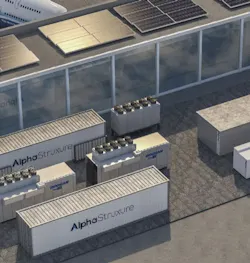
The 7.7-MW solar project is one of the largest rooftop arrays in New York. What makes the future microgrid different is the inclusion of fuel cell technologies, which use an electrochemical process to convert fuel to electricity without carbon emissions.
Fuel cells can work using natural gas and carbon-free hydrogen. Okoye noted that the Phase A program includes six fuel cells and work is progressing toward mechanical completion by the third quarter.
“The electricity generated by the fuel cells is produced by extracting hydrogen from natural gas and then combining it with oxygen,” she said. “Natural gas is supplied through a high-pressure gas main which is regulated down to low pressure in the terminal’s meter and regulated room and is distributed to the power islands with the fuel cells located at ground level and on the roof of the terminal.”
The efficiency of the cycle and looped nature of the fuel cell component also take into account the heat produced in the power generation, utilizing that elsewhere within the New Terminal One.
“A key efficiency lever is heat recovery: the thermal energy produced by the fuel cells is captured and reused to generate chilled water via absorption chillers, or hot water via plate and frame heat exchangers,” Okoye added. “That’s what turns a generation asset into an efficiency asset at the same time.”
Airports know what’s it like not to have mission-critical power security
When the JFK New Terminal One microgrid project was announced about four years ago, its urgency was obvious because of the unnerving 11-hour power outage which had shut down Atlanta’s Hartsfield-Jackson Airport in 2017. If JFK suffers a grid outage in the future, the microgrid can activate independently to ensure continued operations at the famous international aviation hub.
Since then, airport microgrid projects have been undertaken in Dallas-Fort Worth, Pittsburgh and elsewhere.
“This project is paving the way for all transportation hubs and municipalities across the country. Not only is it about resilient energy, it’s about decarbonization, risk transfer and cost predictability via the energy-as-a-service business model,” AlphaStruxure CEO Juan Macias said during an initial project press announcement in January 2023.
AlphaStruxture is an energy-as-a-service microgrid developer jointly formed by Schneider Electric and private equity investor Carlyle Group. Energy-as-a-service developers pay for the project capital costs up front, as well as owning, maintaining and operating it. These providers gain their return through a long-term and predictable rate paid by the customer.
Work is on schedule for the first phase opening later this year. The entire project is aiming for completion by 2030.
Schneider Electric leads integration of microgrid and airport operations through its software, design, hardware infrastructure and digital twinning capabilities.
“The New Terminal One is designed to push the boundaries of sustainable airport infrastructure,” reads the Schneider Electric ESG report. “From generating solar energy onsite to reducing construction waste and harvesting rainwater, we’re integrating forward-looking solutions that match the scale of our operations and the urgency of environmental challenges.”
About the Author
 Rod Walton, Microgrid Knowledge Managing Editor
Rod Walton, Microgrid Knowledge Managing Editor
Managing Editor
For Microgrid Knowledge editorial inquiries, please contact Managing Editor Rod Walton at [email protected].
I’ve spent the last 18 years covering the energy industry as a newspaper and trade journalist. I was an energy writer and business editor at the Tulsa World before moving to business-to-business media at PennWell Publishing, which later became Clarion Events, where I covered the electric power industry. I joined Endeavor Business Media in November 2021 to help launch EnergyTech, one of the company’s newest media brands. I joined Microgrid Knowledge in July 2023.
I earned my Bachelors degree in journalism from the University of Oklahoma. My career stops include the Moore American, Bartlesville Examiner-Enterprise, Wagoner Tribune and Tulsa World, all in Oklahoma . I have been married to Laura for the past 36-plus years and we have four children and one adorable granddaughter. We want the energy transition to make their lives better in the future.
Microgrid Knowledge and EnergyTech are focused on the mission critical and large-scale energy users and their sustainability and resiliency goals. These include the commercial and industrial sectors, as well as the military, universities, data centers and microgrids. The C&I sectors together account for close to 30 percent of greenhouse gas emissions in the U.S.
Many large-scale energy users such as Fortune 500 companies, and mission-critical users such as military bases, universities, healthcare facilities, public safety and data centers, shifting their energy priorities to reach net-zero carbon goals within the coming decades. These include plans for renewable energy power purchase agreements, but also on-site resiliency projects such as microgrids, combined heat and power, rooftop solar, energy storage, digitalization and building efficiency upgrades.