Microgrids Need Rooftop Solar, and Solar Needs Permitting Reform
Key Highlights
- - Permitting costs and delays can add $6,000-$7,000 to the cost of residential solar systems, discouraging adoption.
- - States like California and Texas are leading in policy reforms to streamline solar permitting processes and reduce bureaucratic hurdles.
- - Local governments often slow down permit approvals with inconsistent rules, handwritten applications, and site survey requirements.
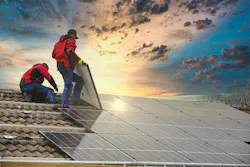
Microgrids often include rooftop solar deployed on homes. But one obstacle to installing more solar for microgrid projects is permitting.
Americans interested in installing rooftop solar and battery storage in their homes face bureaucratic hurdles that can add $6,000-$7,000 to the cost of a typical residential solar system, according to a report released by Permit Power, Environment America Research & Policy Center and Frontier Group. The Solar Permitting Scorecard ranks states on policies that overcome these hurdles.
In fact, homeowners cancel one in five home solar projects that start the permitting process, pointing to permitting delays as the cause. Delays can last from weeks to months, said Nick Josefowitz, founder and chief executive at Permit Power, a nonprofit that aims to overcome solar and energy storage permitting barriers.
“Unfortunately, for far too many American families, it is just far too expensive and far too complicated and time-consuming to get the permits and to go through the bureaucratic web to be able to just do a really simple thing, which is put solar on their roof, a battery in their garage,” he said States can make this process easier, he added. The scorecard ranks California and Texas as top states working to end bureaucratic red tape, giving them “B” grades.
California and Texas also take the two top spots for installed solar capacity, according to the Solar Energy Industries Association.
Local governments slow the permitting process and increase solar costs
Local governments tend to be the top culprits, he said. They often take a long time to process permits, their rules aren’t clear, and every local government has its own rules.
In addition, in some places, homeowners must walk a permit into city hall, which involves standing in line and waiting. The local government often drags its feet on providing feedback, and the homeowner has to go back again to make revisions.
What’s more, some governments require handwritten applications, call for notary signatures, or mandate site surveys, which can be expensive and time-consuming.
“It just takes an enormously long time, adds a huge amount of complication and expense, and it’s unnecessary,” he said.
The average American family spends $36,000 to install solar on their roof, while a family in Australia installing the same system spends $6,000. Much of the extra cost is permitting, inspections, homeowner association approvals and utility interconnection requirements.
Another report from Permit Power, As Cheap as Our Peers, found that by cutting these “soft costs” of installing solar, homeowner electricity bills could drop 61% by 2040—saving an average of $1,600 a year.
Plug-in solar faces permitting hassles, too
Less expensive, small systems such as plug-in solar–which can be installed by renters, homeowners and apartment owners– also face permitting challenges. But it’s illegal in all states except Utah and Virginia, Josefowitz noted.
“Of the recent bills coming out of Virginia, I think that accelerating balcony solar is likely the one that will have the most immediate impact on customers’ bills,” said Cameron Brooks, executive director of Think Microgrid, an advocacy group that focuses on policies affecting microgrids.
Other states and counties are taking on the red tape challenge
Pima County, Arizona, has instituted automated permitting, which allows solar installers to apply online for permits on behalf of their customers.
The software verifies that the solar system meets building codes and issues permits instantly. Inspections are completed remotely, with inspectors using FaceTime or other live video platforms, along with photos and videos submitted by homeowners.
It's an incredibly seamless process and it works really well for Pima County,” he said.
Automation is also at the heart of a Texas law, SB 1202, that allows licensed engineers and building inspectors to review solar plans on behalf of local governments, using automated tools for remote inspections, Josefowitz said.
In addition, New Jersey passed S 4100, which aims to speed up the approval process, requiring an online, automated permitting platform for rooftop solar and energy storage.
In 2022, California passed SB 379, which created instant, online solar permitting in counties with over 150,000 residents. The state has also instituted caps on fees to prevent local governments from charging excessive fees for permits to install home solar and battery projects. And it has limited reviews by homeowner associations, which often call for aesthetic requirements for solar systems.
This earned California a “B” grade, but it has more to do to expedite solar permitting, he said.
“There's still a lot more California can do, not just in terms of passing new laws, but also enforcing the ones that are already on the books,” Josefowitz said.
On March 25, California’s Joint Legislative Audit Committee called for a state audit of the California Public Utilities Commission’s oversight of utility delays in approving customer-sited solar and storage. The audit will determine whether the utility commission has ensured that utilities comply with mandated interconnection timelines.
Aiming for $1/watt solar cost
Cutting red tape could help the solar industry reduce solar costs to about $1 per watt, Josefowitz said.
“If we can get the cost of solar down in the U.S. to what we see in other developed countries, over 18 million American families would be able to access rooftop solar.
“And collectively, they would save over a trillion dollars on their utility bills over the life of their solar systems,” he said.
How DERs Are Earning Their Place in the Grid Market
EnergyTech QuickChat with PowerSecure
About the Author
 Lisa Cohn
Lisa Cohn
Contributing Editor
I focus on the West Coast and Midwest. Email me at [email protected]
I’ve been writing about energy for more than 20 years, and my stories have appeared in EnergyBiz, SNL Financial, Mother Earth News, Natural Home Magazine, Horizon Air Magazine, Oregon Business, Open Spaces, the Portland Tribune, The Oregonian, Renewable Energy World, Windpower Monthly and other publications. I’m also a former stringer for the Platts/McGraw-Hill energy publications. I began my career covering energy and environment for The Cape Cod Times, where Elisa Wood also was a reporter. I’ve received numerous writing awards from national, regional and local organizations, including Pacific Northwest Writers Association, Willamette Writers, Associated Oregon Industries, and the Voice of Youth Advocates. I first became interested in energy as a student at Wesleyan University, Middletown, Connecticut, where I helped design and build a solar house.
Twitter: @LisaECohn
Linkedin: LisaEllenCohn
Facebook: Energy Efficiency Markets