Why a Microgrid Didn’t Pencil Out in this California Advanced Energy Community.
The California Energy Commission (CEC) has been working for nearly 10 years, along with numerous partners, to create pilot advanced energy communities that integrate distributed energy resources and microgrids at the community level.
At a Feb. 19 symposium organized by The Climate Center, project participants described four efforts, funded by the CEC, in various stages of development.
In one of them, the Oakland EcoBlock project, a proposed microgrid wasn’t economically feasible. It would have fared better with a community microgrid tariff that valued resilience, critical services in the block studied and more support given by state regulators and Pacific Gas & Electric (PG&E), researchers said.
Developing a grid of the future
The aim of the advanced energy communities effort is to create a concept for the grid of the future, said The Climate Center CEO Ellie Cohen.
“This would be an electricity system built from the bottom up, with hundreds of advanced energy communities, thousands of microgrids and millions of clean, distributed energy resources, intelligently orchestrated and working seamlessly together,” she said during the symposium.
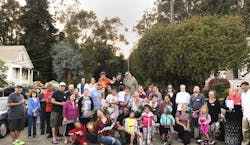
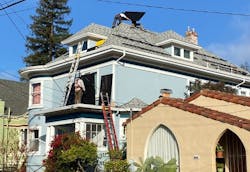
The Oakland EcoBlock project is designed to demonstrate the technical, social, legal and financial strategies for decarbonizing cities by retrofitting neighborhood blocks. The project is led by the California Institute for Energy and Environment, and the Banatao Institute at University of California Berkeley, and primarily funded by the CEC.
Initially EcoBlock–25 units on 15 properties– included a microgrid.
A proposed microgrid with its own distribution system
“We wanted to install our own distribution system on the block and have a ‘master meter’ at the point of common coupling, but there was no support at Pacific Gas & Electric (PG&E) or the California Public Utilities Commission for this approach,” said Rich Brown, academic researcher at the California Institute for Energy and Environment in an email.
The project participants scrubbed the distribution system idea, and in the final version of the microgrid proposal, the microgrid included about 100 kW of rooftop behind-the-meter solar with a 125 kW/250kWh front-of-meter battery located on private property at one of the participating residences, Brown said.
Under that proposal, PG&E would own and operate the distribution system and the microgrid recloser. A curbside electric vehicle (EV) charger for a shared EV would also be served from the PG&E service on the block so the charger could be energized during an outage, he said.
The plan was to use Heila Technologies for the microgrid controller, with home energy management systems in each home to manage the loads while the microgrid was islanded.
Researchers set up a cooperative to own and operate the microgrid.
Under the proposal, during a power outage, PG&E would flip a switch and the rooftop solar, battery, central battery and a grid forming inverter would form a microgrid to supply lights, heat, air conditioning and other critical electric service to all the homes on the block, as well as the EV charger.
Why the EcoBlock microgrid didn’t make economic sense
Ultimately, the microgrid didn’t make financial sense, said Therese Peffer, associate director, California Institute for Energy & Environment.
The microgrid cost came in too high because PG&E’s estimated costs were unexpected, the battery shed in a proposed tight space was expensive–including sound mitigation and air conditioning–and some costs were unknown.
“PG&E could not predict the cost of certain equipment--the prices were volatile,” Peffer said in an email.
Also boosting the cost were COVID delays and inflation, which led to a reprioritization of funding.
An additional factor determining the no-microgrid decision: A block in Oakland may have been interesting from a research perspective, but not might be the best use case.
With a neighborhood critical facility, more microgrid value
The microgrid would have been more valuable if the project included a critical facility that would value the power resilience–-a hospital, police or fire station for example, Peffer said. Resilience would also be valuable in an area that experiences more power outages.
In addition, commercial properties such as a retail strip mall near a residential area with higher energy costs would have improved the economics, as would a new construction project, she said.
A successful microgrid deployment would need a higher value of resilience, possibly through a tariff structure, Peffer added.
The economics of the California investor-owned utilities’ Community Microgrid Enablement Tariff (CMET) also made the project hard to justify financially, Brown and Peffer said. CMET only provides value from the microgrid during an outage affecting the wider grid. “There is no value during blue sky conditions (the microgrid essentially doesn’t exist in blue sky),” Brown said.
A microgrid tariff would be helpful
This is a common complaint from community microgrid proponents in California.
"Oregon and other states are far ahead of California in enacting policy to enable the construction of microgrids needed to withstand the increasing frequency and severity of extreme weather events we can expect because of climate change that will knock out the grid," said Kurt Johnson, community energy resilience director at The Climate Center.
In 2025, Oregon passed HB 2065 and HB 2066, which support microgrid development by creating resiliency corridors and boosting community powers.
During the symposium, participants stressed the need for policy reforms, including
revising Public Utilities Code 218 to allow over-the-fence connections to deploy community microgrids at scale, Johnson said.
Right now, it’s very difficult to install community microgrids in California because of this and other policies.
The rule prohibits private entities from distributing electricity across property lines to more than two adjacent customers. The entities would have to be regulated as a public utility.
Advanced energy communities projects include VPPs
Along with the EcoBlock project, participants at the symposium described:
1. The Bassett Avocado Heights Advanced Energy Community, a low-income community in eastern Los Angeles County. A team of local nonprofits, community organizations and energy technology leaders developed community-scale renewable energy to decarbonize households, boost EV infrastructure and introduce zero-emissions EV mobility options.
2. The Lancaster Advanced Energy Community, which studies projects in the service area of Lancaster Energy to boost community resilience through community microgrids and virtual power plants (VPP). Project participants established a community-focused VPP operated by a community choice aggregation and enrolled distributed energy resources at three customer sites, creating community resilience hubs.
3. The Richmond Advanced Energy Community, a pilot project that uses a VPP that’s owned and operated by MCE Community Choice Energy to boost grid reliability and resilience and support decarbonization. The project aimed to demonstrate that it’s possible for community choice aggregations to integrate with California Independent System Operator markets and reduce their costs through active load shaping via VPPs.
During the symposium, Erik Stokes, chief of staff to CEC Commissioner Noemi Gallardo, summed up the aim of the advanced energy communities project, saying, “The goal was to create space for communities to develop and test new approaches to planning, financing and coordinating distributed energy resources in ways that could reduce costs, expand access and make integrated deployment practical at scale.”
About the Author
 Lisa Cohn
Lisa Cohn
Contributing Editor
I focus on the West Coast and Midwest. Email me at [email protected]
I’ve been writing about energy for more than 20 years, and my stories have appeared in EnergyBiz, SNL Financial, Mother Earth News, Natural Home Magazine, Horizon Air Magazine, Oregon Business, Open Spaces, the Portland Tribune, The Oregonian, Renewable Energy World, Windpower Monthly and other publications. I’m also a former stringer for the Platts/McGraw-Hill energy publications. I began my career covering energy and environment for The Cape Cod Times, where Elisa Wood also was a reporter. I’ve received numerous writing awards from national, regional and local organizations, including Pacific Northwest Writers Association, Willamette Writers, Associated Oregon Industries, and the Voice of Youth Advocates. I first became interested in energy as a student at Wesleyan University, Middletown, Connecticut, where I helped design and build a solar house.
Twitter: @LisaECohn
Linkedin: LisaEllenCohn
Facebook: Energy Efficiency Markets