Footprint Project: From Disaster-Relief Do-Gooders Funded by Donations to RFP-Issuing Microgrid Providers
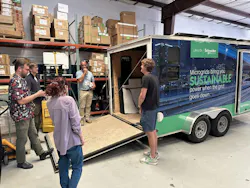
When brothers Will and Nate Heegaard and colleague Jamie Swezey founded the Footprint Project in 2018, they were three hopeful do-gooders with a goal of delivering portable solar microgrids to areas hit by hurricanes and other disasters.

The official creation of the nonprofit followed the founders’ initial work in Puerto Rico after Hurricane Maria destroyed the grid in 2017, knocking out power to 100% of 1.57 million accounts served by the Puerto Rico Electric Power Authority (PREPA), the island’s utility.
In its early years, the disaster relief organization arrived at the scene of emergencies with a truck, trailer and solar suitcases containing solar panels. Footprint Project depended on donations for support.
Doing good after Hurricane Idea, Winter Storm Uri and in Ukraine
The nonprofit has jumped into action to provide solar generators for communities affected by Hurricane Ida, for desperate Texans during the state’s February 2021 deep freeze and other crises. It also came to the rescue in Ukraine when the war with Russia broke out in February 2022, partnering with New Use Energy to send solar microgrids to Ukrainian hospitals and emergency power equipment to a refugee camp in neighboring Moldova.
No longer is Footprint Project a three-person operation fueled by donations. The number of full-time staff members has swelled to 18. With an annual budget of $2.9 million, the nonprofit has two warehouses, one in North Carolina and one in Louisiana, recently hired a Caribbean manager to work on recovery in Jamaica and is deploying assets in Hawaii, which has experienced heavy flooding.
RFP for a beehive in North Carolina

Funding has poured in, so much so that in March Footprint Project released a Request for Proposals (RFP) for microgrid “bees” and on April 8 issued an RFP for a microgrid “beehive.”
Under the organization’s model, a microgrid beehive, trademarked by Footprint Project, is composed of stationary microgrids that serve as the hive. A group of portable microgrids–known as the “bees”-can charge or discharge energy at the beehive and then travel where they’re needed. With this type of setup, the stationary microgrids have a permanent location, and the “bees” can be stationed at the beehive until they’re needed in the surrounding community.
Funding has come from the North Carolina Department of Environmental Quality State Energy Office–via the U.S. Department of Energy–which provided $5 million for the project, aimed at ensuring access to power during weather disasters. The Land of Sky Regional Council, a planning and development agency, provided $1.25 million to build the Western North Carolina beehive.
No longer a small nonprofit
“We've never before had the resources to bid out for beehive microgrid construction,” said Will Heegaard. “I used to say we're a small nonprofit. We can no longer say we're small.”
The RFP calls for proposals to design and manufacture a “mobile, deployable self-sustaining command center” or “hive” that will provide regional resiliency support in Western North Carolina. It will support a fleet of bees that address energy, water and cooling needs. The hive will consist of a 10 KW-40KW PV array, a 40 JWh-200kWh battery energy storage system, associated power electronics and storage and transportation of a forklift and other shipping and an optional generator backup sized 10 kW and above. The RFP also requests material handling equipment, a shaded, covered work area and an enclosed, lockable storage space.
Respondents can bid on one or more components of the package.
The challenge of Trump Administration policies
As Footprint Project has worked on this effort, one obstacle has been the Trump administration’s policies, including the rollback of the solar investment tax credit (ITC) and the foreign entity of concern requirements (FIAC), which exclude energy storage projects from the ITC if their supply chain is linked to China, Russia, North Korea or Iran. That has slowed Footprint Project’s latest grant.
“If we had done this with Biden-era funding, it would be faster and better,” Will Heegaard said. The organization can install a microgrid in Jamaica for a third of the cost that it can install a similar-sized system in the U.S. because of FIAC, the rollback of the solar ITC and increased costs related to President Trump’s tariffs.
Despite the obstacles, Footprint Project is dedicated to serving communities hit by disasters and will continue to fund its work through individual donations, private philanthropy, public investment, creative financing, earned revenue streams, and donated equipment from the industry.
The dream of deploying microgrid beehives throughout the U.S.
The organization’s next step is to apply its learnings from North Carolina to create beehives in Louisiana, leveraging the partnerships it has there, then expand the network of beehives across the Gulf.
Footprint Project hopes to continue rolling out RFPs–as the organization attracts more funding–and the bees and beehives will be deployed in areas on the front lines of climate change, especially in coastal communities that need to build back quickly after disasters so they’re ready for the next hit.
“Based on how much we can expand this, we're looking at–fingers crossed–being able to do this in every state in the country. We don't have the money to do that yet. But the reality is, that’s our dream,” Will Heegaard said.
About the Author
 Lisa Cohn
Lisa Cohn
Contributing Editor
I focus on the West Coast and Midwest. Email me at [email protected]
I’ve been writing about energy for more than 20 years, and my stories have appeared in EnergyBiz, SNL Financial, Mother Earth News, Natural Home Magazine, Horizon Air Magazine, Oregon Business, Open Spaces, the Portland Tribune, The Oregonian, Renewable Energy World, Windpower Monthly and other publications. I’m also a former stringer for the Platts/McGraw-Hill energy publications. I began my career covering energy and environment for The Cape Cod Times, where Elisa Wood also was a reporter. I’ve received numerous writing awards from national, regional and local organizations, including Pacific Northwest Writers Association, Willamette Writers, Associated Oregon Industries, and the Voice of Youth Advocates. I first became interested in energy as a student at Wesleyan University, Middletown, Connecticut, where I helped design and build a solar house.
Twitter: @LisaECohn
Linkedin: LisaEllenCohn
Facebook: Energy Efficiency Markets