West Virginia's Microgrid Revolution: Powering AI Data Centers with Natural Gas and Battery Storage

An ambitious 2-GW gas-fired power project with strong backing from West Virginia political leaders has brought power generation equipment giant Caterpillar Inc. on board to eventually energize AI computing infrastructure with on-site microgrid power.
American Intelligence & Power Corp. (AIP) is contracting Caterpillar and its regional distributor, Boyd CAT, to deliver 2 GW of fast-response natural gas generator sets in support of the planned Monarch Compute Campus. The gas-fired gen-sets will be paired with battery energy storage systems designed to handle high-level demand loads from future artificial intelligence factories in Mason County.
Caterpillar and Boyd CAT are scheduled to deliver the initial gas-fired gen-sets from September through August 2027.
“This strategic alliance reflects a shared commitment to delivering reliable, scalable, and capital-efficient power solutions on an accelerated timeline,” said Daniel J. Shapiro, CEO of American Intelligence & Power Corp., in a statement. “Our design is purpose-built for AI data center operations, combining fast-response natural gas generation with battery energy storage to manage rapid load variability and deliver consistent power quality at scale. By leveraging our existing microgrid designation from the State of West Virginia, we can bring new capacity online quickly while supporting long-term grid reliability and resilience, without increasing rates or adding costs for existing utility customers.”
Political power boosting data center development in the Mountain State
West Virginia is not known for high-tech infrastructure compared with neighboring Virginia’s nation-leading concentration of data centers. The Mountain State, however, is situated above parts of the natural gas-rich Marcellus and Utica shales, while the region also has access to multiple fiber-optic lines.
West Virginia legislators and Gov. Patrick Morrisey last year signed into law the “Power Generation and Consumption Act” which some nicknamed “the governor’s microgrid bill.” The new microgrid and data center energy law was passed in tandem with House Bill 2002, which is intended to simplify and speed up the project permitting process.
The Power Generation and Consumption Act creates a certified microgrid program statewide to support new on-site power, utilize coal and natural gas and provide funding for capacity to stabilize the electric grid.
“The Power Generation and Consumption Act will make West Virginia the most attractive state in the country for data centers and help America better compete with China in the technology arms race of the future,” Gov. Morrisey said in a statement on the governor’s website after the bill’s passage last spring. “Combined with the one-stop shop permitting bill, companies will now be able to quickly build, expand, and increase job creation right here in West Virginia.”
Hybrid microgrid with gas-fired generators, battery storage and (maybe) hydrogen
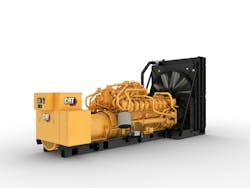
The Caterpillar G3516 fast-response natural gas generator sets are being deployed on-site for behind-the-meter applications to provide prime power. It is not known by post time whether the off-grid project planners will eventually interconnect into the primary utility grid system.
The G3516 platform can ramp from zero to full load in approximately seven seconds, supporting AI-driven workloads characterized by rapid load fluctuations and stringent power quality requirements, according to Caterpillar. The gensets will operate on natural gas and incorporate advanced emissions controls, including selective catalytic reduction (SCR), to support ultra-low emissions performance and compliance with all relevant air permitting requirements.
“This collaboration reflects Caterpillar and our dealers’ continued focus on supporting customers that require primary, continuous-duty power at scale through our broad energy solutions portfolio,” said Melissa Busen, senior vice president of Electric Power, Caterpillar. “Projects like Monarch demonstrate how Caterpillar’s natural gas generation platforms are being deployed as core infrastructure for data centers and other power intensive applications where reliability, speed of deployment, and lifecycle performance are critical.”
Fidelis New Energy originally announced the combined Monarch and Mountaineer Gigasystem project in 2023. The vision announced involved natural gas and renewable power generation to meet AI and cloud-computing load, with work toward hydrogen production also part of the long-term plan.
AIP’s website page about the Monarch Compute Campus touts its technology and political support with a tagline emphasizing “no regulatory interference or interconnection delays.” The rising need for AI computing power, yet challenged by lengthy utility and regulatory delays, is driving many cloud-based and AI-enabled technology companies to seek off-grid and microgrid prime power applications.
Speed to power is the aim in era of interconnection delays
Many microgrid developers, including new Enchanted Rock CEO John Carrington, are stressing the customer demand for “speed to power” and the increasing value of battery storage to help balance that energy generation mix.
New research indicates that AI is not a bubble when it comes to actual deployment in the commercial and industrial sectors. Reports by University of Pennsylvania’s Wharton Business School and other researchers agree that at least 70% of companies are already incorporating AI technologies into their businesses.
We firmly believe it is not a bubble,” James Lee, a partner at private equity giant BlackRock’s Global Infrastructure Partners, said during a keynote session on AI and energy at the Schneider Electric Innovation Summit in Las Vegas several months ago. “There are strong fundamentals, first in the rapid acceleration of adoption. . . That adoption is driving real revenue.”
And it is also driving hyperscalers such as Microsoft, Google, Amazon, Meta and Oracle to get off the energy sidelines and invest big in support for next-generation capacity both on the grid and possibly off-grid. These new power plants could be microgrids or co-located power plants, which the data industry sometimes calls energy parks, powered by natural gas and next-gen nuclear resources.
About the Author
 Rod Walton, Microgrid Knowledge Managing Editor
Rod Walton, Microgrid Knowledge Managing Editor
Managing Editor
For Microgrid Knowledge editorial inquiries, please contact Managing Editor Rod Walton at [email protected].
I’ve spent the last 18 years covering the energy industry as a newspaper and trade journalist. I was an energy writer and business editor at the Tulsa World before moving to business-to-business media at PennWell Publishing, which later became Clarion Events, where I covered the electric power industry. I joined Endeavor Business Media in November 2021 to help launch EnergyTech, one of the company’s newest media brands. I joined Microgrid Knowledge in July 2023.
I earned my Bachelors degree in journalism from the University of Oklahoma. My career stops include the Moore American, Bartlesville Examiner-Enterprise, Wagoner Tribune and Tulsa World, all in Oklahoma . I have been married to Laura for the past 36-plus years and we have four children and one adorable granddaughter. We want the energy transition to make their lives better in the future.
Microgrid Knowledge and EnergyTech are focused on the mission critical and large-scale energy users and their sustainability and resiliency goals. These include the commercial and industrial sectors, as well as the military, universities, data centers and microgrids. The C&I sectors together account for close to 30 percent of greenhouse gas emissions in the U.S.
Many large-scale energy users such as Fortune 500 companies, and mission-critical users such as military bases, universities, healthcare facilities, public safety and data centers, shifting their energy priorities to reach net-zero carbon goals within the coming decades. These include plans for renewable energy power purchase agreements, but also on-site resiliency projects such as microgrids, combined heat and power, rooftop solar, energy storage, digitalization and building efficiency upgrades.