Amentum to Develop Co-Located AI Data Center and Power Infrastructure at Savannah River National Laboratory

The National Nuclear Security Administration (NNSA) has selected engineering and consulting firm Amentum to develop a co-located artificial intelligence (AI) data center and on-site power generation project at the Savannah River National Laboratory site in South Carolina.
The choice of Virginia-based Amentum by NNSA, which operates as part of the U.S. Department of Energy, comes after a competitive request for proposals process initiated last year. DOE has identified its 16 federal sites which it decided could support construction and pairing of AI data centers and co-located energy infrastructure.
The so-called Savannah River Site Artificial Intelligence Infrastructure and Energy Generation Project, when realized, could generate the project’s electricity needs without shifting huge costs to utility customers, according to NNSA/DOE.
“This proposed partnership represents an opportunity to strengthen America’s leadership in artificial intelligence, expand reliable energy generation, and strengthen our national security,” said NNSA Administrator Brandon Williams in a statement. “By working with the private sector, we can move faster, apply innovative technologies, and make productive use of federal land while maintaining our commitment to mission delivery.”
Why AI needs so much power
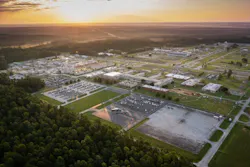
Amentum is contracted to lead construction of the data center and on-site power generation. No details were given about the types of generation which the on-site power would contain, but the DOE says the project could also increase availability of power to the grid.
“Artificial intelligence, energy resilience, and national security are becoming increasingly interconnected, creating new opportunities to strengthen America’s strategic advantage,” said Amentum CEO John Heller. “Amentum is uniquely positioned at that intersection, combining deep engineering expertise, trusted mission execution, and decades of partnership with the U.S. government. This agreement gives us the opportunity to partner with the NNSA to deliver infrastructure that will help power the technologies shaping our nation’s future.”
The combination of objectives in the Savannah River Site AI Infrastructure and Energy Generation Project could help solve several pressing challenges facing AI-led data center power. It is designed to accelerate domestic U.S. AI computing capacity and help the nation stay ahead in a global AI race, while also expanding power generation reliability and resiliency on-site.
Supercomputing in AI applications can consume multiple times more electricity than conventional data center load and creates wide-swinging transient load challenges. AI electricity consumption could quadruple its part of total global electricity use from 4% to 20% by 2035, according to analysis by the Penn State Institute of Energy and the Environment.
Data center experts predict that supercomputing racks are eventually accelerating to need as much as 1 MW each, while AI factories can require 1 GW in electricity capacity.
“The global race for AI dominance is the next Manhattan project, and with President Trump’s leadership and the innovation of our National Labs, the United States can and will win,” Secretary of Energy Chris Wright said earlier this year.
The NNSA is focused on the defense capabilities of nuclear power. Amentum was selected earlier this year to provide design and engineering services for Savannah River National Lab’s Tritium Finishing Facility. Tritium is a key element in nuclear weapons and is a critical element in fueling nuclear fusion experiments.
No immediate timeline was given on the Savannah River Site AI Infrastructure and Energy Generation Project. Amentum and NNSA will collaborate on expanding private sector partnerships in the projects.
Amentum is the second largest government services contractor in the U.S., after Leidos. It was spun out of infrastructure contract AECOM six years ago.
Live Tuesday and on Demand
Mastering Requirements, Standards and Risk
in a Digitally Transformed Energy Sector
Join us for July 21 EnergyTech Webinar with Siemens
About the Author
 Rod Walton, Microgrid Knowledge Managing Editor
Rod Walton, Microgrid Knowledge Managing Editor
Managing Editor
For Microgrid Knowledge editorial inquiries, please contact Managing Editor Rod Walton at [email protected].
I’ve spent the last 18 years covering the energy industry as a newspaper and trade journalist. I was an energy writer and business editor at the Tulsa World before moving to business-to-business media at PennWell Publishing, which later became Clarion Events, where I covered the electric power industry. I joined Endeavor Business Media in November 2021 to help launch EnergyTech, one of the company’s newest media brands. I joined Microgrid Knowledge in July 2023.
I earned my Bachelors degree in journalism from the University of Oklahoma. My career stops include the Moore American, Bartlesville Examiner-Enterprise, Wagoner Tribune and Tulsa World, all in Oklahoma . I have been married to Laura for the past 36-plus years and we have four children and one adorable granddaughter. We want the energy transition to make their lives better in the future.
Microgrid Knowledge and EnergyTech are focused on the mission critical and large-scale energy users and their sustainability and resiliency goals. These include the commercial and industrial sectors, as well as the military, universities, data centers and microgrids. The C&I sectors together account for close to 30 percent of greenhouse gas emissions in the U.S.
Many large-scale energy users such as Fortune 500 companies, and mission-critical users such as military bases, universities, healthcare facilities, public safety and data centers, shifting their energy priorities to reach net-zero carbon goals within the coming decades. These include plans for renewable energy power purchase agreements, but also on-site resiliency projects such as microgrids, combined heat and power, rooftop solar, energy storage, digitalization and building efficiency upgrades.