NVIDIA Leads $500 Billion Private Equity Investment in AI Infrastructure and Power Solutions
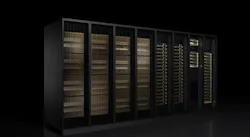
Last week, artificial intelligence chip and graphic processing unit giant NVIDIA flexed its financial muscles by announcing a new $500 billion partnership with some deep-pocketed private equity firms, known as Blackstone, BlackRock, Apollo, Brookfield, Goldman Sachs and KKR.
Half a trillion dollars of private funding is exercising tremendous confidence and strength, although individual AI factory projects still require regulatory and siting pathways to become reality. In essence, hyperscalers and other data center developers utilizing NVIDIA’s AI ecosystem products have more direct access to ample amounts of third-party financing “to create dedicated pools of capital at significant scale at attractive rates for NVIDIA customers,” according to the Blackstone release.
“Modern compute has emerged as a scarce, mission-critical asset class with compelling investment characteristics that is positioned to drive significant long-term economic growth and productivity gains,” said Apollo President Jim Zelter in the joint statement.
The world’s biggest private equity investment entities are ready and amply supplied to get in front of the AI revolution, and they see NVIDIA as the clear operational infrastructure leader of the pack.
“We’re in a pivotal moment of a historic AI investment cycle. NVIDIA’s full stack platform is in high demand and uniquely positioned at the center of that global buildout,” said David Solomon, Chairman and CEO of Goldman Sachs. “Our investment and distribution roles reflect our confidence in NVIDIA’s leadership, and we’re excited for the new opportunity to create a market for credit backed by NVIDIA compute."
AI is the dollars, electricity is the promise of completion
They may have the multi-gigawatt financing plan secured, but what about the must-have electrons? Who supplies the energy side of this AI computing revolution? This question is as critical as any part of the financial answers potentially offered in this memorandum of understanding between NVIDIA and the private equity titans.
Building AI factories at anticipated future 1-GW scale may cost $60 billion each in construction and operational costs, according to varied reports. Among those tasks—and the major roadblocks for getting the projects up and running—is several billion dollars in potential costs for building out each co-located and dedicated gas-fired powered and electrical equipment required to make AI run, according to NVIDIA founder Jensen Huang and research groups such as Stanford, Cushman & Wakefield.
Why do AI factories consume so much more energy than a traditional data center or cloud computing storage site? Because, in all honesty, there are two different things moving at two different paces.
As NVIDIA’s Rev Lebaredian, vice president of Omniverse and Simulation Technology, explained it as last year’s Schneider Electric (SE) Innovation Summit North America, a traditional data center is essential a warehouse which can be accessed with relatively minor computing power, while an AI factory is an intensely power-consumptive manufacturing and refining center where that data is intensively and often instantaneously distilled into a new product entirely, formed around the frequency and processing needs of prompts and millisecond supercomputing power.
“You put into a factory all the raw materials and energy, and all the raw materials are reconfigured into it and out comes a refined production that is better than all of its parts,” Lebardedian said at the SE summit last November in Las Vegas. “With the factory you want to maximize the density as much as possible.”
Grid constraints do not compute
Each 1-GW AI factory requires at least the same GW level of power capacity but even more in total generation supply plus flexible and often direct-current assets such as battery storage to deal with huge transient loads in AI computing activity.
Where is this new power generation capacity going to come from considering the U.S. has an electric grid dealing with capacity restraints in the PJM, MISO, ERCOT and other interconnections? The answer could be a wave of co-located or even behind-the-meter power plants, as the Federal Energy Regulatory Commission and U.S. Department of Energy push grid system operators to streamline the pathway for more decentralized and yet giga-scaled power generation.
“All of the FERC commissioners want action on the transmission grid integration of large loads and co-located generation quickly and they will not be tolerant of much deviation from their identified reforms,” said Eric Runge, who is an attorney within the national energy practice group of law firm Day Pitney LLP, in an exclusive interview with Microgrid Knowledge posted last week.
“Rapid development and implementation of tariff provisions to accommodate large loads, such as data centers, and their supporting co-located generation will be a FERC priority for the foreseeable future,” Runge added.
The independent system operators and regional transmission planners have until late November to respond to FERC's directives, although a real plan to match AI computing with co-located and on-site power may not be finalized until 2027 at the earliest.
Private equity increasingly becoming power generators
So where is all this power generation going to come from to energize AI factories utilizing NVIDIA’s 800 VDC high voltage and direct-current architecture enabling Blackwell GPUs? Good news is that many of those private equity funds led by Blackstone and the other investment groups are also owners of power generation assets as well as project development firms.
For instance, last year Blackstone acquired Texas-based energy platform Enverus for about $6.5 billion. Goldman Sachs’ Renewable Power unit has engaged in financial development of hundreds of solar projects across the U.S. and this summer announced it was acquiring RWE’s U.S. Distributed Clean Energy business totaling nearly 350 MW of assets across 16 states.
Yet even those deals pale in comparison to Brookfield quintupling its commitment to helping fuel-cell developer Broom Energy develop projects through a $25 billion financing pipeline. This on-site energy project partnership constitutes about one-fourth of Brookfield’s overall AI Infrastructure Fund.
Brookfield CEO Bruce Flatt expressed the same level of commitment month to enabling NVIDIA and its customers to build out AI factory capacity.
“As our strategic partner, NVIDIA is enabling us to scale AI factories. We are excited about further collaboration to build and fund the backbone of AI globally,” Flatt said. “With demand for large scale AI compute growing significantly as adoption scales across industries, compute is fast becoming the essential layer of infrastructure and a core pillar of the Brookfield AI infrastructure strategy.”
If the U.S. racing to win a global AI race is a desired solution, at least the money doesn’t seem like a problem. Private equity clearly sees the future of AI as nearly limitless and finding the energy must be inexhaustive, as well.
About the Author
 Rod Walton, Microgrid Knowledge Managing Editor
Rod Walton, Microgrid Knowledge Managing Editor
Managing Editor
For Microgrid Knowledge editorial inquiries, please contact Managing Editor Rod Walton at [email protected].
I’ve spent the last 18 years covering the energy industry as a newspaper and trade journalist. I was an energy writer and business editor at the Tulsa World before moving to business-to-business media at PennWell Publishing, which later became Clarion Events, where I covered the electric power industry. I joined Endeavor Business Media in November 2021 to help launch EnergyTech, one of the company’s newest media brands. I joined Microgrid Knowledge in July 2023.
I earned my Bachelors degree in journalism from the University of Oklahoma. My career stops include the Moore American, Bartlesville Examiner-Enterprise, Wagoner Tribune and Tulsa World, all in Oklahoma . I have been married to Laura for the past 36-plus years and we have four children and one adorable granddaughter. We want the energy transition to make their lives better in the future.
Microgrid Knowledge and EnergyTech are focused on the mission critical and large-scale energy users and their sustainability and resiliency goals. These include the commercial and industrial sectors, as well as the military, universities, data centers and microgrids. The C&I sectors together account for close to 30 percent of greenhouse gas emissions in the U.S.
Many large-scale energy users such as Fortune 500 companies, and mission-critical users such as military bases, universities, healthcare facilities, public safety and data centers, shifting their energy priorities to reach net-zero carbon goals within the coming decades. These include plans for renewable energy power purchase agreements, but also on-site resiliency projects such as microgrids, combined heat and power, rooftop solar, energy storage, digitalization and building efficiency upgrades.