How Microgrid and DER Developers Can Collaborate with NVIDIA-Backed AI Company to Speed Grid Interconnection
ThinkLabs AI–which focuses on artificial-intelligence solutions to grid challenges–demonstrated in a Southern California (SCE) Edison pilot that it’s possible to use AI to shorten interconnection studies from months to minutes, said Josh Wong, CEO at ThinkLabs.
The company in late March closed a $28 million Series A financing round led by Energy Impact Partners, backed by NVentures, NVIDIA's venture capital arm, and Edison International, parent company of Southern California Edison (SCE). Other existing investors also participated, including GE Vernova, Powerhouse, Active Impact Investments, Blackhorn Ventures and Amplify Capital.
A common complaint among microgrid and distributed energy resource (DER) developers is interconnection delays that can drag on for years, sometimes killing projects.
A number of obstacles have led to this standstill, including long and complicated interconnection queues, unexpected grid upgrades, permitting challenges, transmission bottlenecks and equipment and supply chain delays.
Flexible interconnection and energy storage can help speed interconnection
To shorten their interconnection queues, developers can collaborate with ThinkLab, often by choosing a flexible interconnection or adding energy storage to create flexibility, said Josh Wong, CEO at ThinkLabs.
Increasingly, energy flexibility is critical to addressing grid challenges. Flexible resources — whether they are microgrids, energy storage or generators — bring a new level of efficiency to the grid. They are a non-wires alternative, a disruptive technology that offers a way to make electricity more cost-effective, sustainable and reliable without building conventional transmission lines and power plants.
When and where the electric grid needs relief, flexible resources can come to the rescue. They turn on and off in response to price signals or the sudden cessation of wind or solar, situations that can cause too much demand to chase too little power supply on the grid. In that way, they act as a booster to renewable energy growth.
How AI strengthens the power of flexibility
AI can make flexibility even more powerful by tracking grid operations in real time and suggesting improvements.
While ThinkLabs generally works with utilities, microgrid and DER developers can approach utilities through the company, Wong said.
“Especially for connecting large loads like data centers, I think if we need to come in together to a utility and say, ‘Hey, can I connect faster? Can I explore a flexibility program?’Thinklabs is capable of providing some of those flexibility signals,” Wong said.
For its SCE demonstration, ThinkLabs was asked to investigate speeding up the interconnection of large loads.
Shortening SCE interconnection times
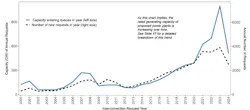
SCE receives thousands of interconnection requests each month, and each request takes about 30 to 45 days to process, Wong said.
Traditional interconnection studies are slowed by worst-case scenarios, he said. Part of the solution is to use AI to take a finer-grained, real-time look at what’s happening on the grid and add suggestions for speeding interconnection in specific locations.
He compared the process to using Google Maps to find the most efficient route between two points.
“Google Maps knows about the roads, learns about traffic, and updates it on a continuous basis so you're not just running an ad hoc analysis every now and then,” Wong said. “It continuously analyzes the entire system and then it optimizes your routes.”
In the grid, AI is used similarly, focusing on optimizing power flow.
The ThinLabs model continuously analyzes the entire grid. It identifies where congestion occurs or where traffic jams are, as well as problems such as voltage violations, Wong explained. It then suggests ways to solve the problems, perhaps by adding flexibility in specific locations.
In the Google Maps example, AI suggests possible actions–like avoiding a specific road or taking a shortcut. It suggests shortcuts where there’s less congestion. AI can do the same thing for the grid.
When ThinkLabs identifies a grid constraint, it also proposes solutions. The solutions generally include flexible interconnection, under which the interconnection seeker agrees to cut back or eliminate demand during high-demand periods, or add storage to provide flexibility. This could serve as a bridge to utility upgrades.
The role of energy storage in boosting flexibility
With storage, the microgrid or DER developer could store energy in batteries when rates are low and discharge them when rates are high and the grid is congested, meeting the utility’s need for flexibility. Wong said it’s possible that the utility could add storage as a solution in some cases.
If the storage is placed behind the meter, the microgrid or DER developer could possibly join a virtual power plant program.
“There are many models right now. AI can help calculate and optimize the size and operation of the storage unit,” Wong said.
Another option for solving grid constraints is load rolls, which involve transferring load from one feeder to another.
Another option to address grid constraints is another big tech-backed effort, the Utilize Coalition, which involvesTesla, Google, Carrier, Verrus and GridLab and aims to increase the utilization of excess grid capacity.
Wong in 2024 spun ThinkLabs out of GE Vernova, where he was general manager of grid orchestration and was responsible for GE’s Grid of the Future strategy and focused on AI for power flow analysis.
The recent financing round helped reinforce ThinkLabs AI’s work using AI to help utilities plan, optimize and operate the grid, Wong said.
“The message is AI for the grid is real,” Wong said.“It's here and now, and we have all the right partners and ecosystem players to make this happen.”
Growing Need for Battery Storage Across the Midwest Grid
New MGK QuickChat with ELM Microgrid
About the Author
 Lisa Cohn
Lisa Cohn
Contributing Editor
I focus on the West Coast and Midwest. Email me at [email protected]
I’ve been writing about energy for more than 20 years, and my stories have appeared in EnergyBiz, SNL Financial, Mother Earth News, Natural Home Magazine, Horizon Air Magazine, Oregon Business, Open Spaces, the Portland Tribune, The Oregonian, Renewable Energy World, Windpower Monthly and other publications. I’m also a former stringer for the Platts/McGraw-Hill energy publications. I began my career covering energy and environment for The Cape Cod Times, where Elisa Wood also was a reporter. I’ve received numerous writing awards from national, regional and local organizations, including Pacific Northwest Writers Association, Willamette Writers, Associated Oregon Industries, and the Voice of Youth Advocates. I first became interested in energy as a student at Wesleyan University, Middletown, Connecticut, where I helped design and build a solar house.
Twitter: @LisaECohn
Linkedin: LisaEllenCohn
Facebook: Energy Efficiency Markets