Battery Program Provides Resilience-as-a-Service Through Microgrid Islands for Texas Co-op Customers
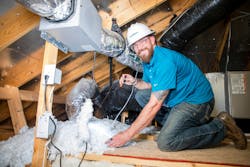
More utilities are offering customers battery programs under which utilities help pay for homeowners’ batteries and then use some of the batteries’ output, usually during peak demand periods.
The homeowners gain resilience through what are essentially residential microgrids consisting of batteries or solar plus storage, if the homeowners purchase or already have solar systems.
Three types of utility battery programs
These programs fall broadly into three categories, said Arif Gasilov, partner, sustainability and environmental, social and governance strategy at Gasilov Group.
One option is an aggregator-led program, which is offered in Colorado for example. A second option is utility-administered, including a program in Minnesota.
Under a third option, a third party owns batteries deployed in homes.
An example of the third option is Base Power’s project with CoServ, an electric cooperative and gas distribution company serving eight counties in North Texas. In this case, Base Power will provide batteries to homeowners who are CoServ customers, and those customers receive resilience-as-a-service. CoServ will use the batteries when it needs them, often during peak demand periods when prices jump, and in doing so, lower its wholesale costs.
Cooperative’s customers pay $695 upfront, $19/month for batteries
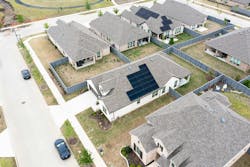
Under the program, Base Power owns the batteries. CoServ customers pay $695 upfront and $19 per month for the batteries, which is significantly less expensive than buying them up front at a price of $15,000 to $20,000, said Tim Pianta, head of utility partnerships at Base Power.
If the participating homeowners have solar systems, during outages the solar and batteries can provide backup. With solar only, that’s not possible.
With the company’s grid-forming inverter–with or without solar– homes become “microgrid islands,” Pianta said.
The batteries won’t be discharged below 20% so there’s always energy available for homeowners during an outage. Participating homeowners can use all the energy stored in their batteries during an outage.
Base Power operates the batteries based on the utility’s input.
The project is essentially a 10-MW utility-scale distributed storage plant, Pianta said.
“We've cut that 10 MW up and we've put that next to people's homes so it can provide backup when the power goes out,” he said.
For CoServ, the program will help lower wholesale power costs. That includes the costs that the cooperative spends for energy along with its share of transmission from the Electric Reliability Council of Texas, said Gary Franzen, chief energy resources officer at CoServ.
“By using these batteries, we'll be able to reduce our overall system demand during peak times. And that can be peak times for pricing or that can be peak times for loads that are used to allocate transmission costs and both ways it'll help us to manage costs,” he said.
In CoServ’s territory, prices are generally low most of the time, but can jump quickly during peak demand periods, rising to up to 100 times the cost of off-peak prices, Franzen said.
CoServe and other utilities that serve mostly residential markets face higher peak costs than other utilities because residential usage tends to fluctuate more than other types of load in the market. On a calm spring day, prices are low because there’s little heating or cooling demand. In the summertime, when temperatures rise, people turn on their air conditioners, leading to high peak demand periods. The high costs are reflected in CoServ’s rate base through a power-cost recovery mechanism.
The cost savings are expected to pay for the Base Power program, under which CoServ pays Base for each kilowatt of capacity, he said.
Customers are now signing up to get the batteries and the program is expected to launch in the next two months.
Under utility-administered battery programs, customers buy the batteries
CoServ has a separate battery program that falls under the utility-administered category. Under PeakTime Perks, homeowners purchase and own Tesla batteries and are paid for lending them to CoServ during peak demand periods. Homeowners can earn up to $360 annually.
Other utilities offer similar programs as CoServ’s PeakTime Perks.
For example, under Portland General Electric’s (PGE) Smart Battery Pilot, homeowners can decide how much energy PGE can use from their batteries during scheduled peak time events, earning $1.70 per kWh for each event. The battery system is available to homeowners during power outages. Energy Trust of Oregon offers cash incentives for adding batteries to existing solar systems.
Such programs require homeowners to purchase batteries. The appeal of the Base Power program for CoServ customers is the ability to use a battery without paying the full up-front cost.
To Base Power, one of the goals of the battery program is to help utilities avoid building peaker plants. The Base Power model avoids interconnection and gas turbine permitting and supply chain delays.
“We can add capacity faster and are cost competitive with centralized capacity,” Base Power’s Pianta said.
A Grid in Peril and Resiliency Lives at the Edge
New and Free E-Book by Microgrid Knowledge
About the Author
 Lisa Cohn
Lisa Cohn
Contributing Editor
I focus on the West Coast and Midwest. Email me at [email protected]
I’ve been writing about energy for more than 20 years, and my stories have appeared in EnergyBiz, SNL Financial, Mother Earth News, Natural Home Magazine, Horizon Air Magazine, Oregon Business, Open Spaces, the Portland Tribune, The Oregonian, Renewable Energy World, Windpower Monthly and other publications. I’m also a former stringer for the Platts/McGraw-Hill energy publications. I began my career covering energy and environment for The Cape Cod Times, where Elisa Wood also was a reporter. I’ve received numerous writing awards from national, regional and local organizations, including Pacific Northwest Writers Association, Willamette Writers, Associated Oregon Industries, and the Voice of Youth Advocates. I first became interested in energy as a student at Wesleyan University, Middletown, Connecticut, where I helped design and build a solar house.
Twitter: @LisaECohn
Linkedin: LisaEllenCohn
Facebook: Energy Efficiency Markets