Home Energy Giants Collaborate to Boost Grid Capacity for Data Centers and AI Demands
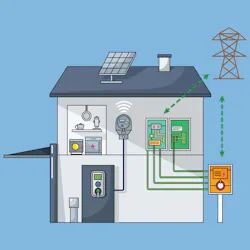
Creating what they are calling the largest distributed energy power plant in the U.S., three of the nation’s biggest home energy providers are combining forces to offer an alternative power supply solution to growing data center and artificial intelligence electricity demand.
Residential solar and storage developer Sunrun, battery technology giant Tesla and virtual power plant aggregator Renew Home announced they are teaming up to make available more than 16 GW of flexible energy capacity through reallocating home energy into the grid to aid in capacity challenges brought on by digital infrastructure demand.
Getting small to solve big grid challenges
This move comes as accelerating data center, AI and industrial electrification may increase utility-scale loads by more than 100 GW or more into the 2030s.
"The grid of the 1800s cannot power the innovation of 2026," said Sunrun CEO Mary Powell in a statement. "Americans deserve innovation that does not create unnecessary energy costs. When data centers are asked to throttle down operations during the most expensive and stressful hours of the day, we can activate our distributed power plants to help provide them the power they need while also protecting American families from footing the bill for costly new infrastructure."
This joint effort will combine the available electron capacity of home solar, batteries, smart thermostats, appliances, lighting and EV-to-grid charging infrastructure.
Virtual power plants aggregate distributed energy resources (DERs) by using advanced software and communication technologies to manage, optimize and coordinate the output of tens, hundreds or even thousands of DERs.
Renew Home, Tesla and Sunrun together have access to energy resources in nine million homes and more than 12 million devices. Aggregating those can create a single, dispatchable resource that can be used to bolster the grid by reducing load or creating supply during times of peak demand, helping the grid to stay in balance.
In Virginia—where data center density is the highest in the U.S.—the three companies already have access to more than 300 MW of distributed energy capacity which can serve the grid. They expect that DER capacity in that region will grow to 500 MW by 2030.
Home is where the energy is
Grid operator PJM and industry overseers such as North American Electric Reliability Corp. have warned about impending capacity shortfalls and that power generation installations are not keeping up with load growth due to AI, automation and industrial electrification.
“The stakes are clear. America’s grid faces mounting pressure from data centers, electrification, and manufacturing growth that no single infrastructure solution can solve fast enough,” said Colby Hastings, Senior Director of Residential Energy at Tesla. “Sunrun, Renew Home, and Tesla believe that a huge piece of the answer is already in place — in the batteries, thermostats, and electric vehicles inside millions of American homes, waiting to be put to work.”
Utilizing DERs as VPPs could alleviate load challenges with lower or carbon-free resources while avoiding expensive construction investments or additional water consumption required in building new centralized or even off-grid power plants.
Some hyperscalers, such as Amazon Web Services, are working to maintain utility interconnections and focus on the front of the meter, but others are concerned enough about grid constraints to push for behind-the-meter, co-located or prime power which can later be interconnected into the grid.
Virtual power plants utilizing already operational DERs can also meet speed-to-power priorities for data center customers.
“Renew Home convened this strategic coalition because we believe hyperscalers are motivated to drive down costs through this transition and that this group of residential-focused energy companies can help them accomplish that goal,” said Ben Brown, Chief Executive Officer at Renew Home.
Virtual power plants also can increase the value proposition of DERs and microgrids by giving developers and customers revenue opportunities through grid services.
New analysis from The Brattle Group finds that better utilization of the existing power grid could reduce U.S. electricity bills by $110 billion to $170 billion over the next decade and accelerate data center interconnection by several years.
About the Author
 Rod Walton, Microgrid Knowledge Managing Editor
Rod Walton, Microgrid Knowledge Managing Editor
Managing Editor
For Microgrid Knowledge editorial inquiries, please contact Managing Editor Rod Walton at [email protected].
I’ve spent the last 18 years covering the energy industry as a newspaper and trade journalist. I was an energy writer and business editor at the Tulsa World before moving to business-to-business media at PennWell Publishing, which later became Clarion Events, where I covered the electric power industry. I joined Endeavor Business Media in November 2021 to help launch EnergyTech, one of the company’s newest media brands. I joined Microgrid Knowledge in July 2023.
I earned my Bachelors degree in journalism from the University of Oklahoma. My career stops include the Moore American, Bartlesville Examiner-Enterprise, Wagoner Tribune and Tulsa World, all in Oklahoma . I have been married to Laura for the past 36-plus years and we have four children and one adorable granddaughter. We want the energy transition to make their lives better in the future.
Microgrid Knowledge and EnergyTech are focused on the mission critical and large-scale energy users and their sustainability and resiliency goals. These include the commercial and industrial sectors, as well as the military, universities, data centers and microgrids. The C&I sectors together account for close to 30 percent of greenhouse gas emissions in the U.S.
Many large-scale energy users such as Fortune 500 companies, and mission-critical users such as military bases, universities, healthcare facilities, public safety and data centers, shifting their energy priorities to reach net-zero carbon goals within the coming decades. These include plans for renewable energy power purchase agreements, but also on-site resiliency projects such as microgrids, combined heat and power, rooftop solar, energy storage, digitalization and building efficiency upgrades.