The Land of Lincoln May Soon be the Land of VPPs
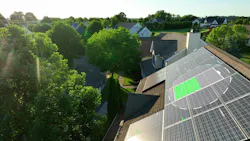
Homeowners in Illinois served by utilities ComEd and Ameren Illinois now have the opportunity to receive a solar and energy storage system with no upfront costs thanks to a new virtual power plant (VPP) program from SOLRITE Energy.
Powered by advanced software, VPPs connect and coordinate distributed energy resources (DERs)—everything from rooftop solar panels and home batteries to electric vehicles and smart appliances. By aggregating tens, hundreds or even thousands of DERs into a single, dispatchable resource, VPPs can reduce demand or add supply during peak hours, keeping the grid resilient and balanced.
Fort Worth-based SOLRITE will finance, build and own the residential virtual power plant purchase agreement projects. SOLRITE will provide a complete solar system and a 60 kWh whole-home battery. Homeowners don’t need to buy, maintain, or install any equipment.
Program participants will initially pay 12 cents per kWh for the solar energy — typically less than their current utility rates. Annual rate increases are capped at 2.9%, no matter how high retail prices climb, providing customers with more predictable energy bills for the 25-year term.
The 60-kWh battery, which SOLRITE says is four times larger than standard residential storage systems (a Tesla Powerwall 3, for example, is 13.5 kWh), can provide backup power for multiple days, ensuring resiliency during grid outages.
It can also dispatch stored energy to reduce a home’s demand for grid energy during peak hours, as well as send power to the grid when it’s needed.
"We are giving homeowners a predictable rate, a battery big enough to keep the lights on for days instead of hours, and a system that actually supports the grid they depend on,” Regan George, CEO and founder of SOLRITE Energy, said in a statement. “It is a genuine win for the homeowner, for the grid, and for the investors backing this infrastructure."
Illinois homeowners with existing rooftop solar can also participate in the program. SOLRITE will add the 60-kWh battery to their system under the same ownership model.
California advances two VPP bills
Virtual power plants are increasingly popular as utilities and grid operators look for ways to relieve stress on the grid, meet surging demand, and keep electricity prices in check.
The California Assembly Appropriations Committee, for example, recently advanced two Virtual Power Plant bills.
SB 913 would task the California Public Utilities Commission with developing a way to value energy that customer-owned battery systems send to the grid when it’s stressed. It would also allow behind-the-meter batteries to sell into the statewide energy market — paving the way for VPPs to earn resource adequacy (RA) credit for the entirety of their stored, on-demand energy.
“SB 913 is an important step because fleets of customer devices are currently only allowed to participate in the RA market to the extent those devices reduce the consumption of each individual customer,” Brad Heavner, executive director of the California Solar and Storage Association (CALSSA), said in a statement.
SB 905 would create a load factor metric to measure how efficiently each segment of the distribution grid is used — revealing which circuits and substations can absorb more energy without costly upgrades, simply by shifting usage away from peak hours. Most circuits sit well under capacity most of the time, maxing out for only a few hours a year.
This would show utilities exactly where and when grid capacity is tight, allowing VPPs to be dispatched precisely to the constrained locations — and building the case that targeted, on-demand storage can replace costly grid upgrades.
If SB 913 and SB 905 pass a full vote of the Assembly this month, they will be sent to Governor Newsom’s desk for his signature.
FERC sides with VPP provider in PJM
The federal government is also pushing VPPs as part of the solution to the grid’s woes. The DOE has suggested that tripling existing VPP capacity by 2030 — adding 80 to 160 GW — could address 10% to 20% of the forecasted peak load.
The Federal Energy Regulatory Commission (FERC) further signaled government support when it recently sided with VPP firm Voltus and Mission:data — a coalition of tech companies advocating for consumer access to energy usage and cost data. Both had argued that many PJM utilities either fail to provide bulk access to hourly interval meter data for thousands of residential customers or impose requirements so burdensome that they effectively block access altogether.
The commission ordered PJM to accept statistical sampling as a legitimate way to verify how reliably demand response and VPP programs perform. The ruling pushes the grid operator to rework overly rigid data-verification standards that Voltus and Mission:data claimed shut VPP providers out of PJM's supply-constrained capacity market.
Market conditions primed Illinois for VPPs
SOLRITE believes it can connect enough large home batteries in Illinois to create grid-scale capacity that utilities can dispatch on demand.
It has already established similar VPPs in Texas, California, Connecticut and Massachusetts.
The dynamics of Illinois' residential energy market made it a strategic choice for SOLRITE's expansion. First, residential electric rates have risen significantly in recent years, driven by sky-high capacity auctions in PJM and MISO, the state’s two regional grid operators.
Ameren’s summer 2026 rates are nearly 40% higher than they were in 2024, according to the Citizens Utility Board, a nonprofit, nonpartisan group created by the Illinois General Assembly to advocate for customer rights. ComEd’s rates stand about 50% higher than two years ago.
Second, full retail net metering ended for new customers in 2025, shrinking the credit available for sending excess solar to the grid and ultimately making solar-only installations less economically viable.
"Illinois families are watching their utility bills climb with no ceiling in sight, and the old solar playbook stopped working the day net metering went away," George said.
As the system owner, SOLRITE can leverage federal clean-energy tax credits for batteries purchased as part of a PPA agreement, as well as renewable energy credits available through Illinois Shines, a state-administered solar program.
These credits make it possible to install the battery and offer the low solar rates to all households in the state.
How to Talk to your CFO about Batteries and Microgrids...
...Without Losing the Room
New Perspective from ELM Microgrid
About the Author
 Kathy Hitchens
Kathy Hitchens
Special Projects Editor
I am a writer and special projects editor for Microgrid Knowledge. I have over 30 years of experience covering the renewable energy, electric vehicle, utility, technology, entertainment, education, and financial sectors. I have a BFA in Media Arts from the University of Arizona and a MBA from the University of Denver.