PG&E Finds Value in Excess Solar with Vehicle-to-Microgrid Project at Redwood Coast Airport in Northern Cal
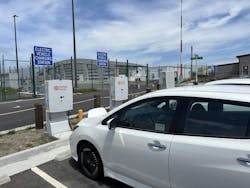
Pacific Gas & Electric (PG&E), working with the Schatz Energy Research Center, is testing vehicle-to-microgrid technology at the Redwood Coast Airport to demonstrate how bidirectional electric vehicles (EV) in a microgrid can integrate solar and boost resilience.
The project is a collaboration between Pacific Gas & Electric (PG&E), Schatz Energy Research Center and Nuvve, formerly a vehicle-to-grid company that recently purchased Fermata Energy.
How bidirectional EVs can help add solar to the microgrid
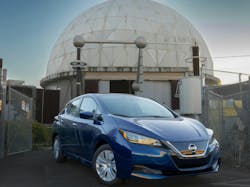
“A big takeaway from this project is that we successfully demonstrated bidirectional power flow control with frequency,” said David Carter, principal engineer at Schatz Energy Research Center, which is located on the campus of Cal Poly Humboldt. “We can basically put the microgrid into an absorb mode if there's an abundance of energy, or we can put it into a conserve mode if there’s not enough energy–without relying on network connections to distributed energy resources.”
Inverters are usually used to adjust unintentional frequency deviations that can disrupt grid or microgrid stability, Carter said. “But in this case, we programmed the microgrid controls to adjust the frequency slightly as the EV battery starts to either approach empty or full.”
When the microgrid islands, the main battery’s state of charge trends up or down, depending on the net load. The Redwood Coast Airport Microgrid has 300 kW of behind-the-meter solar, so solar production is typically trending up during the day.
If the microgrid battery state of charge is trending upwards while islanded, as it exceeds 90%, commands are sent to the grid-forming battery controller to raise the frequency, Carter said.
“The vehicle-to-grid charger controls notice that change in frequency that we have deliberately initiated on our side,” he explained. The charger controls then absorb solar in the EV batteries.
If communication is out during PSPS, this frequency control scheme adjusts EV charging
During a public safety power shutoff (PSPS), if communication is out, it would be nearly impossible for PG&E to control charging and discharging of the EVs without the frequency control scheme, said Abel Levin, project manager at PG&E.
The EV chargers, controlled by Fermata’s platform, sense a change in microgrid frequency from the controllers on the microgrid side. The Fermata system then pushes more power into the EV batteries.
“That’s how we regulate the potential overgeneration inside the microgrid. We first absorb the solar into the cars, and then turn down the solar to the point where it’s basically matching the load inside the microgrid,” Carter said.
In a normal grid, if there's too much solar, the frequency keeps rising until eventually protection kicks in and trips everything off and the grid goes dark. This strategy prevents that from happening.
The vehicle-to-microgrid scheme would be helpful to islands like Puerto Rico and Hawaii, where solar over-generation is a challenge, Carter said.
A first for bidirectional EVs in a multi-customer microgrid
This is the first time in the US that bidirectional EVs responded to automated frequency controls in a multi-customer microgrid, Levin said.
This strategy can be used in the future as the utility adds multi-customer microgrids under the utility’s microgrid incentive program. The company wants to use lessons from this pilot to help incorporate vehicle-to-microgrid technologies into those projects.
“The frequency control enables both PG&E and the Redwood Coast Airport Microgrid to charge and discharge behind-the-meter distributed energy resources to keep the microgrid balanced and also keep the microgrid operating the best it can,” Levin said.
PG&E is offering microgrid developers participating in the microgrid incentive program access to subject-matter experts who can help add bidirectional EVs to the microgrids.
“If we have the microgrids performing optimally at ideal power quality, that supports the larger grid. That’s why this project is important to the microgrid and the larger grid as well,” Levin said.
Economic dispatch of energy from EVs
In addition to controlling EV operation with frequency, the airport project focuses on dispatching energy from the EVs when it makes the most economic sense, said Hamza Lemsaddek, COO at Fermata Energy. When the microgrid is grid-tied, the platform looks at energy costs and revenue opportunities, with a goal of extracting the most value from the EVs.
While bidirectional EV deployment has slowed somewhat in response to the Trump administration’s phase-out of EV tax credits, certain states continue to focus on the advantages of these mobile microgrids, said Greg Poilasne, CEO of Nuvve. They include California, New York, Illinois and Maryland.
“In California, bidirectional EV buses won’t slow down. California is still supportive of all this,” Poilasne said. For example, the California Energy Commission awarded a $3 million grant to fund vehicle-to-grid projects.
In addition, state incentives are replacing federal EV incentives.
Not only do bidirectional EVs help integrate more solar and renewable energy. They can extend the time a microgrid can island during outages.
After 2022 earthquake, bidirectional EVs could have kept microgrid running
In December 2022, an earthquake hit Humboldt County, and the airport microgrid islanded. But because it was the middle of winter, days were short, and the battery had already discharged into the California Independent System Operator market and had a minimum state of charge kept in reserve.
“We were still able to provide just shy of 15 hours of backup power to the airport and the Coast Guard and 18 other customers as they dealt with the emergency,” Carter said. “But we were about a half hour short of being able to keep the lights on until PG&E got that circuit restored. “In that case, these EVs would have gotten us to the finish line.”
Vehicle to Microgrid Technolology on Tap for MGK 2026
Microgrid Knowledge Conference 2026 in Orlando
May 4-6 at the Renaissance SeaWorld
About the Author
 Lisa Cohn
Lisa Cohn
Contributing Editor
I focus on the West Coast and Midwest. Email me at [email protected]
I’ve been writing about energy for more than 20 years, and my stories have appeared in EnergyBiz, SNL Financial, Mother Earth News, Natural Home Magazine, Horizon Air Magazine, Oregon Business, Open Spaces, the Portland Tribune, The Oregonian, Renewable Energy World, Windpower Monthly and other publications. I’m also a former stringer for the Platts/McGraw-Hill energy publications. I began my career covering energy and environment for The Cape Cod Times, where Elisa Wood also was a reporter. I’ve received numerous writing awards from national, regional and local organizations, including Pacific Northwest Writers Association, Willamette Writers, Associated Oregon Industries, and the Voice of Youth Advocates. I first became interested in energy as a student at Wesleyan University, Middletown, Connecticut, where I helped design and build a solar house.
Twitter: @LisaECohn
Linkedin: LisaEllenCohn
Facebook: Energy Efficiency Markets