Interconnection Crossfire: PJM Grid Constraint Prompts DOE Emergency Order as FERC Rejects ‘Bring Your Own Capacity’ Proposal
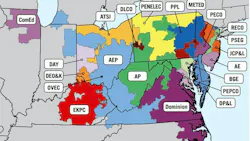
To maintain grid reliability, PJM Interconnection was granted authority under a U.S. Department of Energy (DOE) emergency order on Monday to manage tight electricity supply conditions across 13 states and Washington, D.C.
The directive arrived just as the Federal Energy Regulatory Commission (FERC) rejected a PJM proposal that aimed to allow data centers to forgo matching new capacity if they agreed to be curtailed in the lead-up to grid emergencies.
The DOE emergency federal order, in effect Oct. 13 through Oct. 16, authorizes the largest U.S. grid operator to dictate exactly how much electricity power operators must produce and when to run units to prevent potential widespread blackouts during this period. For commercial energy users, the DOE order allows PJM to tap into more than 35 GW of unused backup generation that remains available nationwide.
This would be done as a last resort before declaring an Energy Emergency Alert 3—the highest and most critical level of a power grid emergency, triggered when electricity supply and demand can no longer be balanced.
“This order will help ensure millions of American families and businesses across the mid-Atlantic have access to affordable, reliable and secure electricity by making additional power generation, including backup power, available to use as needed,” said U.S. Secretary of Energy Chris Wright in a statement.
The U.S. grid is currently facing a critical moment to fast-track third-party power suppliers for data centers. At the same time, balancing paths to strengthen reliability while managing affordability has become a severe challenge.
FERC greenlights data center registry, blocks PJM’s broader grid framework
FERC approved a PJM proposal this month to create a registry for large electricity users like data centers to better define large loads as facilities demanding 50 MW or more. However, in the very same ruling, FERC rejected PJM’s "Bring Your Own Capacity" (BYOC) rules and broader Interim Resource Adequacy Service (IRAS) framework.
Under the rejected IRAS proposal, PJM had included provisions that would allow large loads to connect to the grid without matching new capacity if they agreed to be curtailed in the lead-up to grid emergencies. But ultimately, FERC determined that this curtailment proposal would “intrude on state jurisdiction over retail rates and appear to discriminate against large loads.”
“We find that several provisions of the proposed tariff appear to place obligations directly on eligible new large loads, which are, for the most part, retail customers; that certain other provisions appear to dictate which retail customers taking retail service will be curtailed; and that the proposed compensation framework appears to establish a retail rate,” FERC said in its IRAS framework rejection filing.
Hyperscalers tap on-site generation to counter load growth
Because the nation’s long and winding grid interconnection queue has slowed and entangled both utility and distributed energy power generation projects since at least 2020, support for the “speed to power” movement has become a core objective for microgrid developers and industrial customers.
An example of this strategy is Google's grid optimization strategy within PJM's territory. Virtual Power Plant (VPP) aggregator Voltus plans to deploy up to 100 MW of distributed energy resources (DERs) under a three-year BYOC agreement.
Voltus will aggregate this energy from local businesses and homes into a Google-funded VPP in the PJM grid to help offset data center load growth. It also establishes additional power capacity for Google's AI and data center infrastructure over the next two years.
However, scaling these private-capacity solutions faces steep regulatory hesitation, as highlighted in FERC’s rejection ruling over PJM’s proposed BYOC framework. This included suspension over PJM’s permission to hold private auctions as a third party for data centers to negotiate and purchase power generation from suppliers for distribution and transmission onto PJM’s grid.
These regulatory dilemmas add grid pressure as PJM forecasts new large load requests are expected to increase by an estimated 70 GW by 2038, even as 15 GW of existing electricity generating resources have been retired since 2022. Highlighting this supply crunch, PJM’s recent capacity auction for the 2028/2029 delivery year left a 6.8 GW shortfall below its strict reliability requirement.
In June, FERC issued show-cause orders to all six regional grid and independent system operators to try and revolutionize timelines under which “speed to power” projects are achieved for the nation’s amassing new GWs of digital and industrial infrastructure capacity.
Attorney Eric Runge of law firm Day Pitney LLP previously told Microgrid Knowledge that these reforms should positively impact development of microgrids, co-located “energy parks” and behind-the-meter projects built and paid for in large part by the data center or manufacturing site customer.
PJM’s 13-state region includes 67 million residential, commercial and industrial customers across Virginia, Maryland, Pennsylvania, New Jersey, Michigan, North Carolina, West Virginia, six other states and the District of Columbia.
About the Author
 Eric Moody
Eric Moody
Staff Writer
Eric is a staff writer for the Endeavor Business Media Energy group, which includes EnergyTech, T&D World, and Microgrid Knowledge media brands. He is a Philadelphia native with over nine years of experience in multimedia and print journalism throughout the news industry. He graduated with a B.S. in Communication Studies from Mansfield University of Pennsylvania.