Siemens and FuelCell Energy Collaborate to Accelerate On-Site Power Deployment
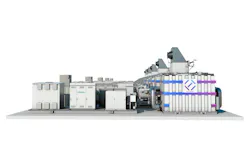
Siemens Smart Infrastructure and FuelCell Energy are joining forces to accelerate the rapid deployment of large, on-site fuel cell-based commercial power generation projects.
As part of a recently announced collaboration, Siemens, an electrical infrastructure provider, will supply electrical balance of plant (EBOP) systems for FuelCell Energy, a global manufacturer, operator and servicer of fuel cell power plants.
EBOP systems include the supporting electrical components, networks and systems in a power facility that manage, condition and distribute power.
The companies will look for ways to improve timelines, reduce costs and increase the number of deployments for mission critical facilities, such as industrial plants and data centers. Siemens and FuelCell Energy are focusing on large-scale installations of at least 100 MW each.
In a recent interview with Bloomberg, FuelCell Energy CEO Jason Few said the pressure to “Bring Your Own Power,” is driving data center developers to become more comfortable with and invest in behind-the-meter solutions, such as on-site fuel cells. Speed to power and access to power where the data center needs it are also key, he said.
“This collaboration with Siemens enables us to deliver what the market has been asking for—bringing generation and electrical infrastructure together into a single, scalable solution,” said Shankar Achanta, chief product and technology office for FuelCell Energy, said in a statement. “For customers, that means reliable, on-site power that is faster to deploy and built to scale, beginning with the data centers driving today’s demand.”
Under the agreement, Siemens and FuelCell Energy will also pilot and develop solutions to evaluate emerging uses for fuel cell technology and electrical systems, such as medium-voltage DC power distribution and modular electrical setups. The memorandum of understanding lays out a process for moving successful pilots into full commercial rollout, including identifying target markets and deployment strategies.
“The rapid growth of electrification and distributed energy is redefining how power must be delivered at scale,” Kevin Brown, head of sustainability solutions, electrification and automation at Siemens Smart Infrastructure USA, said in a statement. “By combining FuelCell Energy’s fuel cell technology with Siemens’ electrical infrastructure, service, and integration expertise, we can deliver scalable, on-site power solutions for energy-intensive applications – helping customers deploy power faster, scale with confidence, and advance their transition to lower-emission, more resilient energy systems.”
A fuel cell generates electricity through an electrochemical process by converting a fuel — such as hydrogen, gas, biogas — rather than burning it. Because there is no combustion, fuel cells have minimal carbon emissions and are more efficient.
FuelCell Energy fuel cells are powering the Toyota Logistics Services facility at the Port of Long Beach, California and providing resilience for Naval Submarine Base New London in Groton, Connecticut., among others.
About the Author
 Kathy Hitchens
Kathy Hitchens
Special Projects Editor
I am a writer and special projects editor for Microgrid Knowledge. I have over 30 years of experience covering the renewable energy, electric vehicle, utility, technology, entertainment, education, and financial sectors. I have a BFA in Media Arts from the University of Arizona and a MBA from the University of Denver.