Monetizing Investment Tax Credits: The $30M Financing Play Behind Montgomery County’s Latest Microgrid
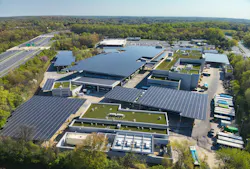
Foss & Company (Foss), a national tax equity investment firm, has made a roughly $30 million Section 48 tax equity investment in a solar, energy storage and EV charging microgrid in Montgomery County, Maryland.
Located at the David F. Bone Equipment Maintenance & Transit Operation Center (EMTOC) in Derwood, the 6.8-MW microgrid manages a 4.8-MW solar array, a 2 MW / 6.9-MWh battery energy storage system and 2.6 MW of EV and electric bus charging capacity. It also includes two diesel backup generators.
As one of the largest transit depot microgrids in the country, the EMTOC installation is expected to generate more than 6,000 MWh of clean energy annually. Final testing is expected to wrap up later this month, though the facility is already operational and charging some of the county’s electric buses.
Foss is partnering on the project with the microgrid’s developer, AlphaStruxure, which also designed, built and operates the microgrid powering Montgomery County’s Brookville Bus Depot. Both facilities provide power to the county under a power purchase agreement.
AlphaStruxure is also developing a microgrid for the new Terminal One at John F. Kennedy International Airport in New York.
Another avenue for financing renewable energy projects
A Section 48 tax equity investment is a financing mechanism where a corporate investor provides upfront cash to a qualified renewable energy project in exchange for federal Investment Tax Credits (ITC) and depreciation benefits.
These credits go to whoever owns the project once it's operational — so a developer could, in theory, keep them. But they often can't use the credits themselves, since doing so requires a large tax liability to offset against.
That makes monetizing the credits a central piece of project financing.
For the EMTOC microgrid, Foss established a fund with an undisclosed corporate investor with substantial tax liability, who invested equity into the project and became a part-owner.
“A large portion of the financial return that our investor receives is through the tax credits,” Bryen Alperin, partner and managing director at Foss & Company, told Microgrid Knowledge.
Depreciation benefits and revenue from the project during the five- to six-year investment period sweeten the deal.
Foss has a long history in the investment tax credit market, having deployed more than $11 billion in tax equity on behalf of insurance, banking, and other large corporate clients. The firm’s initial focus was on real estate tax credits for low-income housing projects and historic building rehabilitation projects.
“About eight years ago we launched a dedicated renewable energy team out in Denver,” Alperin explained. Foss had worked on renewable energy projects in the past, primarily solar, but it was on a more ad hoc basis, he said.
With the passage of the Inflation Reduction Act in 2022, the firm expanded into other types of tax credits that became available — including those for standalone batteries, fuel cells, renewable natural gas, clean fuels and advanced manufacturing.
Expansion into the microgrid market was a natural continuation of that trend.
The project of the year
EMTOC is Foss’ first collaboration with AlphaStruxure, and its first investment in a project that includes solar, energy storage and electric vehicle charging.
There are several key considerations Foss uses when selecting investment projects. Size is one: the project needs to generate enough tax credits to catch the attention of the Fortune 500-scale investors this kind of deal typically requires.
Another is durability — who's buying the power, and whether that counterparty is likely to stick around. A long-term contract with a stable buyer, like a hospital or county government, makes for an easier investment decision.
“I've been calling this particular project ‘Project of the Year’,” said Ella Rose, vice president of construction engineering for Foss & Company. “I think this is an incredible example of a soup-to-nuts execution — the perfect execution of a well-placed clean energy project.”
AlphaStruxure broke ground on the grid-connected and islandable microgrid in 2024. Solar covers as much of the depot's footprint as it can handle, backed by a BESS system comprising four batteries.
The site was designed with room to grow, as Montgomery County expects the depot will charge nearly 200 hydrogen fuel cell buses by 2035.
“It was very clear that AlphaStruxure worked really closely with the county on getting this project off the ground,” Rose said. “That is one of the most important things when you’re executing any energy project.”
That close collaboration showed up in the details, she explained. She noted that AlphaStruxure resurfaced badly damaged pavement in the parking structure and upgraded the fire suppression system's capacity as part of the project — work that improved the facility for long-term use as both a parking garage and a generating facility.
AlphaStruxure’s relationship with Mortenson, a construction contractor with deep experience in renewable energy, was also a key selling point for Foss. The logistics of building around a bus station that was operational throughout the construction process meant workspaces had to be set up and broken down roughly every half day, Rose explained.
“The coordination and the calmness that a contractor needs to have in order to make that happen and maintain safety and also execute the work in a timely manner…I’m really just impressed with AlphaStruxure's execution of it and Mortenson's construction execution,” Rose said.
Sharing the risk
For AlphaStruxure, ITC eligibility factors into project selection, but isn’t the deciding factor, Adam Vosker, AlphaStruxure’s head of finance, told Microgrid Knowledge.
When a qualified project does bring in a tax equity investor, the money typically follows a standard structure for these deals — around 20% is delivered at mechanical completion, with the rest arriving at substantial completion, once the project is placed in service.
That back-loaded timing “is a de-risking move by the investor," Vosker explained. It gives them confidence that the project is sound and unlikely to trigger an IRS clawback before they commit the bulk of their capital. “In return, investors get a fast payback once they're in, since the tax credit arrives quickly, relative to their investment,” he said.
For developers like AlphaStruxure that cover a project’s upfront capital, the financing mechanism accelerates project payback. Rather than waiting years to recoup that initial spend through cashflows alone, the developer receives a considerable portion of its investment when the project reaches substantial completion.
That faster recovery is part of what makes these large renewable energy projects feasible.
“It’s all part of sharing the risk and part of what makes these projects viable in the first place,” Vosker said.
Headwinds may change the investment landscape
While Alperin expects his firm will continue to make similar investments in renewables and microgrids in the coming years, there are some challenges to overcome, including the potential sunsetting of solar tax credits and new compliance requirements enacted as part of the One Big Beautiful Bill.
“These new regulations are complicated,” Alperin said. “Investors have a hard time dealing with uncertainty and ambiguity when we just don't know what the rules are yet because the guidance isn't out.”
The rising risk is pushing investors toward established, well-capitalized developers with strong track records, Alperin said, making it harder for newer entrants without much of a balance sheet to secure financing. This dynamic could accelerate industry consolidation.
Even so, he’s optimistic about the path forward. “Over its history, the solar and wind tax credits have expired something like 11 times and continuously been extended and brought back."
With growing demand from data centers and volatile energy costs due to the war with Iran, “there's politically maybe some goodwill towards continuing to keep energy costs low, and these tax credits help with that,” Alperin said.
About the Author
 Kathy Hitchens
Kathy Hitchens
Special Projects Editor
I am a writer and special projects editor for Microgrid Knowledge. I have over 30 years of experience covering the renewable energy, electric vehicle, utility, technology, entertainment, education, and financial sectors. I have a BFA in Media Arts from the University of Arizona and a MBA from the University of Denver.