Paving the Way to Electrification in Long Island: Hampton Jitney’s Vision for a Modern-Age Fueling Station
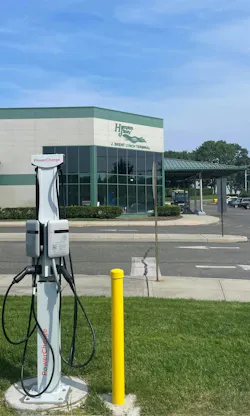
For more than a half a century, Hampton Jitney motor coaches have carried travelers between Manhattan and the eastern tip of Long Island. What started as a way to bring people and their bicycles to Sag Harbor and the Hamptons during the 1970s gas crisis has grown into an iconic transportation service that, today, makes 50 round trips a day — every day — between New York City and some of Long Island’s most exclusive enclaves.
Owned by the Lynch family since the late 1980s, when they bought the business from a distant relative, the company operates a fleet of between 50 and 55 motor coaches, depending on the time of year.
Like so many other industries, the transportation space is evolving as diesel costs climb to an average price of more than $6.50 per gallon mainly due to disruptions in the Strait of Hormuz, and state sustainability mandates take shape. Hampton Jitney isn’t relying solely on its storied history to sustain future operations — it’s addressing them head on.
“Electrification is certainly coming,” Andrew Lynch, vice president of Hampton Jitney, told Microgrid Knowledge.
While the firm won’t receive its first electric bus until sometime in 2027 or 2028, it’s already investing in the infrastructure that will power its future electric fleet — as well as many other electric vehicles in the area.
Within the next month, one of the region’s first mid-market fleet microgrids will be commissioned at Hampton Jitney’s Calverton facility, about 20 miles west of Southampton.
A phased roll out
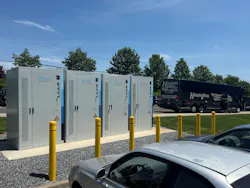
Phase one of the new behind-the-meter microgrid project, developed by Sprocket Power, features 250 kW of onsite rooftop solar, a 500 kW / 1 MWh battery energy storage system (BESS) and Sprocket’s cloud-based automated optimization software. Ten Level 2 direct current (DC) fast chargers were also installed, so passengers can charge their electric vehicles while they’re traveling to and from the city.
“Phase one was a very heavy lift,” Lynch said. “We had to upsize our transformer. We had to do a lot of electrical work” to prepare the site.
Phase two, which includes a 1-MW hub expansion and a Level 3 fast charger for the forthcoming electric motor coach, will also connect the Calverton terminal building to the microgrid, ensuring operations roll on, even if there’s a grid outage. Level 3 chargers deliver direct current directly to the battery, allowing charging to happen faster.
“We don’t have a diesel generator at our facility,” Lynch said. But now, “if we lose power and we don't use HVAC, we have almost a 50,000 square foot facility here in Calverton that we could power for nearly two days with full batteries. That avoids the need for a diesel generator, which we're happy about.”
As Hampton Jitney’s electric fleet expands over time, additional solar and storage will be added to the facility.
A microgrid delivers more than just resilience
In addition to reliability, Hampton Jitney will reap other economic benefits thanks to the microgrid.
Stored energy can be used to lower operational costs by powering the facility during peak demand times, when grid power is more expensive. It can also enable participation in utility demand response programs that compensate large load users for decreasing their load when the grid is stressed.
“Often a medium-sized business like this might be encouraged to participate in demand response, but they'd be left to their own devices to actually do it,” Maria Fields, CEO and co-founder of Sprocket Power, told Microgrid Knowledge.
For a facility that has customers coming in and out all day long, shutting down systems to conserve energy isn’t feasible.
“With a battery, they're able to [participate in demand response] without having any impact on their operations, " Fields said.
The microgrid’s optimization software can decide whether it’s economically beneficial to participate in the moment — and if so, seamlessly switch from drawing power from the grid to drawing it from the BESS.
Sprocket Power has also developed several microgrids for Long Island car dealerships.
A modern-age fuel station
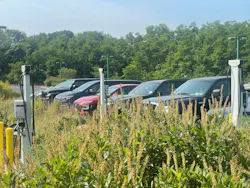
While the Hampton Jitney microgrid will certainly benefit the company financially, the Lynch family has a bigger vision.
“We're looking at becoming kind of a modern-age fuel station for the local industry that surrounds us,” Lynch said.
That includes eventually making charging stations available to everything from local delivery services operating fleets of medium- and heavy-duty vehicles to the local school district, whose bus yard is right next door.
“We've gotten a lot of positive reception,” Lynch said. “We'll continue to have conversations with [the town] about opening up our facility for school buses to charge here, which would make great sense for them and be a good use of the chargers for us during the day.”
Hampton Jitney’s fleet would primarily charge at night.
“We're creating this and demonstrating this for the business, and it's a unique use case for this business and they're great partners, but we're also demonstrating this for the New York grid and how a project like this can operate in the grid,” Fields said. “New York and other states desperately need this kind of capacity.”
The farming community, in particular has expressed interest in learning more about the microgrid.
“We have a strong agricultural sector in eastern Long Island, and power is their second largest cost,” Lynch explained. The community wants to retain its farming heritage and access to local food, and microgrids could help make that possible.
That’s why they’re working with local organizations to educate others to be able to follow in their path, he said.
A slow roll to electrification
Lynch expects Hampton Jitney’s transition to a fully electric fleet will take time. The company, and other mid-market motor coach operators, have some hurdles to overcome before diesel coaches can be retired.
First, there are challenges with the electric coaches themselves, starting with range, which, is currently significantly less than diesel models, Lynch explained. There are no charging facilities in New York City that could accommodate electric motor coaches, and “the idea of pulling over a bus full of people to charge for a couple of hours is obviously untenable,” he said.
There are also some design issues — the battery footprint on most electric coaches consumes more luggage space than operators can realistically cede.
Then there are the economics. As a privately-owned company, Hampton Jitney will foot the bill for not only the new buses, but also the charging infrastructure and grid upgrades.
While there are some state funding opportunities, Lynch said most of those are largely focused on medium-duty trucks — there are fewer programs for heavy trucks and motor coaches.
They must also navigate local regulatory and permitting frameworks, which differ from town to town, as well as navigate utility interconnections.
Finally, there are community concerns to be addressed, particularly where battery energy storage systems are concerned. Fire issues with some early systems have negatively skewed public perception, according to Lynch.
“There isn't an acknowledgement of the newer technologies that have been come into play with battery energy storage,” he said.
Chemistry advancements have improved battery safety and reduced the chance of thermal and “we're hoping that we can help change [perceptions] by showing that these are safe and that these are reliable,” he added.
Maximizing ROI
Lynch said his team leaned on the experts at Sprocket Power to build a system that would scale with them as they electrified and made financial sense.
“They were very sharp when it came to modeling out the financial future for this project and how it could be a net positive for us,” he said.
They are also relying on Sprocket to operate the system.
“A system like this is fairly complex,” Fields said, and optimization means managing the seasonal fluctuations and the real-time dispatch of the stored energy to the owner’s advantage.
While the theoretical benefits of microgrids are numerous, the system must be designed and operated so that it hits the necessary metrics to deliver those benefits.
Hampton Jitney wants to be community and environmental stewards, Fields said, “but in the end they’re running a business…and this [microgrid] is a way to really directly impact this business's operating profile and their cost profile,” Fields said.
About the Author
 Kathy Hitchens
Kathy Hitchens
Special Projects Editor
I am a writer and special projects editor for Microgrid Knowledge. I have over 30 years of experience covering the renewable energy, electric vehicle, utility, technology, entertainment, education, and financial sectors. I have a BFA in Media Arts from the University of Arizona and a MBA from the University of Denver.