The Missing Middle: How Community-Led Microgrids are Rewiring the Grid

The state of the U.S. electric grid is becoming a political liability for incumbents on both sides of the aisle as rising bills and more frequent outages work their way into kitchen-table conversations and campaign platforms.
Average residential rates have climbed nearly 50% since 2016 and some experts predict rates could rise another 15% to 40% by 2030.
Behind the increase is a basic supply and demand problem. Utilities simply can’t build infrastructure fast enough to keep pace with surging demand from data centers and electrification efforts.
The issue is compounded by an aging grid that's growing more vulnerable to extreme weather and, in a growing number of states, more prone to precautionary shutoffs during wildfire season.
Faced with these mounting pressures, more and more communities are opting to take matters into their own hands — nowhere more visibly than in the Pacific Northwest, where a wave of community-led microgrid projects is reshaping the way developers think about power generation and delivery.
Putting communities in the driver’s seat
At the center of that shift are two Bellingham, Washington-based companies — and the founders who've spent the past four years turning community resilience into an actual construction pipeline.
Markus Virta and Callum McSherry, both solar industry veterans, founded Cascadia Renewables in 2022 to fill what they saw as a gap in the market.
"We've seen large developers come in that are really just real estate speculation companies," Virta told Microgrid Knowledge. "They've really confused the purpose of [microgrid] projects with the economics needed to serve their business model."
The pair set out instead to help tribes, local governments, small businesses, nonprofits, and utilities build distributed energy assets that serve both the community and the broader grid, as well as the bottom line.
After landing a technical resource advisor contract with the Washington State Department of Commerce's Solar Plus Storage for Resilient Communities grant program, the firm conducted around 80 microgrid feasibility studies — work that revealed demand not for one or two microgrids, but for dozens, all on aggressive timelines.
It also revealed a skills gap. Building a microgrid takes a different toolkit than a standard solar install, McSherry said, and most solar contractors aren't equipped for the multi-trade coordination it requires.
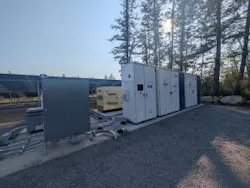
That gap led them to create Sulis Energy, an energy solutions provider that has built microgrids for the Swinomish Indian Tribal Community and the Orcas Center, a community and performing arts complex on Washington’s Orcas Island.
Sulis currently has 16 microgrid projects in various stages of development.
“The one thing that we found that's really critical to a project being successful is finding that anchor in a community who's interested in a multidisciplinary application of the project,” Virta said.
That anchor can be a local government official trying to balance decarbonization with improving resilience, but it's frequently the local emergency manager who ends up making a project happen, Virta said. Their existing relationships with faith groups, nonprofits and other community organizations are often what help identify where a project should be sited.
Cascadia and Sulis map a project's potential value across four areas — grid needs, community growth plans, climate resilience and emergency preparedness — to show communities how a distributed energy asset helps them meet their specific goals.
"Where can we find a place where there's a need at a grid level, at an economic business level, and also at a community level?" McSherry said.
The feasibility study is the mechanism that guides a community through that process — surfacing what resilience means to them, mapping the economic and technical hurdles, and grounding all of it in the specific geography and assets available.
For Virta and McSherry, it’s the essential first step in turning an idea into a microgrid that supports the grid and the community. But getting utilities to that table hasn't always been simple.
Working with the utility, not around it
Cascadia and Sulis intentionally focus on what Virta calls the "missing middle" — commercial- and industrial-scale projects that sit at the distribution level. "We like to call it the dance," Virta said. "The distribution system's the dance — it's where all the fun happens."
It's also where things get complicated.
Building at this scale can mean working directly with dozens of individual utilities, each with its own rules around interconnection, transmission congestion and resource adequacy. Historically, that's meant an oppositional relationship between the renewable energy industry and utilities. But that's starting to shift, Virta argued, because utilities are no longer just weighing intangible goals like decarbonization — they're facing a concrete capacity problem, and distributed assets are part of the answer.
Realizing that potential at scale requires standardization, McSherry said — shared agreements on interconnection, telemetry, dispatch and funding, so utilities know what they're getting, and communities and contractors know what's expected of them.
It also means designing these assets so they're not sitting idle waiting for a disaster: a microgrid that only activates during a once-a-century earthquake is a wasted resource, when it could otherwise be lowering costs for ratepayers or easing strain on the local grid day to day.
"If we could crack that nut and work really closely with the utilities and demonstrate how we can provide value to them, it makes it much easier for us to work as three collaborative partners — the community, the contractor and the utility — to build out Grid 2.0," McSherry said. “If we're oppositional, then we're going to keep falling over and falling over, because you cannot deploy a large number of distributed assets if every single one is a battle between those three groups.”
Creating microgrid-friendly environments
That kind of standardization doesn't happen on its own — it requires funding and regulatory groundwork. McSherry and Virta said the Pacific Northwest region is at the forefront of community-led microgrids because those states have prioritized both the funding and legislation necessary to create a microgrid-friendly environment.
In recent years, Washington and Oregon have invested heavily in microgrid projects as a way to meet growing demand, manage consumer energy costs and mitigate the impact of extreme weather events and natural disasters on the grid.
To date, Washington’s Department of Commerce has granted more than $77 million to community-led renewable energy projects and microgrids. Earlier this year, the Oregon Department of Energy awarded $12 million to microgrid, solar and storage projects.
While the funding is critical, it’s only part of the picture. The Oregon Public Utility Commission is now working to build the legal structures that will enable these projects to be developed at scale.
Docket AR681 is the rulemaking that will establish the state’s microgrid frameworks as directed by House Bills 2065 and 2066. Signed into law last July, the bills pave the way for microgrids to provide resilience and advance local energy production and storage — helping insulate communities from rising electricity costs driven by load growth.
Among other things, the laws enable any local jurisdiction — including city, county and tribal governments — to designate microgrid development zones for resilience, economic development or resource adequacy purposes.
Jigar Shah, the director of the Department of Energy’s Loan Programs Office under the Biden administration, said in a recent LinkedIn post that AR681 could establish a fundamentally new approach to how microgrids are built, funded and connected to the distribution grid.
“If we get this right, it won't just be a win for Oregon. It becomes a replicable model for how every state PUC could think about distributed infrastructure investment,” Shah said.
A grid built together
For Virta and McSherry, their work in Washington and Oregon is a proof of concept for something bigger: a grid where communities aren't just customers, but owners and operators of the infrastructure that powers them.
Getting there will take utilities, contractors and communities choosing collaboration over the adversarial posture that's defined the industry for decades — a shift Virta believes is both necessary and already underway.
"There's something so exciting and empowering and galvanizing around energy systems that are owned and operated in communities," Virta said. "And I think that's where the future has to go."
About the Author
 Kathy Hitchens
Kathy Hitchens
Special Projects Editor
I am a writer and special projects editor for Microgrid Knowledge. I have over 30 years of experience covering the renewable energy, electric vehicle, utility, technology, entertainment, education, and financial sectors. I have a BFA in Media Arts from the University of Arizona and a MBA from the University of Denver.