Washington State’s Swinomish Tribe Adds to Its Growing Microgrid Fleet
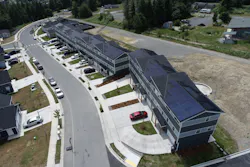
Along the northern shores of Washington’s Puget Sound, the Swinomish Indian Tribal Community (SITC) has wholeheartedly embraced microgrids. The reservation has built six solar and energy storage microgrid systems over the past two years. Construction on the seventh, at the Swinomish Youth Center, should be complete by the end of the month.
The Youth Center microgrid, which includes a 59 kW solar array and a 660 kWh battery energy storage system, will also enable the SITC to establish its first resilience hub.
Resilience hubs are designated sites—such as a community center, school or church—equipped to support residents during weather-related disasters and other public emergencies. They offer the community a place to gather information, food and other emergency supplies, charge devices and store refrigerated medication.
Hubs typically include islandable microgrids that disconnect from the grid during an outage. Onsite solar and energy storage systems power heating and cooling systems, refrigerators and communications devices until grid services have been restored.
The Swinomish Youth Center houses the community’s day care center, and it has both a commercial kitchen and a large gathering space, making it an ideal site for a resilience hub, according to Michiel (Mac) Zuidweg, principal at MZ Solar Consulting and the project’s developer.
“It’s right next to the police station and the emergency management center, so it’s also a great place for community members to come get information,” he said.
The reservation is often hit by strong winter storms that damage distribution lines and cause lengthy outages.
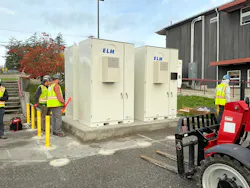
The microgrid will power the Youth Center for at least 12 hours during winter grid outages, and longer during summer months when more daylight is available. If necessary, the microgrid will call on an existing diesel generator to cover the load and charge the batteries.
Forecast Energy, the site’s contractor, should complete construction by the end of the month, according to Zuidweg. ELM MicroGrid, which is providing the energy storage system and microgrid controls, will test and verify its equipment in July.
Once that’s complete, Puget Sound Energy (PSE), the local utility, will conduct its inspections.
Zuidweg expects the project will be operational by the end of third quarter.
Energy and economic relief
The Swinomish people and their ancestors have lived in the Puget Sound region for thousands of years. Salmon fishing and shellfish harvesting remain an important part of the economy, but the Tribal government also operates a casino, golf course, wellness center, cannabis retailer, and a number of food and fuel markets.
Microgrids enable SITC and other Tribal communities to manage their own energy systems and resources, rather than relying solely on the broader power grid. Often, reservations are located in remote areas and at the end of long transmission lines, so generating and storing energy locally improves reliability.
Solar and energy storage microgrids can also significantly reduce energy bills for community members, many of whom live below the poverty threshold.
Like other utilities across the country, PSE electric customers have seen their rates jump in recent years — rates increased by 11.5% in 2025 and 12% in 2026. If accepted, PSE’s latest proposal would see rates climb another 30% over the next three years.
A growing fleet of microgrids
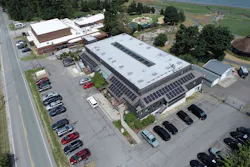
The Swinomish foray into microgrids began when several high school students suggested that Tribal leadership add solar and energy storage to 21 new apartments and cottages they were building.
The idea caught fire and the SITC applied for and was awarded a $1.75 million grant from Washington State Department of Commerce through the Climate Commitment Act (CCA).
The CCA is a market-based climate policy that limits total greenhouse gas emissions from major sources—such as power plants, fuel distributors or industrial facilities—and requires those emitters to purchase allowances for every ton of CO₂ they release. The money raised from selling these allowances is then invested in clean energy, climate resilience and community benefit projects.
The tribe was also awarded CCA funds to install microgrids at its fishery, tribal administration building (known as STAC), dental clinic, police station and social services building, and its senior center.
Plans are well under way for microgrid number eight, with construction expected to begin this fall. The 934 kWh solar and energy storage system will be built at the reservation’s medical clinic/IT building. It will integrate a large generator already on site.
Sulis Energy, which built the microgrids at the dental clinic, senior center and police station, will serve as the contractor for the project. The firm recently completed a solar and energy storage system on nearby Orcas Island.
It takes a village — of microgrids
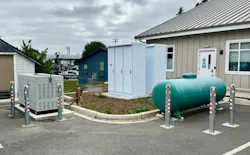
Most of the microgrids are located along a short stretch of Pioneer Parkway, the main thoroughfare through the reservation. Eventually, they could be interconnected, creating a grid of microgrids — and possibly the backbone of a Tribal utility.
“I like to always assume when I'm doing a project that that is the goal, so that I'm thinking ahead with how these multiple projects would be interconnected,” Zuidweg said.
He acknowledged that the Tribe has a lot of work to do before a utility can become a reality, but the SITC is taking steps in that direction.
“They now have a full-time person that manages the entire renewable energy division of the tribe,” he said. “He manages and watches all the portals, does the quarterly and annual checks for each of the systems and helps site new projects.”
Maximizing grants for the good of the community
The Swinomish grant writers have been busy in recent years, maximizing the funds available to Tribal communities for resilience and energy security projects.
Grants from Puget Sound Energy have funded two dual port Level 2 electric vehicle chargers at the fisheries, a dual port Level 2 charger at the senior center, and a DC fast charger at the medical clinic, according to Zuidweg.
Seven Ford Lightning EV trucks, an electric boat and a boat charger have also been purchased with grant money.
A U.S. Department of Energy grant paid for a Combined Heat and Power (CHP) generator feasibility study for Swinomish Casino, which is about eight miles north of the village center.
The tribe is now working on grant applications to pay for the CHP project, as well as more residential solar and battery systems.
“It's fun to work with a client that has the ability to do so many projects,” Zuidweg said. “This is all very positively led by Chairman Steve Edwards and the entire Tribal senate. They just have a good vision and long-term goals to help the community.”
About the Author
 Kathy Hitchens
Kathy Hitchens
Special Projects Editor
I am a writer and special projects editor for Microgrid Knowledge. I have over 30 years of experience covering the renewable energy, electric vehicle, utility, technology, entertainment, education, and financial sectors. I have a BFA in Media Arts from the University of Arizona and a MBA from the University of Denver.