Minnesota Tribal Communities Boost Resilience with Solar, Storage and Microgrids
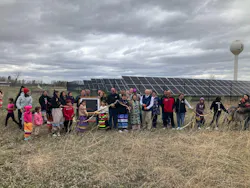
This month, the White Earth Nation celebrated the completion of a solar and energy storage microgrid at Pine Point School, a K-8 Tribal school on the White Earth Reservation in northwestern Minnesota.
With the 500-kW solar array and 400-kW/2.76-MWh battery energy storage system now operational, the school will serve as a resilience hub for the tribal community, providing a safe place to shelter, charge phones and medical equipment and store refrigerated mediations during emergencies.
In addition to providing power during grid outages, the grid-connected microgrid will be used to reduce the school’s energy bills by prioritizing use of on-site solar and stored energy. The system is expected to satisfy most of the facility’s annual demand.
During the summer, when the building is not occupied, the microgrid assets will support the local grid, providing additional resilience during times of peak demand. Pine Point School owns the microgrid.
The project was led by 10Power, a renewable energy developer, in partnership with the White Earth Nation, Pine Point School and 8th Fire Solar, which manufactures, markets and installs thermal solar panels from its Pine Point-based facility.
Ziegler Energy Solutions, an ELM MicroGrid dealer, built and installed the microgrid controls and energy storage system.
Funding for the project came from a mix of federal funds, grants, tax credits and private donations.
Red Lake Nation building 3 MW solar array
The Pine Point School microgrid is not the only project in Minnesota providing energy security for a tribal community.
About two hours north, the Red Lake Nation recently broke ground on a 3-MW solar array. The Makwa Solar Array, located near Blackduck, is expected to be one of the largest solar installations on tribal lands, capable of powering roughly 500 homes.
Spanning nearly 1,300 square miles, the reservation is home to the Red Lake Band of Chippewa Indians.
The project will join the tribe’s growing fleet of solar resources, including arrays at both the Red Lake Government Center and its workforce development center.
Solar Bear, a solar installation company owned by a Red Lake Nation member, will build the array. Funding for the project came from grants and the Red Lake Nation, which will own the installation.
In charge of their own destiny
Energy sovereignty – the ability to produce, deliver and manage energy on their own lands – is a driving force behind many tribal renewable energy projects, including those in Red Lake and Pine Point.
In Washington state, for example, the Confederated Tribes of the Colville Reservation told Microgrid Knowledge last year that reducing reliance on outside entities for their power was one of the main reasons they were developing four new solar and energy storage microgrids.
The Swinomish, Hopi, Cherokee and Penobscot Nations have all expressed similar desires.
Tribal communities are often in remote locations and at the end of distribution lines, making them vulnerable to extended power outages. Leveraging solar, wind, energy storage and other renewable resources allows Native communities to power critical services, improve reliability and lower energy costs.
About the Author
 Kathy Hitchens
Kathy Hitchens
Special Projects Editor
I am a writer and special projects editor for Microgrid Knowledge. I have over 30 years of experience covering the renewable energy, electric vehicle, utility, technology, entertainment, education, and financial sectors. I have a BFA in Media Arts from the University of Arizona and a MBA from the University of Denver.