U.S. Army, Xcel Energy Developing $1.4M Military Microgrid at Fort McCoy
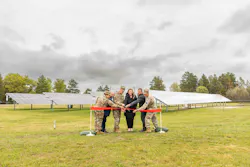
Fort McCoy, the U.S. Army’s only installation in Wisconsin, got an upgrade this month when a new $1.4 million solar and energy storage microgrid was turned on.
Located near the installation’s main gate, the microgrid will provide at least 14 days of power resiliency for the garrison’s primary entry point and nearby mission critical facilities in the event of a grid outage.
“This microgrid directly supports our mission and readiness,” Fort McCoy Garrison Commander Col. Sheyla Baez Ramirez said during the microgrid’s recent ribbon cutting ceremony. “Its independent island mode capability is a critical portion of our continuous security.”
About 90 minutes south of Eau Claire in western Wisconsin, Fort McCoy is home to several elite military training and readiness divisions. Spanning nearly 60,000 acres, it provides field and classroom training for more than 100,000 soldiers from all branches of the military annually.
The microgrid was developed through a public-private partnership with local utility Xcel Energy. It is one of the first instances of the Army leveraging third-party financing for this type of energy resilience infrastructure, according to Fort McCoy Senior Commander Maj. Gen. Joseph Ricciardi, who noted the financing structure in his comments during the ceremony.
“This project, the first of its kind at Fort McCoy, and a pioneering effort within the Department of the Army, ensures that our critical operations continue without interruption, regardless of external conditions,” Liane Haun, director of Fort McCoy’s Directorate of Public Works, said during the ceremony.
Microgrids continue to advance on U.S. military bases
The Fort McCoy microgrid is one more example in a growing list of military microgrids. The Army, in particular, is marching forward with its plan to ensure mission-critical facilities remain operational during a grid outage or emergency. In 2022, Army leaders announced each of its 130 bases worldwide would have an onsite microgrid installed by 2035.
They are making rapid progress on achieving that goal.
In April, U.S. Army Garrison Fort Bliss in Texas announced the completion of a microgrid that will provide resilience to approximately 40% of the installation’s critical facilities. Earlier this year, the U.S. Army Corps of Engineers awarded a $54.3 million contract for the construction of a new power plant and microgrid at Fort Stewart-Hunter Army Airfield in Georgia.
And, earlier this month, the U.S. Army Corps of Engineers Louisville District established a $2 billion pipeline to fund energy resilience projects, including microgrids.
In addition to the resiliency benefits, Fort McCoy’s grid-connected microgrid is expected to reduce the garrison’s annual energy costs by approximately $200,000. Energy generated and stored by the microgrid’s components will be discharged to reduce the post’s load during peak demand periods.
The onsite solar and energy storage systems will also reduce the amount of power Xcel must import to support Fort McCoy under normal operating conditions.
Resilience from multiple sources
Fort McCoy’s Directorate of Public Works is also working with Xcel to improve energy resilience by updating and modernizing the garrison’s electrical grid.
Xcel, which owns the base’s electrical infrastructure, is in the process of transitioning from a Delta to a Wye Electrical System.
While both systems deliver 3-phase power, they are wired differently. The Wye system is more reliable and offers greater flexibility in which loads can be connected, explained Brandon Gronau when the conversion project began in 2022. Gronau is an engineering technician with the garrison’s Directorate of Public Works.
“We are the only Delta system that Xcel has in the state, so in order to standardize all of their equipment, they made the decision to change us over, too,” he said.
Part of the grid upgrade includes undergrounding wires in the base’s residential areas, further enhancing Fort McCoy’s resilience.
About the Author
 Kathy Hitchens
Kathy Hitchens
Special Projects Editor
I am a writer and special projects editor for Microgrid Knowledge. I have over 30 years of experience covering the renewable energy, electric vehicle, utility, technology, entertainment, education, and financial sectors. I have a BFA in Media Arts from the University of Arizona and a MBA from the University of Denver.