Deploying Minigrids in Unelectrified Countries the Humanitarian Way– Funding Local Entrepreneurs, Letting Them Energy Innovate
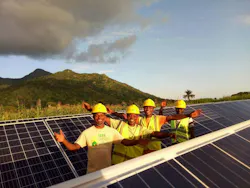
When the Institute of Electrical and Electronics Engineers (IEEE) launched its Smart Village project in 2019, funding efforts to deploy off-grid minigrids in unelectrified areas, including Africa and other parts of the world, co-founders Ray Larsen and Robin Podmore decided it made more sense to fund local enterprise than charity.
The Smart Village model provides seed money to local entrepreneurs so they can create their own companies and become independent enough to finance and expand on their own.
Stepping back and watching entrepreneurs grow their companies
“We are a charity, but what we fund is business,” said Rajan Kapur, president, IEEE Smart Village (ISV). “We are a high-touch remote business incubator. As the businesses mature, we are delighted to step back and watch them grow,” he said.
Since 2010, ISV has worked in 28 countries with 58 developers and entrepreneurs, has incubated 90 projects and impacted more than 2 million people, according to a 15-year ISV retrospective. The nonprofit organization plans another 10 to 15 projects per year and has invested more than $12 million.
For more than 10 years, ISV has supported two Nigerian entrepreneurs, Ifeanyi Orajaka, CEO of Green Village Electricity, and Henry Ureh, CEO of Darway Coast Nigeria (DCN). They were both awarded $119 million in contracts. They’re working to deploy 109 solar and storage minigrids that will provide electricity to more than 230,000 homes and businesses. The International Finance Corporation and the Norwegian Investment Fund have committed $37 million in funding to the projects.
Two entrepreneurs, electrification for four million people
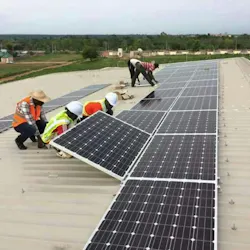
The two men initially received about $200,000 each for four years to build off-grid solar minigrids in the 20 kW-25 kW size range. After four years, they received additional funding and built 40 to 50 minigrids, bringing the fleet to 12 MW, funded by an ISV investment of $119 million. ISV expects the two entrepreneurs to double the number of people ISV entrepreneurs reach with electricity to about 4 million.
Green Village Electricity, launched in 2012 with a single solar microgrid and seed money from ISV, has reached more than 25,000 households and businesses in Nigeria. According to the ISV retrospective, it has created 920 direct jobs and more than 3,000 indirect jobs. The company aims to become Nigeria’s largest and most efficient electric utility and serve millions of customers with sustainable energy.
The IEEE Foundation, which raises money from outside sources such as companies and retired IEEE members, helps fund ISV.
Other ISV projects include the Africa Development Promise, which focuses on improving the lives of rural women through training and resources that help them compete in the marketplace. ISV funded a microgrid that powers the organization’s training center in Uganda. The center offers vocational programs that develop marketable skills.
Solar farm cuts farmers’ post-harvest losses.
In Rwanda, ISV helped finance a solar farm packhouse and cold storage facility for a cooperative that helps farmers reduce post-harvest losses and generate income by renting space during off-season, according to the ISV retrospective.
“Our goal really is not so much parachuting technology. Our goal is to find local leaders and nurture local leaders so that they can be the owners of the technology deployment, they can have community engagement, and then they can make self-sustaining and long-lasting impact,” Kapur said.
ISV generally works with entrepreneurs remotely because it doesn’t want to disrupt their operations or worry about caring for ISV personnel. With this model, local people learn from each other.
“That's the other part of our model: there's a lot of peer-to-peer learning. These are smart people, and they have access to the same internet that you and I do. The one thing that they often lack is access to funds and a local Home Depot,” Kapur said.
Attracting entrepreneurs, donors and volunteers
Others interested in this strategy should broaden stakeholder participation by attracting donors, applicants, and volunteers, Kapur said.
ISV finds applicants at conferences and from regional IEEE committees, he said. Non-governmental organizations (NGO) bring the community connection and IEEE supplies the engineers.
“It’s a bit of a challenge because as engineers we think that if we make a black box and toss it over the fence, all the problems of the world are solved,” Kapur said. That’s why NGOs' community connection is critical, he added.
In addition to finding stakeholders, it's important to empower local communities to lead the projects, using their knowledge of their communities. Such efforts should also invest in education and local technical capacity so there are enough local engineers, technicians, and entrepreneurs to maintain and expand the projects.
“We have these superstar entrepreneurs, but we don't have enough of them,” Kapur said. To date, ISV has provided electricity to 4 million people, but 800 million still lack electricity.
“I’d like for us to hit 50 million at some point,” he said. “There’s really a lot to be done.”
About the Author
 Lisa Cohn
Lisa Cohn
Contributing Editor
I focus on the West Coast and Midwest. Email me at [email protected]
I’ve been writing about energy for more than 20 years, and my stories have appeared in EnergyBiz, SNL Financial, Mother Earth News, Natural Home Magazine, Horizon Air Magazine, Oregon Business, Open Spaces, the Portland Tribune, The Oregonian, Renewable Energy World, Windpower Monthly and other publications. I’m also a former stringer for the Platts/McGraw-Hill energy publications. I began my career covering energy and environment for The Cape Cod Times, where Elisa Wood also was a reporter. I’ve received numerous writing awards from national, regional and local organizations, including Pacific Northwest Writers Association, Willamette Writers, Associated Oregon Industries, and the Voice of Youth Advocates. I first became interested in energy as a student at Wesleyan University, Middletown, Connecticut, where I helped design and build a solar house.
Twitter: @LisaECohn
Linkedin: LisaEllenCohn
Facebook: Energy Efficiency Markets