Microgrids Deliver More Than Reliable Power — They Also Bring Hope to Remote Communities Including This Southern California Tribe
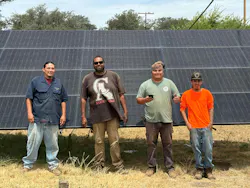
With the completion of three new solar and energy storage microgrids, the Mesa Grande Band of Diegueño Mission Indians have taken their first step towards achieving energy sovereignty and reaching their net zero emissions goal.
Located in the mountains west of San Diego, the Mesa Grande reservation is as remote as the terrain is rugged. Grid power didn’t reach tribal lands until the 1950s, and today there are still two homes that rely solely on small generators to power everyday life.
The approximately 200 tribal members who live on the reservation are subject to frequent and often multi-day Public Safety Power Shutoffs (PSPS), as utility San Diego Gas & Electric (SDG&E) works to mitigate wildfire risks during high wind events.
The new microgrids fully power Mesa Grande’s three administration buildings, so PSPS events no longer interrupt government functions.
“We’re able to be a safe space for our most vulnerable people,” Curtis La Chusa, chairman of the Mesa Grande Tribal Council, told Microgrid Knowledge in an exclusive interview. “They have a place where they can come 24/7 to charge their phone, get something to eat, and be able to get information about what’s going on. It’s just an absolute game changer.”
A little help from new friends
To bring the project to life, the Mesa Grande Band partnered with the Solar Electric Light Fund (SELF), a non-profit dedicated to bringing the benefits of solar electricity and battery energy storage to remote and rural villages around the world.
SELF helped the tribe assess their current energy load and design systems that would power the Tekamuk, Hallyeyaaw and Golden Eagle tribal administration offices with room for future growth.
The final designs called for an 11.5-kW solar array and a 30-kWh battery system at the Tekamuk administration building, 10.37 kW of solar and 20 kWh of storage at Hallyeyaaw, and a 12.45 kW solar/20kWh battery system Golden Eagle. Backup generators provide additional resilience during PSPS events.
SELF organized the funding for the project with help from the William, Jeff and Jennifer Gross Family Foundation and others. It also helped manage the bidding process and oversaw the construction of the systems, which the tribe owns and operates.
Tribal members who had previously obtained solar installation experience and certification helped build the systems.
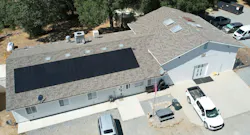
The microgrids are grid-connected, but with a combined 60 MWh of solar electricity generation, that connection serves only to provide backup power to the buildings should it be needed.
“To be able to take this step for their people and be able to achieve their energy independence and autonomy and sovereignty represents a very big step forward [for the Mesa Grande]”, said Bob Freling, executive director of SELF. “We couldn't be happier with the project, and we want to continue working with them going forward.”
The systems are also expected to displace an estimated 18 metric tons of carbon dioxide emissions each year, a critical outcome for the tribe as it seeks to balance what it takes from and gives to the earth.
“The earth will give you everything you need,” La Chusa said. “Mother earth will take care of you as long as you take care of what you’re taking out.”
Electricity access isn’t just a “global south” problem
Much of SELF’s work has been focused on the global south — developing or historically disadvantaged countries in Africa, Latin America and Asia, according to Freling, but there is a need here at home in the U.S. as well. A 2002 project with the Navajo nation was a real eye-opener, he said.
“Right here in our own proverbial backyard, you've got folks that are living in conditions similar to what I've seen in remote parts of Africa. What's wrong with this situation?” Freling asked.
Plenty… of Scarcity
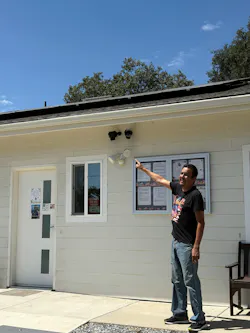
The Mesa Grande Band receives less than $300,000 a year in federal funding to run the tribal government and maintain the aging homes on the reservation. The microgrids are expected to save the tribe at least $16,780 a year in electricity costs — money the tribal council can spend more on other high-priority initiatives, such as the construction of new homes.
The tribe has more than 1,000 enrolled members, many of whom left the reservation in the 1970s and 80s in search of a better education and jobs. La Chusa said there are members in Tennessee, Idaho and as far away as Italy.
But with housing available for only 20% of that population, there is no opportunity for those members — or their children and grandchildren — to return home.
“Having no homes is terrible,” La Chusa said. “You lose that connection with the Earth. That generation went out and did very well and is raising children now. But they should have the option to be able to come back to where they came from if they want to.”
The last homes the tribe built were carved out of a remote, narrow canyon in 2005. The 120-acre plot was maxed out with just 24 units. They recently acquired an additional 560-acres, where they plan to build another 1,500 housing units to address both availability and affordability issues.
Those homes, a mix of single- and multi-family units, will be powered by solar and energy storage microgrids and will be grid-connected for redundancy. La Chusa expects them to be ready for occupancy in late 2027 or early 2028.
The tribe is also looking to create a maintenance program so members can care for the growing fleet of solar, energy storage and microgrid systems across the reservation.
Hope for the future
The Mesa Grande reservation occupies just a tiny swath of lands their ancestors have occupied for more than 12,000 years. Their territory used to stretch “from the beach to the mountains,” La Chusa said, but Spanish and white settlers, and ultimately the U.S. government pushed the into the harshest part of that land over the last 200 years. Their history is fraught with oppression, racism and poverty.
But despite the challenges they’ve faced, La Chusa has great hopes for the future, in part because organizations like SELF are “pulling for us and for the community to be able to stand up and take pride in things.”
He’s noticed a real change in attitude, he said, one that’s rooted in working together.
“I think there’s hope for us yet,” he said. “I think if we have the same common goal for good, we can make it.”
About the Author
 Kathy Hitchens
Special Projects Editor
I am a writer and special projects editor for Microgrid Knowledge. I have over 30 years of experience covering the renewable energy, electric vehicle, utility, technology, entertainment, education, and financial sectors. I have a BFA in Media Arts from the University of Arizona and a MBA from the University of Denver.
Related

 Source: Ziegler Energy Solutions via LinkedIn