How the Big Grid Has Begun to Employ Microgrid Technology to Integrate Renewables
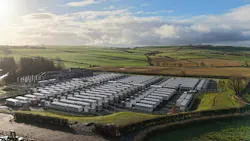
The Blackhillock Battery Energy Storage System, a 300-MW/700-MWh facility located between Inverness and Aberdeen in Northern Scotland, is a transmission-connected facility deployed in early 2025 that uses grid-forming inverters usually used in microgrids.
The project is a first for microgrid technology, and it’s expected to become a trend as more grid operators grapple with integrating renewable energy, said Luke Witmer, CTO at Valo, a global battery energy storage system integrator launched by Wärtsilä and RCT Solutions.
The system helps integrate large amounts of offshore wind energy, reduces wind curtailment and provides stability services for the National Energy System Operator.
Bringing microgrid technology to the world’s big grids
“That's a phenomenon that the world has not seen yet,” Witmer said. Batteries are operating in grid-forming mode, which is what they do in microgrids. “They are now bringing the features and operation modes to the big grids of the world because the big grids are experiencing high enough levels of renewables that they need it,” he said.
With grid-forming mode, batteries autonomously maintain AC voltage and frequency, serving as an independent voltage source rather than waiting for an outside grid signal.
In Northern Scotland, it was difficult to maintain a reliably stable voltage and frequency, and grid operators kept gas plants running to keep the grid stable because the renewable plants couldn’t do it on their own, Witmer explained.
“Wind energy can supply power that flows to the grid, but you need to have a grid that it can connect to,” he said.
The wind plants couldn’t deliver at full capacity because gas plants had to run at a minimum level, leaving little room for wind.
“When you turn a gas plant on, it normally has to run at a minimum of about 50% power,” Witmer explained. By adding a grid-forming battery, they could start shutting off gas and coal plants to let renewables flow.
Texas could be next to utilize the technology
While grid-forming batteries haven’t been installed to address this issue in the U.S., Witmer expects Texas will be the first to take advantage of the technology.
“Texas is its own islanded grid. It's a big island. It's about the same size electrically as the U.K. and as Eastern Australia,” he said. “The renewables expansion in Texas is leaning rapidly towards requirements for grid-forming batteries.”
In addition, data center development will increase the need for grid-forming batteries, he said.
Witmer expects microgrids to start as data center islands and eventually connect to the main Texas grid.
The power of microgrid control capabilities
Karol Kaczmarek, co-founder and podcast host at Net Zero Compare, said that microgrids have to coordinate generation, storage and demand while maintaining a stable local electricity system. Those control capabilities are also important to utilities integrating more inverter-based resources such as solar and wind.
“Grid-forming batteries are a good example,” Kaczmarek said. The inverter controls can establish a voltage and frequency reference, which can support stability.
Utilities, like microgrid operators, also need to manage batteries, generation and flexible demand across a wider network.
“The important caveat is that a successful microgrid demonstration does not automatically establish performance at utility scale; protection, interoperability, and system testing still matter,” he said.
He noted that this trend could potentially expand the microgrid market.
“I think it could create additional sales opportunities, particularly for developers with expertise in controls, storage integration and coordinating distributed resources,” he said. “Those capabilities may be valuable to utilities even when the customer is not buying a complete microgrid.”
But that would not necessarily lead to more microgrid installations, he said.
Spending might go directly to battery, inverter and controls suppliers.
“Developers’ opportunity depends on whether they can turn their integration experience into a repeatable offering that meets utility procurement and performance requirements,” Kaczmarek said.
Microgrids provide important experience with inverter controls
“Microgrids have provided valuable experience in using inverter controls to maintain voltage and frequency, and utilities increasingly need those capabilities as their generation mix changes,” he said.
One example is Australia. The Australian Energy Market Operator reported that about 74% of battery projects in its connections pipeline were grid-forming, Kaczmarek said.
That represents planned projects, not installed capacity, but demonstrates the direction of investment, he said.
Oliver Bodemer, principal systems & AI architect and founder of e-Softworks, said that the Blackhillock Battery Energy Storage System project is a good example of how large grids can utilize microgrid technologies.
“Features that used to live inside a microgrid, such as forming voltage and frequency, staying online through disturbances and taking continuous control setpoints, are now showing up on bulk grids,” he said.
Said Kaczmarek, “I see it as a growing trend. The technology has been developing for years, but what is gaining momentum is its deployment across larger electricity networks.”
About the Author
 Lisa Cohn
Contributing Editor
I focus on the West Coast and Midwest. Email me at [email protected]
I’ve been writing about energy for more than 20 years, and my stories have appeared in EnergyBiz, SNL Financial, Mother Earth News, Natural Home Magazine, Horizon Air Magazine, Oregon Business, Open Spaces, the Portland Tribune, The Oregonian, Renewable Energy World, Windpower Monthly and other publications. I’m also a former stringer for the Platts/McGraw-Hill energy publications. I began my career covering energy and environment for The Cape Cod Times, where Elisa Wood also was a reporter. I’ve received numerous writing awards from national, regional and local organizations, including Pacific Northwest Writers Association, Willamette Writers, Associated Oregon Industries, and the Voice of Youth Advocates. I first became interested in energy as a student at Wesleyan University, Middletown, Connecticut, where I helped design and build a solar house.
Twitter: @LisaECohn
Linkedin: LisaEllenCohn
Facebook: Energy Efficiency Markets