Duke Energy Florida’s Trenton Lithium Battery Facility Gets a Microgrid Upgrade
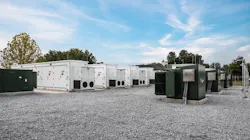
Duke Energy Florida has launched its second large-scale battery storage microgrid in Florida.
The utility added microgrid controls to an existing 11-MW battery energy storage facility this summer, enabling it to provide nearly 1,500 residential, commercial and industrial customers with up to four hours of backup power.
Located in Gilchrist County, about 30 miles west of Gainesville, Duke brought the Trenton lithium battery facility online in 2022 primarily to support the grid during periods of high demand and defer investment in other, more traditional power grid improvements.
With the new microgrid controls, Duke can now island the facility during outages — enabling it to operate independently of the grid and provide backup power to local customers, much like a generator would.
Once power is restored, the facility automatically reconnects to the grid and reverts to its usual demand balancing mission.
“We are continually making smart grid investments to improve reliability for our customers, while keeping costs as low as possible,” said Melissa Seixas, state president of Duke Energy Florida, said in a statement. “This second microgrid in Trenton lets us supply backup power directly to the local community, helping to keep our customers powered when they need it most.”
Investing in resiliency
Duke Energy Florida launched its first energy storage microgrid in 2025. The 8.25-MW lithium battery microgrid in Micanopy, about 15 miles south of Gainesville, can provide 800 customers with power for nearly eight hours during a grid outage.
The utility owns and operates four additional energy storage sites across the state.
Duke Energy Florida provides electricity to 2 million customers across a 13,000-square-mile service territory spanning much of the northern and central parts of the state.
In 2024, three powerful hurricanes — Debby (Category 1), Helene (Category 4) and Milton (Category 3) — raced across the region, each leaving hundreds of thousands of customers without power for days and causing significant damage to critical grid infrastructure.
The integration of microgrid technologies at Trenton and Micanopy complements the utility’s other efforts to improve the resilience of the grid in recent years, including undergrounding distribution wires and replacing wood poles with those made of stronger materials.
Duke Energy Florida is also conducting a 10-year pilot program to study how and when residential battery systems can support the grid.
Microgrid Knowledge Conference Call for Speakers
Now Open: Submit Your Session Ideas
MGK Conference will be May 5-7, 2027, in Glendale, Arizona
About the Author
 Kathy Hitchens
Kathy Hitchens
Special Projects Editor
I am a writer and special projects editor for Microgrid Knowledge. I have over 30 years of experience covering the renewable energy, electric vehicle, utility, technology, entertainment, education, and financial sectors. I have a BFA in Media Arts from the University of Arizona and a MBA from the University of Denver.