Rebuilding from Devastation: Private Nonprofit Helps Fund 10 Puerto Rico Microgrids While Federal Government Funding Lags
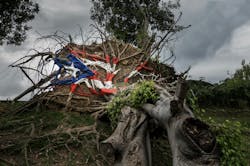
Eight years after Hurricanes Irma and Maria destroyed much of Puerto Rico’s
electric grid, sparking the largest blackout in U.S. history, a large portion of the promised public funding for microgrids and other resilience projects hasn’t been allocated to the island.
For example, only $12 billion of the $41.4 billion in federal recovery funds managed by the Central Office of Recovery, Reconstruction and Resiliency has been allocated.
Hurricane Maria demonstrated the need to fund microgrids
The government is slow to release federal funding even though Hurricane Maria showed that warnings about the vulnerabilities of centralized electric grids – and the need for microgrid development — are not overstated.
When the hurricane hit the U.S. territory, it knocked out power to all of 1.57 million accounts served by the Puerto Rico Electric Power Authority (PREPA), the island’s utility.
To help provide resilience while government funding is being slowed or eliminated, a private nonprofit organization, Bravo Family Foundation, has awarded Cooperativa Hidroeléctrica de la Montaña, an electric cooperative, $2.2 million to install 10 microgrids in the island’s central mountain region. The Department of Energy also provided $3.5 million from the State and Tribal Resilience Formula Grants Program.
Community microgrids will keep essential services running
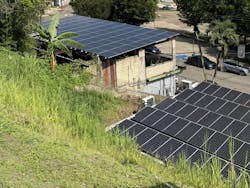
Together, the 10 microgrid systems will provide 875 kW of solar generation and 1.85 MWh of energy storage. Each community microgrid will consist of three to five essential service businesses, including medical clinics, pharmacies, supermarkets and bakeries, ensuring essential services will continue during outages.
The idea behind the project is to support nonprofit organizations and communities in Puerto Rico with financing terms they haven’t been able to access through traditional options.
The project is part of the Cooperativa Hidroeléctrica de la Montaña’s Community Energy Resilience through Photovoltaics program, which has been implemented in communities such as Castañer.
In 2022, the town of Castañer experienced outages 16 times longer than average, based on utility data from the 50 states, according to a community energy resilience plan from the nonprofit Interstate Renewable Energy Council (IREC).
But microgrids developed by the Community Energy Resilience through Photovoltaics Program maintained electric service before, during and after Hurricane Fiona in Castañer in 2022, according to a press release from Cooperativa Hidroeléctrica de la Montaña.
Between 1980 and 2024 eight weather or climate disasters hit Puerto Rico with losses higher than $8 billion each.
Resilience for the Central Mountain Region
The more recent 10-migrogrid project will expand the community energy resilience effort to four municipalities in the Central Mountain Region.
As the second phase of the Community Energy Resilience through Photovoltaics Program, the 10 microgrids are an important strategic expansion of the Cooperativa Hidroeléctrica de la Montaña’s community electricity resiliency program, said C. P. Smith, executive director at the cooperative.
“These microgrids give last‑mile communities the local capacity to keep essential services running despite the island’s unreliable electrical grid,” Smith said. “Despite political and regulatory headwinds, our commitment to supporting communities in Puerto Rico’s Cordillera Central drives our team to bring 21st‑century innovation to these remote areas.”
Airport microgrid in San Juan
In addition to the Castenar project, other resilience projects in Puerto Rico include a $14 million microgrid at Luis Muñoz Marín International Airport in San Juan that will include a 2-MW solar array and 500-kWh battery energy storage system.
Adjuntas, a mountainous community prone to devastating power outages, is also home to numerous microgrids that power both homes and businesses. Those microgrids are now being connected together at the center of a new laboratory focused on developing decarbonized and defensible energy infrastructure for the island.
The Casa Pueblo microgrid in Adjuntas was developed by the team at Casa Pueblo, an environmental organization, in conjunction with the Oak Ridge National Laboratory. Recently, California-based New Sun Road's Stellar Edge Control technology was added to provide remote monitoring and control for the Living Energy Innovation Laboratory.
The island isn’t alone in losing federal funding for clean energy and resilience. On the mainland, some states are stepping in to shore up their own systems. For example, the Oregon Department of Energy has awarded $12 million in funding to help provide renewable energy and resilience through microgrids, solar and storage.
Smith hopes that additional microgrids can be built in Puerto Rico, following the cooperative’s example of obtaining private and public funding for the 10 microgrids.
Getting microgrids up and running can be exhausting
But it’s important to understand how difficult it can be to get through the interconnection and other processes, Smith said. In Puerto Rico, stakeholders get exhausted.
“To move forward on this project since 2024, to get final interconnection, we’ve had 50 emails, 17 calls, and 27 meetings with utilities and stakeholders and still don’t have interconnection,” Smith said.
Super Bowl Halftime: Bad Bunny Sings About Puerto Rico Power Outages
About the Author
 Lisa Cohn
Lisa Cohn
Contributing Editor
I focus on the West Coast and Midwest. Email me at [email protected]
I’ve been writing about energy for more than 20 years, and my stories have appeared in EnergyBiz, SNL Financial, Mother Earth News, Natural Home Magazine, Horizon Air Magazine, Oregon Business, Open Spaces, the Portland Tribune, The Oregonian, Renewable Energy World, Windpower Monthly and other publications. I’m also a former stringer for the Platts/McGraw-Hill energy publications. I began my career covering energy and environment for The Cape Cod Times, where Elisa Wood also was a reporter. I’ve received numerous writing awards from national, regional and local organizations, including Pacific Northwest Writers Association, Willamette Writers, Associated Oregon Industries, and the Voice of Youth Advocates. I first became interested in energy as a student at Wesleyan University, Middletown, Connecticut, where I helped design and build a solar house.
Twitter: @LisaECohn
Linkedin: LisaEllenCohn
Facebook: Energy Efficiency Markets