Flexible Interconnection Models and Frankenstein Microgrids Come Alive at Oregon Conference

Creative interconnection models–including an agreement between utility Portland General Electric (PGE) and five data centers in Hillsboro, Ore.–were the topic of a panel discussion at The Great Transformation conference in Bend, Oregon, July 6-10 that included speakers from Google, GridCARE and Think Microgrid.
The conference focused on the rise of distributed energy resources and how they’re affecting the grid.
Until recently, centralized generation was easy to control, said Pascal Van Hentenryck, head of the AI Innovation Lab at Gurobi Optimization, during the July 9 panel discussion on interconnection. But with the rise of distributed energy resources, managing risk is more difficult.
“How do we connect the many, many, many different resources that are not so easy to control anymore so that we maintain the stability of the system, and at the same time, get a system which is sustainable and much cheaper?” he asked.
During a live podcast, Greg Castle, commercial leader, North American power & grid segment at Schneider Electric, described a “Frankenstein” microgrid pieced together in response to supply chain constraints.
Creative ideas for interconnection from GridCARE and Google
Interconnection is also an important challenge for microgrids, and a creative interconnection panel offered some ideas.
Shanna Brownstein, head of utility partnerships at GridCARE, a grid intelligence platform, described how GridCARE unlocked 400 MW of data center capacity for Portland General Electric (PGE).
GridCARE identifies unused capacity by helping utilities analyze and understand the flexibility available in their system at a particular point of interconnection. The company also helps data center operators understand the flexibility they can bring to the table, she said. In crafting agreements between utilities and data centers, the utility needs to trust the flexibility and data centers need to trust that their power won’t be shut off “willy-nilly,” she said.
For PGE, it wasn’t clear how much capacity was available to provide power to a congested cluster of data centers in Hillsboro, Ore., where Intel is located, Brownstein said.
The challenge of worst-case assumptions by utilities
GridCARE found that the PGE was using worst-case scenarios for planning.
“If you assume that you're charging this battery at peak, and this line over here is out for maintenance and the storm of the century comes in, you're right. You don't have capacity,” Brownstein said.
But that scenario is unlikely. The grid is under pressure for only a handful of hours a year, she added. GridCARE found that the rest of the time, capacity is adequate.
“How can we utilize that spare capacity more? I think that's the fairest thing to do for all repayers. It drives down rates for all ratepayers when you increase utilization,” Brownstein said.
GridCARE identified 400 MW of existing infrastructure to meet the needs of five data centers and signed flexible interconnection agreements with them. This didn’t require any additional buildout of substation or transmission infrastructure and will unlock more than 80 MW in 2026 and 400 MW by 2029.
The contracts will lower rates for utility customers, according to a description of the agreement. The unlocked capacity will yield over $13 billion in value for data center developers.
Google’s clean transition tariffs
Another interconnection innovation comes from Google. David Namura, who heads up Google’s Pacific Northwest government affairs and public policy, said the company is developing clean transition tariffs in the utility territories where its data centers are located.
For example, the Public Utilities Commission of Nevada in 2025 approved Google’s partnership with NV Energy that aims to deploy clean capacity to Nevada under a clean transition tariff.
This type of rate structure aims to create a pathway for utilities and large energy users to invest in clean, reliable electricity and deploy advanced technologies.
The agreement will add 115 MW of new geothermal power to Nevada's grid, developed by Fervo Energy and delivered by NV Energy. It will support Google’s data centers and cloud region in Nevada.
Under the tariff, participating large energy users cover the added cost of the resource and receive credit for its energy and capacity value.
Not only were creative ideas the focus of the conference. A creative naming of microgrids was also a topic of conversation.
The rise of the Frankenstein microgrid
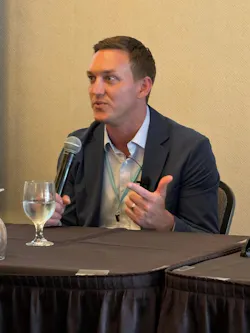
During the live podcast on July 8, Castle from Schneider Electric described the “Frankenstein microgrid,” which is pieced together with whatever generation is available.
The software layer has become very important for these microgrids, Castle said. Developers are buying up generating assets due to supply chain constraints and pulling these components together, just like they did during the COVID pandemic, he said.
“We've seen this with a lot of these large projects. It was kind of a gold rush. Everyone went out, secured whatever they could, airplane engines and pretty much every engine that can be bought, every turbine,” he said. Developers can’t purchase turbines until 2033 right now, he added.
Developers have acquired hundreds of gigawatts of generating assets, and they’re trying to figure out how to knit them together, Castle said.
“They’re not only putting microgrids together to start them up as fast as possible, but then they try to optimize this kind of Frankenstein, multi-gigawatt worth of generating assets, trying to optimize them not only for the utilities, but for data centers, and it’s extremely complex,” he said
Over the next few years, these microgrids will start to come together, and energy management and protection control systems will be critical for optimizing the microgrids and keeping operation and maintenance costs in check, he said.
The local power advantage
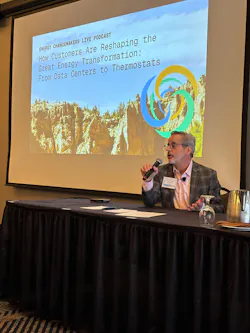
Also during the live podcast, Cameron Brooks, executive director at advocacy group Think Microgrid, emphasized the benefits of delivering power locally with distributed energy resources.
The telecommunications industry decoupled the physical part of its system, and this would benefit the electric industry too, he said. The telecommunications industry no longer has switchboards for making physical connections. Instead, it has created digital packets that can be broken up, sent, stored and moved along. That’s true of the electric system, he said. There’s an opportunity, especially with storage, to move energy around in packets, not on the synchronous grid.
Brooks’ comments reflected a larger theme of the conference: How can utilities, policymakers, and developers integrate distributed energy resources into the existing grid and enable them to help meet today’s power demand?
As Google’s Namura said, “How do you make the utility framework acceptable or workable for the 21st-century need currently facing the market?”
About the Author
 Lisa Cohn
Lisa Cohn
Contributing Editor
I focus on the West Coast and Midwest. Email me at [email protected]
I’ve been writing about energy for more than 20 years, and my stories have appeared in EnergyBiz, SNL Financial, Mother Earth News, Natural Home Magazine, Horizon Air Magazine, Oregon Business, Open Spaces, the Portland Tribune, The Oregonian, Renewable Energy World, Windpower Monthly and other publications. I’m also a former stringer for the Platts/McGraw-Hill energy publications. I began my career covering energy and environment for The Cape Cod Times, where Elisa Wood also was a reporter. I’ve received numerous writing awards from national, regional and local organizations, including Pacific Northwest Writers Association, Willamette Writers, Associated Oregon Industries, and the Voice of Youth Advocates. I first became interested in energy as a student at Wesleyan University, Middletown, Connecticut, where I helped design and build a solar house.
Twitter: @LisaECohn
Linkedin: LisaEllenCohn
Facebook: Energy Efficiency Markets