PG&E’s Bidirectional Charging Programs Seek to Answer “Million Dollar Question” About Lowering Customer Costs
A recent study by utility Pacific Gas & Electric (PG&E) found that demand flexibility–shifting electric use to times when demand is low and energy is less expensive– could save about $1.8 billion in infrastructure costs by 2040.
How much can vehicle-to-everything programs that use bidirectional electric vehicles (EV)- essentially mobile microgrids–help lower rates?
“That’s the million-dollar question,” said Joel Ulloa, manager at PG&E’s vehicle grid integration team.
Three PG&E pilot programs are designed to help answer that question. The programs generally use bidirectional EVs to absorb energy into their batteries when it’s less expensive, then release it to the grid, office building or home when rates are high, lowering energy costs and supporting the grid when it’s strained.
California isn’t the only state that’s embracing bidirectional EVs. In Illinois, electric distribution utility ComEd announced a project that will utilize three electric buses from three school districts to test the ability of vehicle-to-grid (V2G) technologies to bolster ComEd’s grid.
The state of New Mexico has signed a $400 million deal with Nuuve Holding that provides V2G technology to help electrify New Mexico’s more than 2,000 school buses and the state’s 3,500 state-owned vehicles. The goal in New Mexico is to support New Mexico’s fleet electrification efforts, which are designed to help meet the state’s renewable energy goals.
The power of load flexibility through EVs
Bidirectional EVs can provide much-needed load flexibility for utilities across the country.
“Load flexibility from EVs is important to us,” said Ulloa. “The idea of EVs serving as assets for our grid is a fundamental component of why we’re doing this. We can think of EVs as applying downward pressure on rates.”
The utility offers vehicle-to-everything incentives under residential, commercial and microgrid pilot programs. These incentives help pay for interconnection fees and chargers.
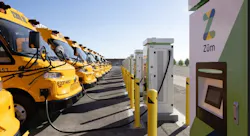
As part of the commercial program, the utility, working with student transportation provider Zum, is running the nation’s first 100% bidirectional electric school bus fleet at the Oakland Unified School District, with 74 bidirectional electric buses participating in demand response events and providing energy to the grid.
Challenges to electric school bus programs include concerns about the buses’ battery life and warranty, given that bidirectional charging programs put more mileage on the batteries, according to the Electric School Bus Initiative.
In addition, it’s important to identify compensation mechanisms for the energy the buses supply to utilities, the initiative said. And installing vehicle-to-grid (V2G) infrastructure is more expensive than installing other EV supply equipment. Interoperability issues between different electric school buses and electric vehicle supply equipment can also be a challenge.
PG&E’s three vehicle-to-everything programs
PG&E’s residential vehicle-to-everything pilot provides $2,500 upfront and $3,000 for customers in disadvantaged communities. EV drivers must use EVs and chargers on PG&E’s approved list of suppliers, which is dominated by GM Energy.
GM Energy has been a partner in the pilots, Ulloa said. At the GM Empower 2026 event, GM announced that by 2030, it aims to sell 130,000 EVs in PG&E territory, of which 52,000 would be grid-tied. The announcement demonstrates that V2G is becoming a more integral part of the EV revolution, he said.
As GM Energy jumps into EVs and bidirectional charging, the company is banking on selling customers–especially those subject to frequent outages– on the stacked incentives available in certain outage-prone areas, especially Pacific Gas & Electric (PG&E) territory.
For example, at least two sets of incentives are available under PG&E’s residential vehicle-to-everything program. Customers receive the upfront incentives and must enroll in the Emergency Load Reduction Program, under which they are eligible to receive additional incentives. The goal is to enroll 1,000 EVs in the residential program.
The benefits of AC-based vehicle-to-grid systems
Also as part of the residential pilot program, the Tesla Cybertruck is now approved to sell power back to the grid. The Cybertruck has an alternating current (AC)-based vehicle-to-grid system, which makes it simpler and less expensive than the DC-based systems from Ford and GM, Ulloa said.
With an alternating current V2G system, the inverter is inside the vehicle–rather than outside–and the customer has to buy fewer items, which reduces upfront costs for consumers because they have to buy fewer items, Ulloa said.
The commercial V2X pilot, which aims to enroll 200 customers, offers up to $2,500 upfront or $3,000 for customers in disadvantaged communities for customers with 3-phase bidirectional chargers sized less than 50 kW: For customers with 3-phase bidirectional chargers sized equal or greater than 50 kW, the incentive is up to $4,500 upfront and $5,000 for customers located in disadvantaged communities. These customers must also enroll in the Emergency Load Reduction Program.
Microgrid resilience during public safety power shutoffs
Under the microgrid program, PG&E customers connected to a multi-customer microgrid subject to public safety power shutoffs must select vehicles and chargers approved by PG&E. That program is not now enrolling new customers.
Ulloa declined to specify how many customers are enrolled in these programs.
As part of the commercial pilot, the Oakland Unified School District project has been running for about a year.
“We’re still assessing the performance internally and still digging into the data to understand what kind of impact it’s having on the distribution grid,” he said. “This project contributes to our vision of load flexibility, being able to apply downward pressure on rates.”
Importance of interoperability in Oakland Unified School District
The Electric School Bus Initiative found that the project benefited from extensive coordination among the district, Zum, and PG&E. In addition, an important factor was ensuring that the district's chargers and vehicles were ISO 15118 compliant. That technical standard aims to help deploy interoperable EVs, meaning vehicles and charging networks can communicate, share data, and process payments across different manufacturers and charging providers.
The initiative said that electric fleets can offer megawatts of on-demand power to communities.
For PG&E, the Oakland project and the utility’s other vehicle-to-everything pilots are testing different aspects of bidirectional charging for the first time. It’s too early to say how the utility plans to use the technology, Ulloa said.
“An important part of the pilots we’re running is to extract the necessary learnings so we can expand on how we think about bidirectional technology in the future,” he said.
About the Author
 Lisa Cohn
Lisa Cohn
Contributing Editor
I focus on the West Coast and Midwest. Email me at [email protected]
I’ve been writing about energy for more than 20 years, and my stories have appeared in EnergyBiz, SNL Financial, Mother Earth News, Natural Home Magazine, Horizon Air Magazine, Oregon Business, Open Spaces, the Portland Tribune, The Oregonian, Renewable Energy World, Windpower Monthly and other publications. I’m also a former stringer for the Platts/McGraw-Hill energy publications. I began my career covering energy and environment for The Cape Cod Times, where Elisa Wood also was a reporter. I’ve received numerous writing awards from national, regional and local organizations, including Pacific Northwest Writers Association, Willamette Writers, Associated Oregon Industries, and the Voice of Youth Advocates. I first became interested in energy as a student at Wesleyan University, Middletown, Connecticut, where I helped design and build a solar house.
Twitter: @LisaECohn
Linkedin: LisaEllenCohn
Facebook: Energy Efficiency Markets