Three Ideas for Using More EVs and Flexible Resources to Support California’s Grid: Report

If 10% of California’s expected number of electric vehicles (EV) were enrolled in vehicle-to-grid programs by 2036, they could provide 9 GW of 12-hour storage, which amounts to one-third of the state’s long-duration storage targets, according to a new report, Unlocking California's Flexible Load: A Durable Blueprint for Affordability and Reliability.
The EVs, already purchased by drivers and serving as mobile microgrids, would be significantly less expensive than procuring stationary storage required by the state, the report found. The report is from GridLab, University of California Davis, Kevala and E3.
Existing load flexibility programs are flawed: report
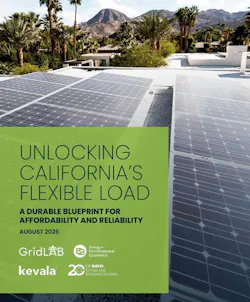
But how can policymakers and utilities put EVs and other flexible resources to work in ways that benefit all ratepayers? The report says existing policies–including net energy metering (NEM) and demand response programs-aren’t working well enough, and policymakers, utilities and other industry members should focus on standardized program design, performance-based incentives and better interoperability programs that could help EVs, batteries and smart buildings provide grid services while improving affordability and reliability,
“Flexible load can deliver benefits today that the demand response programs of the past could not,” the report reads. The generation mix has transitioned from fuel combustion to wind, solar and storage resources with low marginal costs and high fixed costs.
“Flexible load creates value by shifting demand into the hours and locations where clean energy is plentiful and away from those where capacity is tight,” the report said.
Is the potential of load flexibility exaggerated?
A number of studies predict the vast potential of flexible resources–including a $6.7 to $9.9 billion distribution savings estimate from Kevala– which provides grid analytics.
Investor-owned utilities such as Pacific Gas & Electric suggest that the value varies by time and location and is limited by customer adoption constraints, the report said. This poses a risk of exaggerating the potential and overpaying participants.
In addition, California's demand flexibility programs differ from utility to utility, which means customers grappling with fragmented options are less likely to participate.
The state’s net energy metering and net billing tariff are subsidized by customers who don’t participate in such programs and have sparked controversy over ratepayer equity, said Pete Skala, vice president of professional and advisory services at Kevala Analytics and a former California Public Utilities Commission energy division director.
What’s more, existing tariffs- including the net billing tariffs– already incentivize behind-the meter storage owners to self-consume. This means it’s more difficult for flexible load programs to yield extra value.
“There's quite a bit of caution, understandable caution in this space of providing incentives and rewarding distributed resources,” he said.
Using time-of-use and dynamic pricing to deploy more bidirectional EVs
One of the easiest ways to address these challenges is to improve time-of-use and dynamic rates so they incentivize load flexibility, Skala said.
The clearest example is using these rates to get more EV drivers to participate in load flexibility programs, he said. Over the next 10 years, California utilities and load serving entities are required to purchase 25 GW of new grid-scale storage.
“I think it'd be shameful if the industry, utilities, regulators, original equipment manufacturers (OEM) can't figure out how to tap EV resources and give those customers an incentive in which everybody wins,” Skala said. California can reduce its spending on grid-scale batteries by paying EV owners to enroll their batteries in load-flexibility programs.
“It's going to be hugely beneficial to all ratepayers, participants and non-participants, people who own or don't own electric vehicles to tap that resource over the coming decade,” he said.
Enticing EV manufacturers to equip cars with bidirectional technology
To make that happen, the state must create an environment that makes it attractive for OEMs to equip their EVs with bidirectional technology, he said.
What’s needed is a favorable policy environment, the right signals to the market and an incentive structure that covers the costs for the aggregators and utilities, he said.
“If you have a clear picture that in the long run, the cost of doing this will come down and this will make sense and will benefit non-participants. That needs to be communicated and everyone has to be eyes wide open that there's going to be a declining structure to that,” Skala said.
The incentives might be higher at first but will decline over time as EV prices fall and economies of scale kick in.
“Decision makers and legislators and everyone else needs to know that that's the plan up front and it needs to be communicated repeatedly over time,” he said.
Three recommendations for making the most of load flexibility
To overcome existing challenges and speed the deployment of flexible resources, the authors suggest:
● Setting compensation levels below avoided costs to ensure non-participating customers don’t subsidize the program. “These should be ideally below avoided costs because we want non-participants to benefit; there have to be more benefits than costs,” Skala said.
● Compensation should be based on verified services provided, not on enrollment. “Performance-based compensation for flexible loads requires a credible answer to a counterfactual question: how much energy would this customer have consumed if the program had not dispatched them?,” the report said.
● Existing load flexibility programs should be consolidated. The report authors call for “a small number of well-defined products with open, interoperable standards for enrollment, measurement, dispatch and settlement.” Individual load-serving entities can then run their own programs, but a vendor or aggregator would reach customers through common participation programs instead of separate programs for each territory.
“By replacing fragmented legacy programs with standardized, performance-verified products, California can turn its expanding building and vehicle electrification into a reliable grid asset that lowers costs for all ratepayers,” the report said.
About the Author
 Lisa Cohn
Lisa Cohn
Contributing Editor
I focus on the West Coast and Midwest. Email me at [email protected]
I’ve been writing about energy for more than 20 years, and my stories have appeared in EnergyBiz, SNL Financial, Mother Earth News, Natural Home Magazine, Horizon Air Magazine, Oregon Business, Open Spaces, the Portland Tribune, The Oregonian, Renewable Energy World, Windpower Monthly and other publications. I’m also a former stringer for the Platts/McGraw-Hill energy publications. I began my career covering energy and environment for The Cape Cod Times, where Elisa Wood also was a reporter. I’ve received numerous writing awards from national, regional and local organizations, including Pacific Northwest Writers Association, Willamette Writers, Associated Oregon Industries, and the Voice of Youth Advocates. I first became interested in energy as a student at Wesleyan University, Middletown, Connecticut, where I helped design and build a solar house.
Twitter: @LisaECohn
Linkedin: LisaEllenCohn
Facebook: Energy Efficiency Markets